Friday, June 12, 2009

Kansas Bleeding Again

By Phoenix Insurgent

When former director of victim's services for the Shawnee County District Attorney's office, Suzanne James, was asked by the LA Times how she would characterize anti-abortion militants like Dr. George Tiller's alleged killer Scott Roeder, she said, "Some of these guys had that John Brown look in their eyes."

The killing of Dr. Tiller by an anti-abortion militant has again raised the issue of fanaticism in the public consciousness. The fanatic has always occupied a unique space within American politics. Generally despised by the political mainstream as beyond reason, even mentally ill, the political zealot combines extremism and often violence in ways that brings moderates of the right and left together in harmonious -- if disingenuous -- choruses consisting of the righteous denunciation of violence on one hand and the moralistic defense of democratic debate on the other.

Insanity is a common epithet applied to zealots and fanatics. John Brown suffered them. Likewise, Roeder has been characterized as mentally ill, an all-too-common diagnosis in this society for those who act politically beyond what is considered moderate and 'rational'. The LA Times reported, however, that his fellow anti-abortion militants considered that he "held 'fringe' beliefs but was no hard-line lunatic." This is telling.

If not the product of the insane then, fanaticism, we are reminded at times like these, is at least anti-democratic and dangerous. Reasonable people, we are told, act in reasonable ways, and that means moderation and middle ground. Compromise and civility. The fanatic rejects these ideas and acts to obliterate them through her actions and words.

That anti-abortion activists describe pro-choice doctors as "baby killers" or Nazi doctors is an example of this framing. It draws a clear line that allows very little wiggle room for moderation and tends to force a choosing of sides on terms beneficial to the fanatic. After all, goes the argument, how can one be expected to compromise with those who would kill babies?

But the anti-choice militant is only the most recent manifestation of American fanaticism. And although anarchists oppose this extremist and his agenda for good reason, other fanatics have come before him and not all of them from the reactionary right. As a result, anarchists would do well to consider the politics of the fanatic and to consider if there is anything that we can learn from it.

When we look closely, what we see is that fanaticism is not a mental state or a political position opposed to "reasonableness" or "democracy". In fact, fanaticism is a political strategy, and one that can sometimes deliver positive results when employed by people with progressive politics, even if in this specific case it has not. Studying this application, then, even if we as anarchists would oppose the particular desired outcome of anti-choice militants, can be instructive for our own strategies and how we frame debates with regard to our own political opponents.

THE FANATICAL DEMOCRACY OF THE GARRISONIANS

In a recent talk, entitled "Politics of Protestant Violence: Abolitionists and Anti-Abortionists", NAU professor Joel Olson analyzed the two movements by comparing their use of fanatical violence to polarize the respective politics of their times. An anarchist himself, Olson has done a lot of interesting research on fanaticism, and specializes in the politics of the abolitionist movement. His insights on the matter are the perfect place to start for anarchists interested in the politics of the fanatic and I have drawn on them extensively for this essay.

The Garrisonian abolitionists, led by William Lloyd Garrison and his comrade Wendell Phillips, took an uncompromising stand towards the destruction of the slave system. Writing in their journal, Liberation, and acting through debate and civil disobedience, the Garrisonian movement refused to compromise on the question of slavery. Their demand was for an immediate and total end to the slave system and as a result they were routinely denounced as fanatics.

At the same time, they often took their arguments directly to anti-slavery moderates, which frequently led to physical confrontations, sometimes in their churches. Those that did not demand the immediate and total abolition of slavery were accused by the radicals as being just as complicit as the slave owner himself. One Garrisonian, Stephen Foster (famous for disrupting services at churches that didn't take a stand on slavery), denounced less fervent Northerners as “the basest of slaves, the vilest of hypocrites and the most execrable of man-stealers, inasmuch as they voluntarily consent to be the watch-dogs of the plantation.”

When challenged by less radical abolitionists, who advocated a more gradualist position, Garrison was famous for comparing the question of ending slavery to a house on fire: “You do not ‘gradually’ call for the firemen to come ‘gradually’, to ‘gradually’ put out your fire … you want it immediately extinquished”. When further faced with the charge that surely, regardless, an immediate end to slavery was not likely, Garrison would reply, “We have never said that slavery would be overthrown by a single blow, that it ought to be we shall always contend”.

The Garrisonians pushed hard for an uncompromising position on slavery, but their extremism didn't end there. As Olson writes in his interesting essay, "The Freshness of Fanaticism: The Abolitionist Defense of Zealotry", while the Garrisonians were definitely fanatics,
[t]hey were also passionate democrats. They defended the ideals of the Declaration of Independence, fought against racial discrimination, advocated for women’s rights, and condemned the exploitation of industrial workers. Garrisonians championed free speech, welcomed African Americans and white women into their organizations, and developed new participatory practices in public meetings. Their zeal for the antislavery cause reflected their commitment to democracy; in turn, their democratic beliefs inspired fanatical opposition to enslavement and racial inequality. Garrisonians brimmed with zealotry, yet they used their fanaticism to strengthen democracy rather than undermine it.
That is, their brand of fanaticism sought to broaden democratic participation, not to limit it.

Understandably, this brought them into conflict with other abolitionists. They denounced the Republicans -- Lincoln in particular -- as preservationists of the slave system by the fact of their commitment to the maintenance of the Union over the abolition of slavery. In other words, the political moderation of the less radical abolitionists was in fact, in the eyes of the Garrisonians, a capitulation and therefore equivalent the position of the slavocrats. Moderation, then, not just the slave owner, was the enemy of the liberation of the slave in the eyes of the Garrisonians.

FANATACISM AS A POLITICAL STRATEGY

In another presentation in 2006, Olson described fanaticism as "'the mobilization of collectivities according to a friends/enemies dichotomy by non-state actors who are willing to sacrifice themselves or others in such a mobilization.'" He reported that from his research on the abolitionist movement, particularly the radical Garrisonians, what he had found was that rather than being cowed by appellations like "zealot" and "fanatic", they embraced them in their quest to defeat slavery and broaden the democratic character of American society.

Olson continued: "[W]hen we understand fanaticism in this way, we see that it's not inherently undemocratic. That what zealotry really is is a critique and a rejection of political moderation - not a rejection of reason, of rationality or anything like that. And, as such, fanaticism and reason can be consistent. And furthermore, it can be consistent with justice and democracy in times when moderation lends support to the enemies of democracy... so at certain points in history perhaps fanaticism is the more democratic option over liberal moderation."

I take the question Olson has been investigating lately to be one of the orientation that revolutionary movements ought to take towards moderate or liberal elements. These elements often frame themselves against supposedly irrational radical - or fanatical - movements at the same time that they immerse themselves in the liberal democratic myth of the responsible middle ground, in which disagreeing sides can dialogue and come to compromises. American democracy treats the middle ground as hallowed ground. In this 'pragmatic' democratic tradition, fanaticism is treated as irrational or unrealistic, and fanatics are denounced by so-called reasonable moderates in the name of justice and democracy.

However, although Olson's conclusions contradict this commonly held American belief, those of us who study history and have organized in broader movements will probably understand it quite well. It expresses a common relationship that anarchists have to moderate elements in the movements in which we participate. While it can be useful at times, the moderate middle is also the engine of co-optation and recuperation -- and also sometimes the vehicle of left-cover reaction by the ruling class.

So how should committed revolutionaries relate to this malleable center? One possibility is to treat it as a potential ally and therefore to moderate our own actions and rhetoric in service of some larger goal that it is perceived can be achieved through such unity. This has been a path that many anarchists and other radicals have taken in the anti-war movement, for instance. The hope seems to be that either the moderates will come around to our way of thinking, or, perhaps, that their belief (and despite our equal un-belief) in the reasonableness of the system will somehow manifest in reality, persuading through speaking truth to power and other such measures.

But another way of looking at this dilemma is to view the moderate middle as an impediment to revolutionary progress. They are not to be persuaded so much as made irrelevant or politically eliminated from the terrain of political contestation. In that case, perhaps the proper course is not to take a moderate stance, but rather to stick to extremist positions, putting pressure on the middle, thus polarizing the debate and forcing recuperationist moderate elements to choose sides. In this sense, organizing in a fanatical manner means having two targets in mind when one acts: the opponent and the political moderate. This was the strategy of the Garrisonian abolitionists.

With that in mind, and recognizing the reactionary character of the attack and the goals of the anti-choice movement, I think that looking at the case of the murder of Dr. Tiller can in fact provide useful information for anarchists engaged in our own admittedly quite different struggle.

There are three key elements to the fanatical approach to politics playing out as a result of the attack. They can be discovered first by looking at whether and how the action contributes to a polarization in the debate both within the broader popular discussion and within the anti-abortion movement itself. Then, let's consider the question of whether this fanatical act contributes or challenges notions of democracy because, as Olson has pointed out so aptly, fanatacism and democracy are not necessarily at odds, even if the two are generally portrayed as opposites. In fact, as in the case of the abolitionists, fanaticism can actually open up space for broad democratic participation.

THE NATIONAL DEBATE

The national media reacted to the murder of Tiller with near universal condemnation and revulsion. Katie Couric posted on her CBS News blog: "No matter what your moral position may be on abortion, Tiller was first and foremost a doctor and acting within the law. That should not have cost him his life." President Obama echoed this point, saying that "[h]owever profound our differences over difficult issues, they cannot be resolved by heinous acts of violence." The New York Times concurred, calling for increasing national police attention to the issue of extremism while calling on anti-abortion advocates to "refrain from the 'baby killer' rhetoric that inflames an already heated debate." The Dallas Morning News called the murder "a tragedy".

If anything then, this attack seems to have provoked from within the mainstream media a call to a national spirit of moderatism that the Garrisonians would have found familiar. We can enjoy the obvious hypocrisy of the NY Times, head chearleader of the war in Iraq, and Obama, replacement architect of this war, denouncing political violence as a means of accomplishing political goals. But this is to be expected. Certainly their tendency to defend the moderate middle is due in part to the fact that the national press is the beneficiary of its position as the official mediator of the national dialogue. Likewise the "Washington Consensus" and other elite capitalist policy positions reflect a genuine unity in the capitalist class, which may differ internally on some tactical questions but tends to agree broadly on most strategic questions. The press reflects this tendency as well for obvious reasons.

What's interesting about this attack is that it comes as the religious right finds itself in retreat and political disarray. Yet, according to NARAL Pro-Choice America, 87% of counties in the US lack an abortion provider and that is largely thanks to the actions of militants like Roeder. While the media appeals to moderatism, in fact the bombings, the murders and the fake anthrax attacks have had their desired effect. The fanatical application of violence, sabotage and civil disobedience has accomplished genuine reactionary victories that affect real people's lives. And the decision of Tiller's clinic not to re-open following the murder only puts an exclamation point on this fact.

The question now becomes whether this attack will reverse or advance the achievements of the militant wing of the movement. In 1994 and 1998, when two past murders of abortion providers happened, the right was in the ascent. This is not the case now. Will the changed political terrain further the attack against abortion providers outside the legal arena, or will there finally be some push back from the society at large? What effect will the attack have on the positions held by Americans on the question of abortion? This murder will be a test case. Will the moderate middle in the abortion debate be pushed to one side or another by this action? Or will a general moderatism continue to prevail?

One problem that pro-choice organizers have when debate is polarized around abortion is reflected in the growing numbers of Americans who report that they sympathize more with anti-abortion arguments than with pro-choice ones. Because of the general lack of a discussion around abortion that centers around the equality and liberation of women -- that is, of the centrality of abortion rights to women's equality -- the pro-choice movement has little to fall back on when fanatical anti-abortion militants take action to frame the discussion in harsh terms. In a religious country like the US, allowing the terrain to shift towards the moral rather than the libertarian puts the reactionary militant in a powerful position to project his will and this is precisely why they do it. Likewise, the lack of an equivalent response from pro-choice militants maintains a space defined by religious right moralists and this is to their advantage.

THE INTERNAL DEBATE

Now let's turn to the question of what effect the action had inside the anti-abortion movement. It is vital to recognize that this murder aimed to affect the debate there as well, which the attacker seems to have viewed as broadly too moderate. Because this is a fanatical act, it is aimed both at movement enemies - Tiller in particular and those that provide abortions in general - but also, critically, at the anti-abortion movement as well. It's a two-pronged tactic that seeks to evaporate the middle ground so that all that remains is the political extreme represented by the killer and his comrades in the movement. So, the New York Times only gets half the story when they report that the attack was aimed "toward the dwindling cadre of physicians who risk their safety to perform legal medical procedures." Clearly that, but not just that.

When we look at the debate in the religious right, what we see on one side is a fear of a backlash and the pressure to moderate and hunker down. The AP reports that, rather than striking a mortal blow to those few remaining doctors willing to perform abortions, the killing has actually put some in the anti-abortion movement on the defensive. At a recent press conference denouncing the president's supreme court nominee, the Christian Defense Coalition headman Rev. Patrick J. Mahoney was flanked by activists from Operation Save America, an anti-abortion group that promises to use "only biblical principles" in its fight against abortion rights.

Mary Kay Culp, executive director of Kansans for Life, said, "In the immediate future, it makes it difficult to even speak about an issue we've been speaking about for 365 days a year. Anything you say — somebody is going to pounce on us." Anti-abortion groups in Kansas distanced themselves from the killer and lamented the timing with regard to the upcoming debate on Obama's supreme court nominee.

The Southern Baptist Convention's Ethics & Religious Liberty Commission president, Richard Land, explained his reaction this way, saying, "First of all, I thought, 'how horrible'. I thought this is going to be the same song and dance that we had the last time this happened, people trying to paint all of us as wild-eyed crazies." Rev. Pat Mahoney of the anti-abortion Christian Defense Coalition complained, "Please, don't use this tragic situation to broad-brush the pro-life community as extremists... politically, this could not have happened at a worse time."

However, on the other hand, extremists within the movement have taken a harsher stand. “Scott is not my hero in that sense; he has not inspired me to shoot an abortionist," wrote Dave Leach, publisher of Prayer and Action News, a publication to which Roeder subscribed. "But, definitely, he will be the hero to thousands of babies who will not be slain because Scott sacrificed everything for them.” Roeder himself allegedly posted to anti-choice websites comparing Tiller to a Nazi: "Tiller is the concentration camp 'Mengele' of our day and needs to be stopped before he and those who protect him bring judgment upon our nation."

Randall A. Terry, the founder of Operation Rescue, wrote in an editorial on June 1st that "[i]t now falls to pro-life leaders like myself to stand strong and unflinching in the face of the unjust criticism we will now endure because of his killing. And so I turn my attention to the attacks that will follow his death. We must use this as a 'teaching moment;' a chance for 'dialogue' with our fellow Americans concerning this terrific holocaust of the unborn." Rejecting the call for moderation, he closed his piece saying, "These foolish accusations fly in the face of equally radical rhetoric, images, and images in the civil rights movement, the suffragette movement, and the abolitionist movement. If Dr. Martin Luther King had followed the advice of the timid in his day, President Obama would still be riding in the back of the bus."

That's certainly a hell of a comparison for a movement that generally sat out or even opposed the civil rights movement and took quite a conservative stand on women's liberation. Nevertheless, it's worth noting the recurring reference to the abolitionists within the anti-abortion movement, and there has been some discussion within the movement of the abolitionists as a model.

So, it does seem like Roeder has at least hit on a division within his own movement and time will tell whether the rush to moderation by some anti-choice elements will result in a political vacuum that can be filled by more fanatical elements. His attack has if nothing else forced the taking of sides in his own movement, which is a primary goal of fanatical political actors. Kansas City anti-abortion activist Regina Dinwiddie said, "If anybody needed killing, George Tiller needed killing. The gut reaction from everybody who doesn't have their thoughts filtered by fear is 'Yahoo!' "

DEMOCRACY?

The remaining question is whether the attack has broadened or narrowed the space for democratic activity. This should concern anarchists not because we either limit ourselves to bourgeois definitions of democracy, but because broadening the participation of people in the society they live is one of our goals. In a sense, knowing the truth of the bourgeois press's general lack of commitment to actual democracy is enlightening in the context of their galloping defense of it in the face of fanatical acts. Therefore, it's worth considering the way that the mainstream defenders of that narrow spectrum that masquerades as the democratic debate related to this murder. We should analyze the response understanding that some fanatical acts can open space for democracy even if this one may not have.

Defending the traditional church of moderation, Brad Hirschfield wrote in his blog in the "On Faith" section for Newsweek: "Ultimately though, we need to reframe this debate from one about abortion to one about democracy. This debate needs to be framed as being about nothing less than democracy in America. When zealots act as they did this week in Kansas, they are making war on America, upon the constitution and the rule of law."

Similarly, a Dallas Morning News editorial denounced the polarizing rhetoric surrounding the issue, claiming that "Violence undermines any hope of a civil debate about important issues. Sadly, this atrocity is likely to push both sides further from finding any common ground. Democracy is noisy, but it should not be violent. Abortion opponents must focus their efforts on changing the law — not taking it into their own hands."

While violence may or may not push apart opposing sides depending on the circumstances, it's far from clear that violence in all cases is contrary to democracy, as Olson has noted in his research. In the case of the abolitionists it led to the expansion of democratic forces both within the abolitionist movement and American society as a whole.

However, the question for anarchists is not whether the attack broadens democracy in the anti-choice movement (although that would be interesting in itself), but whether it has any potential to broaden democratic participation beyond that. Given the nature of the anti-choice movement's goal of restricting the options available for women with regard to reproduction and the power that flows from that, however, this would indeed be very, very unlikely.

Unlike the civil rights movement and the liberation movements that preceded it, the anti-abortion movement seeks to limit choices that are central to whether women can operate in society as free and equal human beings. Indeed, the anti-abortion movement's historical points of comparison fail when they try to frame themselves as liberators of the unborn. After all, if Tiller is Mengele, then what is the woman who goes to him for an abortion? Is she a Nazi as well? Just a 'good German'? In the end, what we see is that in fact it is ultimately the woman herself who is the target of the anti-choice movement. This can't help but have reactionary results with regard to democracy. As anarchists, however, it is this argument that should appeal to us, not the fake and self-serving defenses of the moderate middle ground and capitalist democracy by the bourgeois press.

CONCLUSION

What awaits the anti-abortion movement and its militants remains to be seen. As American politics has taken a vaguely noticeable turn to the left, will the movement turn increasingly towards fanaticism in the political sense or will the moderate elements maintain the politically advantageous terrain of broker between their opponents, the American public and the extremists? Already, we see more moderate activists within the movement shifting gears to more local and state-level activity. This is a reflection of their evaluation of their diminished opportunities in the new administration.

Interestingly, Roeder said in a recent interview with the AP that he knew that more attacks were planned by others for the future. And meanwhile, the Daily Mail in the UK reports what so many Americans know: secretly, there are millions who support the murder. "I don't lose sleep over the death of anyone who pushes a needle through a crying baby's brain," said a woman interviewed in the article.

The proof will come in whether the debate polarizes and if a solution to the extremists liking is forthcoming. For anarchists, it will be worth keeping our attention on the movement, not leastwise because our fates are tied up in it, but also because political developments there may provide lessons for us in how we orient towards the movements with which we find ourselves allied, whether through political convenience or historical inertia.

The anarchist movement has a well-known history of falling victim to the knives of our so-called allies on the left and in the popular fronts, so the fanatical strategy is one anarchists ought to consider. Certainly as many liberals and leftists continue their failed moderate strategies with regard to issues like never-ending wars and a collapsing environment -- at the same time that these very crises continue to grow and worsen -- the question of how to relate to these so-called progressive forces will become more and more pressing.

When the alliances we find ourselves in keep us muzzled or marginalized, it might just be worth questioning whether it's time to re-evaluate the allies we keep and our orientation towards them. A break with the "play nice" strategy that can tend to dominate big tent coalition-type organizing may be in order. If so, a fanatical voice for liberation may be the appropriate response.

Monday, June 8, 2009

First Friday Transformed! Observers of art become participants in their own lives! Police confronted by mob after raiding the UM gallery


by Jon Riley

First Friday on "Roosevelt Row" took a decidedly confrontational turn last week after undercover Phoenix police officers ran a sting on the UM gallery down on 5th st. PCWC was tabling that night when we noticed everyone in the gallery being pushed out by a handful of uniformed and a couple of undercover cops. The crowd grew in the yard as word spread that they were busted for serving alcohol, particularly angering people as alcohol is prevalent at most of the spaces on First Friday, and to make matters worse the host of the gallery, a DJ, and two artists were held in hand cuffs inside.

Everybody forced out was pretty angry that the police were breaking up the show, so people took photos of both the uniformed and the undercover officers, yelled at the police, and chanted "Let them go!". It was nice to see a united group challenging the actions of the cops, even after the police brought the DJ out in an appeal to the crowd to leave the crowd, people saw through such a cynical move by not leaving, and instead shouting out support and blaming the cops for sending him out. In addition to that a cop came down and tried to talk to someone they perceived as a leader only to have the man cover his ears when the cop spoke, and a local art community big name tried to do one for the cops only to be told off. Everyone wanted their friends freed, right then and there, no compromise, no debate. The handful of cops called in reinforcements, and soon after 30+ cops arrived and cleared the front yard, many people stood their ground and refused to leave, causing a scuffle between a few people and a cop.

The folks inside were eventually released, only after being cited for serving without a permit, and everyone flooded into the gallery to take a last look at the art before the venue shuttered for the night. As we were walking off, word spread that a police car had been tagged, excitedly we turned around to check out a little anti-cop action! We were happy to see a few spray painted tags on the police SUV (one of the many police cars jamming 5th st up), even though one man was arrested.

All in all, a lovely cool late spring night in central Phoenix; an inspiring show of solidarity between young and old, art lovers, radicals, passer-bys, and friends of the detained; and mostly a spontaneous social rupture that Phoenix has needed for sometime. It was rewarding to see the smiles on faces when the police left the gallery with no one in cuffs, to hear people talking about how much fun confronting the police had been, and the crowd of people surrounding the police SUV laughing and taking pictures of the tags while the police stood by wearing grimaces. It was nice to see the police on the defensive! And, best if all, our resistance worked: all charges were dropped a couple weeks later!

We need to remember victories like this and how they happen if we want to defend our own autonomous spaces. When we all stand up in solidarity behind our collective desire to live our individual desires free from the control of Capital and the State, we liberate each other and ourselves. What will we do next time?


Nearly 20 cops stand guard over the gallery in the front yard.


The cops have left, people excitedly return to the UM gallery!


Art is everywhere: A beautiful site in downtown Phoenix.

Thursday, May 28, 2009

Restless Sleep

Phoenix Insurgent

I recently came across the Situationist-inspired film "Call It Sleep". As expected, the movie spends some time discussing and explaining various Situationist themes, many of which are quite relevant today, or at least remain open questions. Revolutionaries who haven't yet encountered the Situationists or their theories (or, for instance, the May 1968 uprising in France) would find this film well-worth watching as something of a primer on their theory, as well as a work that still rings true today in many ways in terms of describing the broad strokes in which Capital paints our lives today.

Probably the foremost analytical "discovery" of the Situationists is the idea of the Spectacle, which is different, though related, to the idea of the mass media. The Spectacle, as I have heard Nowtopia author Chris Carlsson explain it best, is the voice of power telling you that your lived experience is nonsense and that the only story worth knowing (and comparing yourself to) is the narrative of Capital. It's clear to me that this analysis has been borne out, with one of it's chief symptoms being the increasing "medicization" of the western world. What modern society calls depression comes from the divorce between your desires, the desires that are implanted in you by power, your lived reality and the isolation that results from an atomized spectacularized capitalism. Capital is everywhere and you are nowhere. It is everything and you are nothing.

Nevertheless, I do have some minor disagreements with this film. First, and it will come as no surprise to Phoenix Insurgent readers, but while the Situationist-influenced dialogue posits (and often wishes were true because of its own generally white composition) the decomposition of traditional modes of social ordering and social control like race and gender, these categories have not yet ceased operating in the real world. The position of the Situationists is one of putting the theoretical cart before the actual horse.

To take an example, we at PCWC still maintain that the cross-class relationship of white supremacy remains a critical component supporting the maintenance of modern capitalist domination in the US. While I can appreciate the perhaps future and even particular desire of certain factions within Capital to remake this relationship and to replace it with a broader narrative, it's clear to anyone living in the southwest that this hasn't happened yet. Thus, attacking white supremacy is still a worthwhile endeavor for those that seek total liberation given the defining role it plays within American society.

That these decompositions haven't happened yet is perhaps a bizarre reflection of both the schizophrenia of the elite class in the new era and the power of the working class itself to maintain the petty privileges of whiteness in an era of globalized re-ordering, even if they are (in the case of whiteness) regressive identities and, perhaps, on the wane. In a sense, the continuing appeal of whiteness itself is an ironic proof that the white working class thinks and acts politically, which is good news. Sadly, however, it isn't a liberatory position in the long run. Still, recognizing this is a step above the dumb trailer trash elitist analysis so prevalent on the left. Without understand the continuing power of white supremacy to define the political framework for the white working class, I think theorists are at a loss to explain the actual positions taken by it.

By way of explaining this continuing appeal, it does seem that what we are seeing play out in Arizona, for instance, is a battle between two capitalist classes -- one older and rooted in ideas of traditional class divisions and allied by convenience with the white working class, and one new and rooted in transnationalism (although not internationalism, as the libertarian Right wrongly assumes). Perhaps it's the ground level expression of the classic contest between Marx's industrial Capital and finance Capital. That this battle is being waged within the elite class -- especially now in a day when GM has to fight for scraps while the banks get trillions without question -- cannot be denied. And it's precisely the fact that there is a contest around this issue that we know that it has not yet been settled.

In a broader sense, I'm very interested in the congruence between the anti-Bolshevik/Cadre argument of Situationism, the anti-Leftist and anti-organizational argument of post-Leftism and the fanatical argument being made by Joel Olson. "Call It Sleep" ends with the Soweto youth uprising of 1976 in South Africa, in which youth attacked Capital and the State and at the same time refused (and assaulted) the progressive and even radical mediators who sought to give voice to their struggle in their place. In true fanatical fashion, they attacked the moderate middle, demanding all or nothing, total emancipation or zilch. This put both the State and the recuperators in the middle and in the same boat.

One is reminded of the revolt in Paris in 2006 in which suburban North African French likewise attacked both state and capital, police car and store front, and at the same time worked their way through the anti-CPE protests of the students, robbing and stealing IPods from the protesters as they went. There is no room for compromise, perhaps, it turns out. At the least, we see parallels here that are worth exploring.

So, the post-Leftist seeks to refuse the default alliance of the left while the Situationist seeks to attack the anti-democratic, mediated and elitist role of the Bolshevik. And at the same time, the fanatic tries to evaporate the moderate middle ground, from which the compromising and recuperationist liberal emerges. Surely there is something in common here that can be investigated. And maybe that's our role now, viewing this film twenty-some years later.

Watch the full version here:

Monday, May 25, 2009

PCWC presents Beer and Revolution

Collin Sick

A long discussed idea has been made real, an anarchist bar night here in the valley. Years back an essay about the turn of the century German anarchist bar culture had made the rounds here in Phoenix. This piece, Beer and Revolution: Some Aspects of German Anarchist Culture in New York, 1880-1900 ran in Social Anarchism journal back in 2002 (if I recall), and had been passed around by some of the Phoenix anarchists of the day, unfortunately it has since been out of circulation for some time as the Social Anarchism (SA) website hadn't been updated in sometime. As PCWC talked more seriously about starting some sort of a "pub night," I found contact information for the author of the piece, Tom Goyens, and contacted him about reprinting the piece, which he supported and sent the full version to me.

I have a few criticisms of the piece, mainly the attack on "individualist anarchists." PCWC doesn't hold a strict "either/or" ideological conviction on the anarchist schools of thought, rather we look for the most usable pieces of ideas to construct a vision that jibes with our lived experiences. Mostly, Goyens piece offers valuable insights into the workings of the radical milleau of the time, and clearly we are supportive and thankful for his research. For those of you really excited by this history you will want to check out his 2007 book Beer and Revolution: The German Anarchist Movement in New York City, 1880-1914.

This brings me to our latest endeavor. Inspired by the attempts at building a social culture around political discussion and ideas, we have decided to give it a shot here in the valley. We've chosen a local bar in Tempe, Boulders on Broadway (click link for map) , after spending a few Sunday nights there sampling their wide selection of tasty beers. The staff is friendly, there's a great selection of drinks, lots of space, and there's in-door bike parking for all of our bike loving friends. The first night will be held at Boulders on Broadway on Sunday, June 7. Boulders on Broadway is located at the northeast corner of Broadway Rd. & Roosevelt in Tempe. The event will kick off at 9 and last for a couple hours or until people want to leave.

We hope our readers, anarchists, anti-authoritarians, and other radicals join us for our latest experiment in politics. We hope to have a few surprises as well, making this a night to remember, and a future event that will hopefully contribute to an active, critical, and thinking anarchist movement here in the valley of the sun. Below is the flier we distributed at last night's Propagandhi show, we have a few hundred more to get out in the next two weeks. Spread the word!


PCWC is glad to finally premiere the first web appearance of Goyens' entertaining article on the immigrant German anarchist culture below. Cheers!


Beer and Revolution: Some Aspects of German Anarchist Culture in New York, 1880-1900

by Tom Goyens

Paul Goodman once characterized a free society as the "extension of spheres of free action until they make up most of the social life" (Parisi, ed., 1986, p.26). In a similar spirit, Colin Ward thought an anarchist society existed or could be formed "like a seed beneath the snow" (Parisi, ed., 1986, p.16). Goodman and Ward are but two authors who, during the fifties and beyond, launched new ideas in the hope to revitalize the anarchist movement in the West. It is generally understood that the radicalism of the sixties heralded a new kind of anarchism, as Gerald Runkle portrayed in Anarchism: Old and New, published in 1972. The New Anarchism distanced itself from pre-World War I anarchism dominated by immigrant groups and seemingly preoccupied with violence and outmoded analyses of class and power.

In this sense, the German immigrant anarchists of the 1880s and 1890s, personified by the figure of Johann Most, could be said to be of the old school of revolutionaries, having little in common with the subtleties of contemporary activists and thinkers. On the surface this is true. The printed record of this movement such as newspaper accounts, anarchist editorials, manifestoes and pamphlets, clearly shows the impact of Bakunin's notion of underground groups, conspiratorial action, the need for a violent revolution to bring down the bastions of power and greed. Acts of regicide, even if not committed by an anarchist, were hailed as genuinely revolutionary statements. In short, as James Joll put it, the phrase 'propaganda by the deed' was "taking on a more sinister meaning" (Joll, 1964, p.124).

But this same record, beyond the editorial pages, also reveals the workings of an alternative "sphere of free action," maintained by German anarchists who lived and worked in the hive of the American metropolis. Admittedly, linking Goodman and Most would be ridiculous. Nonetheless, the concept of a defiantly built community has antecedents in the life and times of the German anarchists, who not all followed the ranting of Most. This is not to obscure the historical context in which immigrant radicalism operated, a context of murderous violence on the part of the elite that unquestionably drove some of the disaffected to extremism. Nonetheless, parallels exist between an immigrant anarchist community as it thrived in New York City during the 1880s and 1890s, and the network of autonomous anarchist groups, infoshops, and grassroots activists of today.

Setting Up a Federative Network

The German radical socialists of the 1870s and 1880s were the first group to launch an anarchist movement in the United States. Of course individualist anarchists had been active in America since the 1840s, but they tended to either escape from mainstream society by setting up alternative but insular commun(iti)es, or they engaged in scattered polemic and authorial attacks on America's problems. As radical individualists they shunned collective organizing and stayed away from active involvement in the workers' movement. The Germans, and later other ethnic groups, walked a different path. It is their network of meeting places in which politics, leisure and togetherness were cultivated that deserves attention.

The groundwork for the German immigrant anarchist movement was laid in November 1880 when a number of social-revolutionaries (as the anarchists initially called themselves) formed the New York Social-Revolutionary Club after being expelled from the increasingly authoritarian Socialist Labor Party. Nearly all members of the Club were German exiles, victims of Bismarck's anti-socialist legislation which caused widespread emigration of radicals. In New York there also existed the remnant of a German section of the moribund International, most of them radical socialists. The next step was the formation of the Revolutionary Socialist Party during a poorly attended congress of revolutionaries in Chicago in 1881.

But the event that energized and publicized this tiny rather obscure German movement was the arrival of Johann Most in New York in December 1882. Much has been written about Most and his impetuous fervor for revolution in word and deed. His emphasis on violence and terrorism in order to overthrow the established order has been rightly criticized, though he never committed acts of violence himself. However, Most had built a solid reputation as an electrifying speaker and first-rate editor. These qualities he eagerly lent to the project of building a collective (and visible) anarchist movement. After a highly effective lecture tour throughout the Northeast and Midwest, Most championed a newly proposed congress in Pittsburgh in 1883. This convention and especially the resulting manifesto constituted the first relatively successful attempt at non-authoritarian organization; an honor that has been overlooked by many scholars. Despite clauses advocating violent revolution and a few inconsistencies, the Pittsburgh Manifesto outlined a blueprint for the formation of autonomous groups, an Information Bureau and the endorsement of anarchist papers as "official" mouthpieces of the movement (among them Freiheit, edited by Most). Key objectives included equality regardless of gender and race, cooperative production and exchange, and the federalist principle (no central authority) exemplified by the newly formed International Working People's Association (IWPA).

Each group possessed complete autonomy. In cities where more than one group existed, such as in New York and the New Jersey industrial belt, it was proposed to form a General Committee to coordinate joint actions. The Information Bureau, stripped of executive powers, functioned as a means for communication between the often polyglot groups, and also served as an archive. Ultimately though, the center of activity was located within the group with memberships ranging from a dozen to about one hundred each. The Pittsburgh gathering had thus, for the first time, clearly defined the line between Socialism and Anarchism in America.

One has to zoom in to the group level to appreciate the kaleidoscopic character of this early Anarchist movement –a perspective often absent from the myopic studies of the "formal" embodiment of anarchism in this country. The strength of this German anarchist community in New York City, as estimated in Freiheit, was about 2500, with another 5000 anarchists living in Chicago, and some 1700 in other cities (Freiheit, 6 December 1886).

Saloons and Picnics: A Micro-sphere of German-American Anarchists

In his social history of the Chicago anarchist movement, Bruce Nelson came to the conclusion that they had created and maintained a "self-consciously visible, vital and militant movement culture." "Without its club life, press, unions and culture," Nelson asserts, "the ideology of that movement is unintelligent" (Nelson, 1988, p.240-1). Much the same is true for the movement on the east coast, particularly in New York.

Despite the staggering growth of industrial capitalism, the brotherliness between business and politics, and the ubiquitous parade of police power, the German immigrant anarchists succeeded in building a "sphere of free action" in which they could move and expand. Even though this program of group building was conceived as a means toward the realization of Social Revolution, and not so much as a revolutionary act in itself, it is worth examining this "sphere," for it illustrates the need for an autonomous space, a concept still (if not more) relevant today. As will be seen, this "sphere" was not entirely static or insulated; it showed quite some initiative to organize and educate non-anarchists.

The German working-class saloon was the most characteristic meeting place of German anarchists. Owned by Germans, these saloons dotted the streetscape of the Lower East Side, New York's immigrant ghetto. They served the famed lager-beer with hot meals and were different from the traditional American saloons in that women were allowed to enter (quite to the astonishment of reporters). As a radical meeting place, the saloon or bierhal had its origin in the German socialist movement of the 1860s and 1870s, but the dens frequented by anarchists in New York quickly became distinguished from those chosen by socialists. Typically, each group or club conducted its regular bi-monthly meetings in its own pub. New York Group I, of which Most was a leader, gathered at Frederic Krämer's place, and later at Paul Wilzig's saloon, whereas Group Newark invariably met at Edward Willms’ place, to name but a few.

The most famous saloon of all, the "gathering-place for all bold, joyful, and freedom-loving spirits," as its owner advertised, was Justus Schwab's place on First Street (Avrich, 1984, p.50). In popularity, Schwab was seconded only by Most. He had been in New York since the 1870s and became quite well-off, but never relinquished the spirit of rebellion and solidarity with the less-fortunate. Schwab's place was not just a taproom, however, but functioned in every sense as the foremost infoshop of New York radicals. Besides billboards and a piano it featured a library of no less than 600 volumes (of which Emma Goldman made ample use). The backroom, as in all saloons, served as a forum for discussion. Schwab, a close friend of Most, also acted as primary agent for Freiheit in the New York area. It is perhaps no surprise that the death of Justus Schwab in 1900 was seen as another blow to the declining German anarchist movement. His funeral brought together some 2000 people in a procession through the streets of the East Side, as it was witnessed by one New York Times reporter (NYT, 21 December 1900).

Oratory was a central community-building instrument as well as an effective weapon against tyranny and oppression. Perhaps less so today, lectures and speechmaking were as much part of the anarchist community as group meetings and socializing. Lectures were given in saloons, but more importantly, mass meetings were frequently organized to address the entire anarchist (and others) community. These gatherings took place in large halls such as Cooper Union or Germania Assembly Rooms, to name a few. Johann Most was of course the most respected speaker, and his monthly schedule, as gleaned from the anarchist papers, was truly impressive. He spoke at occasions such as the anniversary of the Paris Commune or the commemoration of the 1887 execution of the Chicago anarchists. He addressed general protest meetings attended by thousands of men and women as well as smaller meetings of the Russian Progressive Union or the Pioneers of Liberty, the first Jewish anarchist organization in the 1890s. Such congregations significantly contributed to the bonding of radicals in the urban centers. As many now believe, anarchism is essentially about building relationships, engendering a feeling of solidarity among like-minded people, a feeling that surely must have inspired many attendants. But mass meetings also enabled the movement to demonstrate, even flaunt, solidarity by way of filling a large hall to voice protest. They knew that these rallies were not only attended by workers, but also by plainclothesmen and a legion of reporters.

If propaganda was the main activity of the anarchists' public campaign, the need to practice anarchist ideals almost went without saying. It is this internal club life in all its manifestations that has been so neglected by historians, yet it rendered a meaningfulness to an otherwise dreary and frustrating life of the proletarian activist. One could argue that the participation in a fellowship of anarchists offered more satisfaction (for the rank and file members) than a Nechaev-esque commitment to the cause as it was outlined in the public expressions of anarchism (by mainstream and radical media alike).

Nothing can illustrate this camaraderie better than the frequency with which the German anarchists (often in collaboration with other ethnic groups) organized picnics and outings. Not only did the neighboring parks offer a welcome retreat from the slums of Manhattan, but these occasions embodied anarchism itself. Invariably, beer drinking, music and target shooting formed the cornerstone of these family gatherings in which women and children were as involved as the men (children's games and a raffle never failed). Usually the red or black flag was carried along, and speeches by Most and others clarified their mission once again.

The importance of vocal and instrumental music to the anarchist community cannot be overstated. Nearly every union that was organized along anarchist principles had its own singing society or concert band. In December 1886, the independent singing society Vorwärts (Forward) was formed. They held regular meetings every Friday evening at Lauda's Hall, and it was advertised that only "revolutionary-minded workers" were admitted (Freiheit, 11 December 1886). In Newark alone no fewer than four German anarchist singing societies were active in the Spring of 1887, with names such as "Liberty" and "Teutonia" (Freiheit, 19 March 1887). Singing and dancing were always part of a large meeting. "Women and youngsters fond of dancing," reported the Freiheit after a large Commune-fest, "were not a little happy when after the winding up of the actual Program, a section of the older attendants with their wives withdrew from the festivities thus creating some space for the well-represented youth" (Freiheit, 26 March 1887). Other activities generously sponsored by the German anarchists were theater, Midsummer Night and Christmas celebrations, as well as discussion and mutual aid groups.

It was clear that much of this community life was carried by elements of ethnicity such as a common language, and a love of beer and music. But the solidarity among multi-ethnic radical workers should not be underestimated. Anarchists did not view national identity as un-anarchistic, but rather as a celebration of pluralism. An event such as the remembrance of the Paris Commune, often organized under German leadership, attracted French, Italian, Bohemian and Russian groups, who, at the end of the evening, could all stand up and sing the Marseillaise accompanied by Sundersdorf's music ensemble.

Extending the "Sphere of Free Action"

Despite the community of spirits among immigrant radicals, the glaring absence of English-speaking workers was painfully visible. Why was it that the large majority of socialists and anarchists were from European descent? This typical pre-WWI phenomenon has been food for thought for many scholars, but it is significant to realize that it also troubled the German anarchists during the last two decades of the nineteenth-century. In a larger perspective, this brings to light the question of how inclusive an anarchist organization should be without compromising too much its own principles –an issue still relevant today.

To some extent, the anarchist groups that were formed in the wake of the Pittsburgh Congress possessed some exclusivity in the sense that they were based on card-holding membership and a near-underground status. This can partly be explained by the rampant repression after the Haymarket incident, which produced a veritable Red Scare. For fear of infiltration, the admission of new members was subjected to identity checks and even a two-week surveillance of the newcomer.

But even more essential was the forging of a constructive relationship with the larger body of American working men and women as well as with American middle-class liberals. Again, nineteenth-century anarchists faced the same issues that contemporary organizers need to tackle. In an article published in November 2001, Kim Fyke and Gabriel Sayegh attempt to put this crucial issue at the forefront. They rightly criticize modern anarchists for their lack of broad-based organizing and their aversion to any notions of leadership. The authors call for the building of an "anti-authoritarian revolutionary project" that can uplift an anarchist elite, dominated by white middle-class males, now doomed by "self-imposed isolation" (Fyke & Sayegh, 2001, p.2).

The core of these ideas can easily be traced back to the first anarchists engaged in collective action, the immigrant radicals. It was imperative, they thought, that inroads be made into the vast passivity (as they saw it) of the American workers, an ever-growing segment of the country's population. From the conclusion of the Pittsburgh Congress until 1884, not one English-language paper was included as official organ of the IWPA (there were, however, seven German and two Czech papers). When in 1884 the English-language paper Alarm joined the ranks it was welcomed as a valuable addition in the arsenal of propaganda geared towards the native-born worker. But organizing Anglo-American workers proved difficult. One reason, according to a writer in Freiheit, was the lack of funds, which was complicated by the fact that there was no central treasury. One speaker, associated with the Germans, who did make some inroads was Hamilton Garside who delivered several lectures on the right to rebel in the 1889. But when in June 1889 a meeting for American workers was called at which Most improvised a speech in English, it turned out that most attendants were immigrants.

These frustrations were aggravated by the massive display of patriotism at the centennial celebration of the drafting of the Constitution in May 1887. But even if Most, who criticized American hypocrisy, realized that the patriotic fervor was mostly indulged in by the elite, he nonetheless dismissed the average American as an unscrupulous egoist. "The Americans," he wrote in Freiheit, "are on average devoid of any Idealism" (Freiheit, 27 February 1887).

The problem of building a "non-authoritarian revolutionary project," to use Fyke and Sayegh's phrase, for the German anarchist continued during the 1890s. Such a project was still believed to be largely proletarian, and needed to include English-speaking American workers. The position and influence of Johann Most was in decline, which for some was a blessing. Younger anarchists abandoned Bakunin's collectivist ideas and embraced the tenets of communist-anarchism as espoused by Peter Kropotkin and Errico Malatesta. Among them was Claus Timmermann who in 1891 moved from St. Louis to New York and established his newspaper Der Anarchist on East 5th Street on the Lower East Side.

Timmermann's venture quickly attracted a number of young activists such as Emma Goldman and Alexander Berkman, both of whom had been disciples of Most. Not only did they transcend the ethnic boundaries by offering lectures in English, but also by widening the scope of issue which, they believed, anarchists should concern themselves. These issues ranged from prison reform and birth control to free speech and sexual liberation. Most importantly, Goldman was able to forge strong alliances with American liberals and progressives, especially during the first decades of the twentieth-century.

During the 1890s, Timmermann, who mastered the English language, published two more German-language anarchist periodicals, and soon realized that what was needed was English-language propaganda. He decided to devote his energy to the publication of pamphlets in English, including translations of the work of Kropotkin and Elisée Reclus, two prominent theoreticians of communist-anarchism.

The German anarchists naturally also sought to include more German workers, or workers of the same trade. Trade unionism was a cornerstone of German radicalism and a large portion of anarchists were involved in what they called progressive unions. They tended to criticize parliamentary politics and embraced a kind of anarcho-syndicalism. This branch was heavily present in Chicago where the anarchists were in the forefront of the workers' and eight-hour day movements. The trade unions with the most anarchists in the New York City area were the machine operators, the furniture workers and the cabinet-makers, all holding regular meetings, picnics, outings and get-togethers.

On the group or club level this spirit of recruitment was also visible, though members proceeded with caution. Most of the time the business meetings were conducted by the members only, whereas club gatherings with a topical speaker were often open to visitors. The Social-Revolutionary Club, founded in 1880, when advertising its meetings invariably included the postscript: "Opponents of Anarchy will have freedom of speech" (Freiheit, 5 February 1887). Also, when in 1887 a proposal to re-locate the Information Bureau to New York was approved by all the groups, it was suggested that the identities of all contact persons be kept secret. This secrecy was immediately opposed by the groups in St. Louis who argued that open information on how to set up groups could be useful for individuals outside the IWPA. Another initiative was taken by some of the leaders of the New York Group I, such as Johann Most and Carl Wölky, when they urged members to announce the meetings to their co-workers, the tactic of word-of-mouth.

Despite these efforts, the German anarchist movement was slowly being superseded by another ethnic group that was growing enormously during the first decades of the new century, the Russian-Jewish socialists. These young radicals, such as Roman Lewis, Saul Yanovsky and others, were influenced by Most and took over much of the German infrastructure to build their own Yiddish-speaking anarchist culture. Some of these Jewish anarchists were able to expand their audience and became American radicals, forging a broader radical front in which younger generation Germans also participated, such as Timmermann, Carl Nold and Max Baginski.

It seems that the barriers for extending the anarchist sphere during the turn of the century consisted of ethnic, generational and ideological conflicts. Still the anarchist movement was able, in a small way, to join the growing progressive momentum during the 1910s, where the potential for a broad-based front of liberal forces was possible, a potential repeated during the 1960s and early 1970s.

But to a large extent, it was anarchism's uncompromising critique of capitalism and parliamentary politics and its call for revolutionary measures that alienated it from the larger American society, especially liberals. In an essay on the abolitionist movement, Martin Duberman points to the powerfully engrained optimism of the American mainstream, which caused it to discard any radical attack on institutions. "And so the majority has generally found it necessary," Duberman writes, "to label 'extreme' any measures that calls for large-scale readjustment" (Duberman, 1999, p.5-6). An insight that is as relevant for the nineteenth as for our own century.


References:

Paul Avrich, The Haymarket Tragedy. Princeton, NJ: Princeton University Press, 1984.

Martin Duberman, Left Out: The Politics of Exclusion/Essays/1964-1999. New York: Basic Books, 1999.

Kim Fyke & Gabriel Sayegh, "Anarchism and the Struggle to Move Forward," published on the website of

the Richmond Independent Media Center, November 2001.

http://richmond.indymedia.org/front.php3?article_id=927&group=webcast

James Joll, The Anarchists. New York: Grosset & Dunlap, 1964.

Bruce Nelson, Beyond the Martyrs: A Social History of Chicago's Anarchists, 1870-1900. New

Brunswick, NJ & London: Rutgers University Press, 1988.

Peter Parisi, ed. Artist of the Actual: Essays on Paul Goodman. Metuchen, NJ & London: Scarecrow

Press, 1986.

Gerald Runkle, Anarchism: Old and New. New York: Dell Publishing, 1972.

Bio: Tom Goyens

This is my first contribution to SA. I am a graduate student at the University of Leuven, Belgium working on a dissertation about immigrant anarchists in New York City. I live in Williamsburg where friends and I run an infoshop.


Monday, May 18, 2009

News of interest 5/18/09

How to survive the coming century

ALLIGATORS basking off the English coast; a vast Brazilian desert; the mythical lost cities of Saigon, New Orleans, Venice and Mumbai; and 90 per cent of humanity vanished. Welcome to the world warmed by 4 °C.

Clearly this is a vision of the future that no one wants, but it might happen. Fearing that the best efforts to curb greenhouse gas emissions may fail, or that planetary climate feedback mechanisms will accelerate warming, some scientists and economists are considering not only what this world of the future might be like, but how it could sustain a growing human population. They argue that surviving in the kinds of numbers that exist today, or even more, will be possible, but only if we use our uniquely human ingenuity to cooperate as a species to radically reorganise our world.

The good news is that the survival of humankind itself is not at stake: the species could continue if only a couple of hundred individuals remained. But maintaining the current global population of nearly 7 billion, or more, is going to require serious planning.

-New Scientist


Militants threaten to blockade oil vessels

Nigeria's main militant group said on Monday it would blockade key waterways in the Niger Delta to try to prevent crude oil exports after days of military helicopter and gunboat raids on its camps.

The security forces launched an offensive against militant camps around Warri in the western Niger Delta on Friday after two oil vessels were hijacked and its soldiers were attacked, leading to the heaviest fighting in at least eight months.

"We have ordered the blockade of key waterway channels to oil industry vessels both for the export of crude and gas and importation of refined petroleum products," the Movement for the Emancipation of the Niger Delta (MEND) said.

"This means vessels now ply such routes at their risk," the group said in an e-mailed statement.

-NEXT


Reliving the Sean Bell Case by Renaming a Street

New York politicians love to rename streets, and the battles that ensue range from the explosive to the mundane.

The City Council’s vote in 2007 to reject renaming a street in Bedford-Stuyvesant, Brooklyn, after the black activist Sonny Carson came closer to dividing the Council along racial lines than any issue that members could recall. On the other hand, when Rose Feiss, the founder of a lampshade factory, was honored in 1987 with an eponymous boulevard in the South Bronx, the main objection was that the change might confuse people looking for the former Walnut Street.

So William G. Bell is prepared for anything as he pushes for a Sean Bell Way in Jamaica, Queens. “I can’t get no more disappointed than what I already went through,” said Mr. Bell, who is seeking to rename several blocks of Liverpool Street for his son Sean, 23, who was killed there in a barrage of police bullets as he left a nightclub on what would have been his wedding day, Nov. 25, 2006.

Police officers testified that in a chaotic scene outside the club they believed that a friend of Sean Bell’s had a gun. No gun was found. When a Queens judge last year acquitted the three detectives involved, the decision spurred protests that led to hundreds of arrests.
-New York Times


Indigenous Chiapans Insist They Are in Prison For Belonging to the EZLN

El Amate, Chiapas. May 6 - "I have been detained because I belong to the Zapatista Army of National Liberation" (EZLN), Miguel Vazquez Moreno declared today when he gave his testimony in the second criminal court in the State Center for Social Rehabilitation of Convicts (CERSS in its Spanish initials) number 14, El Amate, where none of the officials and employees, of course, are wearing face masks. Nor do they seem aware that there is a national and state health emergency.

In contrast to his first "statement" given under coercion in pre-charge detention, Vazquez Moreno is assisted by an interpreter who speaks his language, or at least a variation of his dialect (the interpreter the authorities have provided is from Cancuc, while the eight detained men from San Sebastian Bachajon speak the tzeltal dialect of Chilon). But, at least they understand each other, and that is enough.

From behind the railing he declares himself innocent of the charges against him, and requests that he be freed for lack of evidence to proceed with a trial. And he introduces himself in this manner: "I am from the ejido San Sebastian Bachajon and I belong to the support bases of the EZLN, an organization that defends its right to exercise autonomy and self-determination as indigenous peoples, its right to territory and natural resources."
-La Journada (translated to English by Kristin Bricker)

Thursday, May 14, 2009

Contradictions in the border debate: CAROB flyers the Border Security Expo

Phoenix Insurgent

Below I have linked to the text of a flyer distributed Tuesday at the Border Security Expo by PCWC's comrades in the local pro-migrant anarchist group CAROB. Organizers of the Expo itself recently reported their satisfaction with the event, which eerily presented a variety of technologies that vendors hope to see deployed sooner rather than later at the border, but which we will surely see not long after on our streets and in the hands of local police forces. Obama's recent re-invigoration of the high tech border effort will certainly help things move along in that unfortunate respect.

Considering the CAROB flyer, I think it does several things worth remarking on that we at PCWC have been trying to work on ourselves. Most importantly, from my perspective, the piece looks for connections, fault lines and hypocrisies that result from or defy spoken or unspoken ideologies. For instance, linking the deployment of surveillance technology narrowly at the border to their broader spread away from the border and onto our freeways is a point well worth pushing (and one made by the infamous Santa's last Christmas). The same is true with the point about comparing the border and the airport. After all, it's freedom of movement that is being both challenged and defended within the camera/checkpoint dialogue.

At PCWC we've explored similar terrain with our pieces about the light rail and immigrant detention camps. A soon to be forthcoming article by me on cameras statewide and the resistance to them in one context, versus the embracing of them in the other will explore the white supremacist tension that lies at the heart of both issues: that freedom of movement is reserved for whites, not for migrants. One of the interesting things about the Arizona movement against immigration, against the internal checkpoints and against the roadside cameras is its generally libertarian composition. There is much overlap within each particular facet and each makes similar appeals and arguments, but each is tainted by an underlying and often unstated white supremacist assumptions. Presciently, CAROB has recognized the link here between the resistance by many in the white libertarian movement and whites in general to the internal checkpoints, even as these same people remain generally mum or even supportive when it comes to their utilization against migrants or on Native lands.

For instance, evoking the magical word "citizen" is a frequent line of defense used by those white libertarians that challenge the checkpoints, revealing a tacit acceptance of the police tactic if only it were deployed against what are presumed to be the right people -- i.e., Mexicans and others categorized as alien by the white power system (which has historically included more than just migrants). We see further in this example how the word "citizen" itself operates as a codeword for "white" in most cases. Sadly, references to the constitution itself, in this context, likewise echo past rejoinders for the defense of white citizenship. Clearly, such positions have no place in a truly libertarian movement.

Which is precisely why they are so interesting to engage. While many people find the contradictions above reason enough to define an opposition and to line up against it, those of us here at PCWC are more interested in what unseen opportunities may be revealed by them. Which is not to say that one would form an alliance with racist reactionaries. Obviously not. However, not every white libertarian is a Minuteklan supporter. And much of the support in the broader white community isn't as deep as it seems at first glance.

If contradictions exist (and they surely do), within their debate, then it means opportunities to engage with libertarian elements inclined to an anti-racist dialogue that defy the left-right straightjack may present themselves and, if finessed and studied, they may provide the potential to redefine the way that whiteness plays out in that context. Perhaps a rift can be created between the reactionaries and wider white society by focusing on these potentialities. And shifting the ground under whiteness opens further opportunities for class struggle.

For instance, and from a fanatical point of view, a campaign against the internal checkpoints that adheres to unbending opposition to white supremacy might reveal some interesting partners and openings for class struggle and, just as importantly, for the liberation of spaces in the southwest for movement by all people. This is something we here at PCWC have really just started to explore but I think it's quite worth investigating.

Read CAROB's interesting article here:

CAROB flier for Border Security Expo

Monday, May 11, 2009

News of Interest 5/11/09

For Somali Pirates, Worst Enemy May Be on Shore


Mr. Boyah, who lives in a simple little house, explains: “Don’t be surprised when I tell you all the money has disappeared. When someone who never had money suddenly gets money, it just goes.”

He claims that his estimated take of several hundred thousand dollars disappeared down a vortex of parties, weddings, jewelry, cars and qat, the stimulating leaf that Somalis chew like bubble gum.
Also, because of the extended network of relatives and clansmen, “it’s not like three people split a million bucks,” he said. “It’s more like 300.”

Oh, Mr. Boyah added, he also gives 15 percent to charity, especially to the elderly and infirm.
“I’d love to give them more,” he said.

Over all, he seemed like a man on a genuine quest for redemption — or a very good liar.
-New York Times

U.S., Europe Are an Ocean Apart on Human Toll of Joblessness
The little German town of Hohenlockenstedt, where Mr. Butt worked, also used to be a manufacturing powerhouse. In the 1970s it had more industrial jobs than inhabitants; factories had to bus workers in.

Today, hardly any industry is left. In December, the auto-parts factory where Mr. Butt worked for eight years, HWU GmbH, announced its own shutdown. Workers protested, occupying the factory for a week. Mr. Butt, a burly 42-year-old, participated as employees barricaded the gates with forklifts and slept in the factory's canteen. Their demand: Save our jobs.


It was hopeless. Mr. Butt found himself out of work in January.
Normally, German workers get severance pay in large-scale layoffs, but HWU didn't have enough money. As a result, Mr. Butt's benefits are about as bad as it gets for a laid-off German factory worker. Still, compared with the U.S., it's a lucrative package. First, he (and everyone else) got a job at a so-called "transfer" company, a private business that offers training and job-hunting advice with funding from the state and the former employer.

Through transfer companies, German workers can receive the bulk of their former salary for as much as a year before they even have to apply for unemployment. Mr. Butt is getting four months at 80% of his old salary of €2,700 (roughly $3,600) a month. After tax, he's taking home about €350 less than before.
-Wall Street Journal

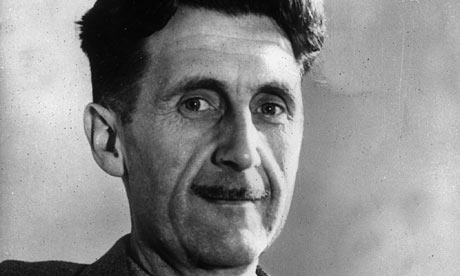
The masterpiece that killed George Orwell


The circumstances surrounding the writing of Nineteen Eighty-Four make a haunting narrative that helps to explain the bleakness of Orwell's dystopia. Here was an English writer, desperately sick, grappling alone with the demons of his imagination in a bleak Scottish outpost in the desolate aftermath of the second world war. The idea for Nineteen Eighty-Four, alternatively, "The Last Man in Europe", had been incubating in Orwell's mind since the Spanish civil war. His novel, which owes something to Yevgeny Zamyatin's dystopian fiction We, probably began to acquire a definitive shape during 1943-44, around the time he and his wife, Eileen adopted their only son, Richard. Orwell himself claimed that he was partly inspired by the meeting of the Allied leaders at the Tehran Conference of 1944. Isaac Deutscher, an Observer colleague, reported that Orwell was "convinced that Stalin, Churchill and Roosevelt consciously plotted to divide the world" at Tehran.
-The Guardian

A Pocket-Size Leveler in an Outsize Land


The cellphone appeals, too, because it plays into the Indian need to place people. Cellular differences today perform the role that forehead markings and strings around torsos and metal bracelets once did: announcing who outranks whom.

Small people have small phones, and big people have big ones. Small people have numerical-soup numbers, and big people have numbers that end in 77777 or something equally important-sounding or easy to remember. Small people have one phone, and big people have two. Small people set their phones merely to ring, and big people make Bollywood songs play when you call them.

The cellphone, in short, has made itself Indian. There are 65 times more cellphone connections than broadband Internet links, and the gap is widening. And so those who wish to influence Indians are not waiting for the computer to catch on, but are seeking ways to adapt the cellphone to the things Westerners do online.

Indian companies have invented methods, via simple cellphone text-messaging, to wire money to temples, pay for groceries, find jobs and send and receive e-mail messages (on humble phones with no data connection).

But the most intriguing notion is that cellphones could transform Indian democracy.

Even in this voting season — the results of a four-week election will be announced May 16 — Indians are famously cynical about their senior-citizen-dominated, dynastic, corrupt politics. The educated often sit out elections. But with cellphones becoming near universal, experiments are sprouting with the goal of forging a new bond between citizen and state, through real-time, 24-hour cellular participation.
-The New York Times

Prison radio station is nominated for four national awards
Although prison radio has been around since the mid-1990s in Britain, when Feltham Young Offenders Institute started a station, there is now one in every seven prisons.

The aim is to provide communication at a place where conditions are poor, and where prisoners, who are on remand awaiting trial on allegations ranging from credit card fraud to murder, arrive with a typical reading age of about 11.
Nominated in the speech category at tonight’s awards is Prisoner’s Voices, a discussion programme in which inmates interview each other — and where Mark (not his real name), who has “a lot of hate and dislove for myself”, talks about cutting his wrists and says that his arms “to be honest, look a mess”.

A prisoner harms himself every other day at HMP Brixton, and while most incidents are trivial, seven inmates killed themselves between 2006 and 2008, at a jail that the chief inspector described as one that “exemplifies all the problems of our overcrowded prison system”.

-Times of London

DOJ Budget Details High-Tech Crime Fighting Tools

Another high-tech program includes the development of the Biometric Technology Center, a joint Justice, FBI and DoD program. Building the center will cost $97.6 million and will serve as a research and development center for biometric technology.

Last year, the FBI announced it would partner with the University of West Virginia to establish the center.
Eventually, the Biometric project will be a vast database of personal data including fingerprints, iris scans and DNA which the FBI calls the Next Generation Identification (NGI).

The FBI has awarded the NGI contract to Lockheed Martin to update and maintain the database which is expected to come online in 2010. After being fully deployed the NGI contract could cost up to $1 billion.


DOJ's budget request also mentions an INTERPOL program called Project Vennlig, which is a terrorist information sharing program run by the international anti-crime organization. The Defense Department initiated the program to obtain criminal information about insurgents killed or captured in Iraq.


The DOJ budget request notes the program gathers information from insurgents' cell phones and documents found in their possession: "The purpose of the initiative is to obtain and integrate collected information for the use of INTERPOL member countries and U.S. law enforcement agencies in proactively targeting terrorism."
-ABC News