Tuesday, April 20, 2010

Some thoughts on SB1070 & civil disobedience


by Jon Riley

Solidarity to the 40 Tucson High students who walked out of class, and to the 9 students arrested at the state capitol yesterday!

Our hats are off to all the youth who took courageous acts today, it is inspiring to see resistance to SB1070, a piece of legislation that has passed the Arizona Legislature, and is waiting for final approval this week by Governor Brewer. This bill was drafted by the notorious anti-immigrant bigot, and state senator, Russell Pearce. Pearce continues to push for legislation that could take Arizona back to something that would only resemble the worst days of the segregation south. In essence, if SB1070 is passed, the state of Arizona will have state sanctioned racial profiling, white supremacists like Pearce are counting on this bill to intimidate much of the Hispanic population so that they would move out of state. This is state sanctioned ethnic cleansing. This one's a game changer.

This wasn't lost upon the nine people who chained themselves to doors at the state capitol today, the most dramatic escalation taken by those in power was met with a response from those below. More than a symbolic gesture, maybe more of a declaration, the immigrant movement in Phoenix took a big step forward today, birthing a civil disobedience campaign that will organize against and oppose the continuing racist assault.


We see this attack on immigrants and communities of color in the cities mirrored in the century old border controls and movement restrictions that the Tohono O'odham people continue to resist on their traditional homeland. Just to travel home, from a village on one side of the border to a village on the other side becomes a life or death situation. IDs are mandatory, profiling is a daily occurrence, the agents of state have their finger on the trigger guard and their eyes on you. How much different will anywhere else be in Arizona if this bill passes? This picture will become more clear everywhere, as the city cop checks for "papers" in Mesa, the border patrol agent in Sells mans a checkpoint, and ICE agents conduct workplace raids in Flagstaff. The struggles that have been isolated, or hidden to each other for too long are finding each other now, only as the attack on human freedom and dignity becomes total.

Lately, we at PCWC have had a saying about this bill, that if is signed into law it will be "the end of politics," this is the end of the debate as far as we're concerned. Unlike a conflict in politics, there's no debate with the law, should we hold onto the illusion that the voice of struggle holds sway in the police station, courtroom, capitol, mayor's office, or white house?

To be sure, this is a dark time, terror lingers on across Arizona these nights, and surely worse will come. Not all is lost though, and these words from a Greek comrade may be of use in these desperate times. "Action dries your tears," he said, and there's always a place for action in our lives.


DROP ALL CHARGES AGAINST THE SB1070 9!
DROP ALL CHARGES AGAINST THE ARPAIO 5!
BROADEN THE SOCIAL STRUGGLE!

Monday, April 19, 2010

Some things worth checking out

Death and the Mielieboer: The Eugène Terre'Blanche Murder & Poor-White Canon-fodder in South Africa

But who are the Boers, truly, beyond the cartoons of black-bearded back-countrymen, scarecrows in the corn, leaning on ancient muskets? Afrikaners today are often are the sons, daughters, granddaughters and grandsons of the tens thousands of women who were deliberately starved to death in British concentration camps a century before as their farms were put to the torch. Do not brush aside this key fact because of the whiteness of their skin: their women-folk and children were deliberately exterminated in an imperialist war that generated so much global opposition at the time that it was the Iraq of its day: Scandinavians, Irishmen and Russians gave their lives on the far-away veld; angered Québécois burned down public buildings; and awed anti-American guerrillas in the Philippines learned their tactics by night. Scratch a highveld Boer and you will likely find a bitter hatred of British imperialism – based on living-memory family experience of the camps. And that war was provoked by the imperialists because Britain lusted after and finally burgled the goldfields of the highveld from a frontier people who had progressively retreated into the African interior away from the claws of the bankers, into the spears of the Bantu.

True, they were and often remain an austere, narrow people: one of their Calvinist sects, the Doppers, is deliberately named after the tin cap or dop used to extinguish a candle, the message being the need to extinguish the Enlightenment. And true, they often beat "their blacks" with an offhanded cruelty, and at best established a paternalistic overlordship over them known as baasskap (boss-hood). But in their warfare with, suffering at the hands of, and eventual enslavement of the Bantu, a strange relationship developed: alone among all white settlers on the African continent, they self-identified en masse as Afikaners, as Africans, not Europeans, and seve
red their ties to their distant motherlands. The they and their black neighbours lived, ate, thought and died, merged and became inextricably intertwined: well over 10-million more black South Africans today speak Afrikaans, the slave's idiom-rich, story-telling pidgin-Dutch of old, than do whites; while platteland (big-sky farmland) Afrikaners are fluent in African vernacular languages. For the British-backed English-speaking elites, the mining bosses and big land-owners, this closeness was worrisome; something had to be done to divide and rule them. Racialised divisions worked successfully among the working class until multiracial revolutionary syndicalism mounted a challenge from 1917 – a challenge undermined and dissipated within five years by the black nationalist mystifications of the aspirant bourgeois party that became the ANC. It may be that despite their progressive approach to the racial question, the syndicalists lost their grip on the labour movement because of the allure of politics of racial polarity that pitted whites and blacks against each other, a politics seized on with fervour by the NP on its ascension to power in 1948.
Via Anarkismo.

University Struggles at the End of the Edu-Deal

The student movement, however, faces a political problem, most evident in the US and, to a lesser extent, in Europe. The movement has two souls. On the one side, it demands free university education, reviving the dream of publicly financed 'mass scholarity', ostensibly proposing to return to the model of the Keynesian era. On the other, it is in revolt against the university itself, calling for a mass exit from it or aiming to transform the campus into a base for alternative knowledge production that is accessible to those outside its 'walls'.iv

This dichotomy, which some characterise as a return to the 'reform versus revolution' disputes of the past, has become most visible in the debate sparked off during the University of California strikes last year, over 'demands' versus 'occupations', which at times has taken an acrimonious tone, as these terms have become complex signifiers for hierarchies and identities, differential power relations, and consequences for risk taking.

The contrast is not purely ideological. It is rooted in the contradictions facing every antagonistic movement today. Economic restructuring has fragmented the workforce, deepened divisions and, not last, it has increased the effort and time required for daily reproduction. A student population holding two or three jobs is less prone to organise than its more affluent peers in the '6os.

At the same time there is a sense, among many, that there is nothing more to negotiate, that demands have become superfluous since, for the majority of students, acquiring a certificate is no guarantee for the future which promises simply more precarity and constant self-recycling. Many students realise that capitalism has nothing to offer this generation, that no 'new deal' is possible, even in the metropolitan areas of the world, where most wealth is accumulated. Though there is a widespread temptation to revive it, the Keynesian interest group politics of making demands and 'dealing' is long dead.
Via Mute

A People's History of Koch Industries: How Stalin Funded the Tea Party Movement
The Soviet oil planners were delighted with Koch’s refineries, which “operated commendably, and would in the future be the type preferred by the heads of the Soviet Union’s petroleum industry when purchasing new cracking equipment.” The Communists were so impressed they kept giving Winkler-Koch business and regularly sent Soviet engineers to train in Wichita. It was a sign of growing mutual trust.

By the time he got out in 1933, Koch earned $500,000, which was a ton of money for a kid fresh out of college. This nut of money served as the foundation for the family’s future wealth, which Koch no doubt started acquiring at rock-bottom prices. After all, 1933 was one of the two worst years of the Great Depression—all assets were priced to go at 90% off. In the end, the capitalist-hating socialists ended up treating Koch fairly, way better than the monopolistic thrashing he got from his native land. So you’d think he’d at least something good to say about the Soviet Union when he got home?

Nope, not at all. He hated the Commies real bad. But for some reason he kept it to himself until the late 1950s (possibly because he was still doing work for the Soviet Union). Then, after coming back from a trip to the Soviet Union in 1956, he flies off the handle. According to a 1956 AP article, Fred Koch was among eleven prominent residents of Wichita, Kansas, “left for Moscow by plane today in an effort to convince the Russian people that Soviet propaganda about capitalists is untrue.” Sounds like the perfect cover for a business trip.

Via The Exiled

Sunday, April 18, 2010

Thoughts on our role in the emerging struggle against the racist state of Arizona

This is not meant to be a final conclusion, just an attempt to get my initial thoughts down about what we could be facing and the means I see as the best way to approach it.

As what seems like the inevitable signing of Russell Pearce's anti-immigrant law grows near, driving a nail into the coffin that is the political strategy pursued by local pro-migrant organizers, the question increasingly becomes what will be the nature of the resistance that will emerge to oppose it. Politics as a means of settling it is clearly dead. There is no political solution and there is no one left to appeal to. Friday's ICE raids proved that. We need to be thinking about the kind of resistance that will work and how we can organize it.

Likewise, we need to be thinking about what the terrain of struggle will be. Who will be our allies? What or who will we target? If we are done trying to convince, what does that mean? It seems to me that the only option left is a campaign of direct action aimed at causing real consequences for the system. We must begin to develop the organizational forms that can disrupt and shut down the functions of the state and Capital in Arizona if need be. The sort of forms that can cause havoc and can respond quickly to the ongoing crisis with a variety of creative resistance measures.

The natural form in my opinion is the affinity group and some kind of facilitating structure for coordination, perhaps a spokescouncil or an assembly. Perhaps the latter that can transform into the former when necessary. Above all, this limited organization must be anti-political, anti-bureaucratic and horizontal. Anyone who can put together an affinity group and agree to a few key points should be able to participate, but no politicians or political parties should be allowed in. For guidance in this we can look to the Zapatistas "Other Campaign". The politicians have failed us utterly, as we always knew they would. We must be done with them.

To my mind, the natural starting point for defining participation in such a group would be the DO@ statement. If someone can agree with that, then they should be able to participate in the resistance we organize. If not, they are, of course, free to do their own thing, as anyone is. Perhaps boiling them down a bit would be worthwhile to develop a clear and concise criteria for organizing. Perhaps there are other criteria that would work just as well. We need to be thinking about that. In particular we need to think of ways to keep the leftist activists out.

One thing the DO@ statement brings to the table is a broader view of the struggle beyond just the country politicos that have been the general focus of movement leadership in town. Whether that was a good way to organize or not is irrelevant now: the problem, with this new law, will be clearly and unambiguously bigger than the county. The DO@ refrain, "Free movement for all, no dislocations for anyone", likewise seems a good starting point to me.

One thing to keep our eye on is the machinations of the leftist managers of struggle. They are desperate now. Already they have tried to intervene against direct action and the will in all likelihood continue to do so. They know they have little to offer the resistance now, but that doesn't mean they won't use all manner of tricks to try to hold on to the movement. It's time for them to recognize failure when they see it. Whatever role they have now must be in bringing their counsel to support the direct action movement that must certainly begin the second that law is signed. I'm sure they have a lot to share, but they must admit that the nature of the struggle is now much changed and so naturally should our tactics and strategies. Rather than scaring people with charges, fines and jail times, they need to be organizing legal defense for what may come. Certainly they have much to offer in this regard.

We also need to be thinking about our opposition and our potential allies. At the Tempe Tea Party rally libertarians stood outside flyering against Pearce's law. This continues to be an important breach in the front of white supremacy and we must recognize it. We must continue to engage it and we must continue to push on that contradiction so that others are emboldened to break with the racist trajectory. We have to also be building connections, not necessarily finding a base of support, but finding sympathizers. We'll need each other. We are autonomous and speak for ourselves, but there are friends out there. Let's get to know and encourage each other.

Likewise, aside from direct action, we need to be producing literature, flyers and media on a scale that we heretofore have not considered in Phoenix. Thousands and thousands of copies must be distributed. We need to think about going places we haven't gone before. Sports games. Gun shows. Malls. Churches. "What side are you on?" we must demand. The priority must be in getting arguments in the hands of white people that can force them to choose one side or the other. We cannot allow the luxury of the middle ground anymore. This similarly goes for the liberal activists and party hacks who will try to negotiate on their own and others' behalves. We must make this position impossible. Our role is to push as far and as hard as we can and to refuse compromise.

These are some of the initial thoughts I have on the struggle that seems likely ahead of us. Above all, we must be creative and refuse to be pushed into the narrow paths of struggle that the state, leftist managers and the reactionary right will attempt to impose on us. Lift your eyes and look to the horizon. Take in the broader view. Look for places where we are strong, where they are weak, or where we can act vigorously and quickly. Consider our strengths versus their weaknesses. Look for contradictions that will be profitable. Fortify yourself, find your comrades and get ready. Solidarity means attack!

Wednesday, April 7, 2010

High Noon is Too Late for Tea: Seeking Ways to Engage and Oppose the Tea Party Movement

It's been quite interesting to see the reactionary right go haywire over the recent call to "crash the tea parties". Reading their blogs, one can literally track the echo chamber effect in real time. One wing nut on the information superhighway characterizes the anarchists without proof as stooges for the Feds (the standard accusation from these folks) and before you know it the next kook is citing the first kook as proof.

For the Truthers in the movement in particular, the standard frame through which they see the world goes like this: the CIA/Feds manipulate movements that aren't "awake" (a term that refers to everyone outside that wing of the Tea Party movement). This skepticism of movements stems in part from their inherently conservative nature. They distrust peoples movements that tend to lead to generally progressive results. Naturally, then, in their eyes such movements must be run by outside paymasters. They are composed of poor fools who don't know they are being used (at best) if not outright paid thugs. Throw in a healthy dose of internets and capital letters and -- boom! -- the anarchists have transformed into a front for the CIA! Infoshop is an organization run by the NWO! Reality be damned!

If the Tea Party people could slow their roll for a minute, I think they would find a lot to learn from this exercise in self-delusion. But for them the ideology, so drenched in American patriotic mythology, trumps the reality. Because of this, a "teachable moment", so to say, is unlikely. So, instead, let's think about what we as anarchists can learn from the call and the reaction.

The first thing that occurs to me is the general wishy-washiness of the call put out on Infoshop. It really doesn't call for much. Indeed, some on the right have found it quite confusing. One criticism made frequently on right wing message boards and blogs that I think is quite prescient is the questioning of how anarchists can come out in defense of government. This is a fair point. Still, calling for the defense of social programs as a bulwark against austerity and direct attack by the capitalists is not necessarily a contradiction. For anarchists it's always been more about the how than the nature of the concession exacted from the elite. After all, we're revolutionaries not reformists. The goal, as always, is the generalization of the attack until a broad insurrection rises to destroy Capital and the State. The struggle is the means to that end.

However, when framed as an attempt to move the Tea Party to the left, it certainly starts to enter the dangerous waters of leftist defense of the State for its own sake. This is clearly not an anarchist position. Indeed, it's not clear at all how, as the call out suggests, a more leftist Tea Party (or Tea Partiers of a more leftist persuasion) would be any better. Are we calling them to support Obama? To become dissident Democrats? To become socialists? What exactly would moving them to the left mean and, more importantly, what would it mean for anarchists and the prospects for revolution? This relationship -- one of persuading Tea Partiers to move leftward -- fails to define anarchists as anything other than extreme liberals and is problematic to say the least. In this case we are nothing but the shepherds of the social welfare state, herding those who wander from the herd to its defense. People on the right are correct to call the piece out on this hypocrisy.

Next, I think that while the very short article is correct to recognize a shift towards fascism in some (increasingly dominant) tendencies within the Tea Party movement, its analysis is in the end quite unsophisticated. For instance, the piece really fails to recognize contradictions within the movement that can be exploited, not to move it to the left, but to divide it, neutralize it and, hopefully, to cause a shaking out of its more truly libertarian elements towards advancing the attack on Capitalism and State. That is, framed correctly, it is possible to intervene in this movement in order to give encouragement to the libertarian and working class elements within it so that they will break with the overall fascist tendency, the reactionary free market ideology and the infantile patriotism. I'll get back to this with some examples from Phoenix Class War Council's organizing here in Phoenix.

But as an aside, before I move on, I do think it's interesting and quite embarrassing for the Tea Partiers that several, much longer and much more critical essays (that deal with the question in depth), have passed them by entirely. It seems that this tiny little essay was just the right dimensions to be digestible by their very limited critical capacities. Likewise, it was probably just simple enough for the big money interests to blast it out like a megaphone to be consumed by the more conspiratorial and hardcore conservative reactionary elements of the movement.

Of course, being generally unaware of the recuperation of their own movement by big money interests because of the weaknesses in their own pro-Capital ideology (the class war equivalent of "Yes, sir, may I have another?"), Tea Partiers have been unable to interact meaningfully outside of the narrow script being written for them by the likes of long-time GOP operative Grover Norquist. Indeed, framed as it is between the "austerity for you, bailouts for us" politics of Obama's banker buddies and the white free marketeers of the Republican "drown big government in the bathtub" cadres, the capitalist class as a whole must be laughing its collective ass off over gold-flaked martinis considering the dialectical outcome of that lovefest of reactionary kissing cousins.

As it is, the Tea Party is being used as a hammer to attack the last remaining source of middle class wages in the US -- the state bureaucracy. The hypocrisy of blue hairs on Medicare and Social Security ranting against "socialism", or military families on government pensions and Veterans Administration health care screaming about "Obamacare" is certainly good for a hearty belly laugh. But the sad truth is teachers, municipal workers and the rest, among the last vestiges of the albeit quite flawed union organizations in the US, are now taking the brunt of the final assault on what remains of concessions extracted from the capitalists by the working class. Such past attacks on Capital, however, having been corrupted by the political relationship of white supremacy, never included everyone, and large populations were left out or pushed out of the deal. And, white supremacy being a relationship to Capital that exists at Capital's convenience, and now having dismantled the heart of organized workers in Detroit (to the cheers of much of the white working and middle class), the capitalists are now moving in for the kill. The Tea Party (having refused solidarity as a weapon), armed now only with its self-hating free market fantasies, is the eager accomplice to the murder, witting or not.

Of course, as anarchists we should defend neither the state bureaucracy nor bloated leftist unions in a knee-jerk fashion. Still, we are left with the fact that the attack on the formally organized wing of the working class has reached levels unprecedented in most Americans' lifetimes. Something fundamental has changed in the relationship between capital and the working and middle class. The Tea Party emerges from this new cocktail. They seek to reassert what they perceive to be a looming collapse of the deal of white supremacy. But is the deal still to be had?

When considering this question, the libertarians within the movement should not be confused with the conservative, fascist wing. The libertarians are attracted by ideology, but they are not the knife's edge in this fight. We share some key things in common with them and the Tea Party is not necessarily a happy home for them. Like the relationship between anarchists and communists, the one between libertarians and conservatives is not as seamless as outsiders might otherwise believe. In fact, they are a point of potential conflict because their overall politics do not fit well within the overall goals of the movement, and the conservative leaderhip knows it. Hence their vigorous push to consolidate control and marginalize libertarian elements.

In PCWC lingo, this conflict is a site of potential "fractures and fissures". That is, putting pressure on this contradiction can potentially cause a split, a falling out or a "coming to Jesus" moment. It can also force one element to stay true to its stated ideology over otherwise reactionary political tendencies. This is something to keep in mind and it points to a fourth way to engage the Tea Party movement beyond either ignoring them, attempting to move them to the left or outright unconditional opposition.

Let me give an example of what I mean. When PCWC was organizing the Inglourious Basterds Bloc to confront the National Socialist Movement, we reached out to libertarians on the right. In Arizona, the libertarian tendency is probably the largest dissident faction in politics. So, in our call to action, which was posted to the largest libertarian news site in the state and got a lot of play in local media, we addressed a particular section to them:
We at PCWC also want to extend a particular invitation to our friends in the Libertarian movement. Because of your vigorous protests at Obama's recent speech, you have been painted as racist. We know that you feel this is unfair. You see yourselves as protesting this country's turn towards fascism. We sympathize with this argument and are ourselves no fans of the Obama administration. However, we want to point out that unlike some of your past protests, the NSM rally offers you the perfect opportunity to make known your opposition to fascism in an unambiguous way. We hope you come to the event.
Our intent here was to call the libertarians in Arizona, who had been flirting with anti-immigration positions for quite a while, to choose whether they were going to act on their alleged opposition to fascism or whether they were going to defend the Nazis. Up to this time, large parts of the libertarian movement in the state had flirted, to say the least, with a kind of anti-immigrant politics that emerged mostly from their unconscious defense of whiteness. At best, they had stood by without speaking up against the crack down on immigrants and brown people generally.

If you know anything about libertarianism as an ideology, whether right or left, a firm commitment to free movement comprises a core tenet. Our sense, through careful analysis of the anti-immigration movement, was that the libertarian wing was uncomfortable to say the least with the relationship. It was more a politics of default, which is what whiteness is in many ways. We also recognized that at the heart of the conservative reactionary wing of even the anti-immigrant front is a pretension to libertarian, constitutionalist values. Values that are almost never lived up to when they come in conflict with whiteness. So, we said to libertarians: will you defend your rhetoric or your whiteness? Will you stand up against fascism or find yourself in the camp of the NSM? If you stand today against fascism we will stand along side you. It's important to note here that such calls were not disingenuous. We meant it.

In this sense, we hoped to appeal to the better nature of the libertarians and to weaken the broader reactionary current. This was in the context of several other interventions into movements in which they participate. And libertarians did the right thing and came out. Interestingly, a week following our triumphant victory against the NSM, the "mainstream" anti-immigrant movement "Save Our State" had a rally. The NSM, who had showed up without challenge many times before to these events, was attacked physically and driven out by organizers. The NSM are racists, they claimed, and had no place at the SOS event. Split accomplished. NSM out maneuvered. The right had attacked the right and the NSM had been denied future access to fertile grounds for organizing. And libertarians had taken a consistent position against white supremacy.

Later, libertarians started to turn out for pro-migrant events. Their politics are now more consistent and a facet of the white reaction has been weakened. A few months after Inglourious Basterds Bloc, there has been a bit of a revolt in the Republican party against the main pusher in the Senate of anti-immigrant legislation. The most prominent face of libertarianism in the state has come out against a new anti-immigration law because it opens the door to Real ID controls on movement.

Interviewed by local New Times writer Stephen Lemons, he said: "This is the police state in immigration camouflage. You want to know how that Nazi Germany [stuff] happens? This is how it happens." Lemons continued, writing, "Hancock observed that the immigration issue often becomes a Trojan horse for civil liberties, with people willing to give up their rights in exchange for ridding their community of illegal immigrants. He called Russell Pearce a 'Judas goat,' leading ordinary citizens 'to the slaughter.'" This in particular was a point we had hit hard on in the past.

In essence what they had done was choose a consistent position over their alliance to whiteness. And we welcome it. This was possible because, among other things, we recognized a contradiction within their position, thought about their politics and their relations to others, and engaged them. We pushed on a contradiction, held them to their rhetoric and offered an either/or choice: defend the NSM or defend migrants. What will it be? We were both vocal and unequivocal in our position. We were fanatical: free movement for all people without compromise. It's worth noting that since being booted from the SOS event, the NSM has not shown its face -- even to counter protest at immigration rallies.

So, I reference this one particular incidence of the "fissures and fractures" practice we have been using as a potential fourth way to engage the Tea Party. I could list others. But the essence of the strategy is this: find the contradictions within it and push on them; try to give elements in the movement either/or choices; call them on their hypocrisies; and, most importantly, find elements within them to whom sympathetic arguments can be made. These elements, if approached honestly and directly, can pick up your criticisms and make them their own.

Because, when facing your opponent, it's not always necessary to defeat them outright through head on attack. And persuasion of the broad reactionary current is generally impossible. However, you can, especially when you're a minority movement, look to split them and see what the political fallout is. In our experience at PCWC, the result tends to change political relationships in some interesting ways, remaking the field of battle and providing for new opportunities for anti-authoritarian, anti-capitalist politics that weren't possible before.

We find this is particularly the case with the context of white supremacy, which is in fact a political relation that tends to trump all others. In the case of those who advocate the free market, history shows to what extent their denunciations of social programs is in fact belied by their reliance on the social program of whiteness, which has its roots in settlerism, slavery and imperialism and has its most prominent manifestation domestically nowadays in the the prisons and the various police departments. Indeed, the Tea Party's demand for the dismantlement of the welfare state, framed as it is under non-revolutionary pro-capitalist conditions, is in fact a demand made against what they believe to be the improper redistributive nature of taxation and the welfare state; that is, the welfare state, they think, takes wealth from those who "earn it" (which we understand to mean whites) and gives it to those who do not (everyone else). They of course reject this characterization, but that in my opinion doesn't make it less true.

It is the contradiction of white supremacy that reveals the lie behind the working class revolt elements within the Tea Party. It is also what will in the end deny them anything more than the pathetic privileges of white supremacy at the end of the day. Such a limited vision is anything but revolutionary to be sure. And, by reinforcing white supremacy, it does nothing to go after the fatcats that many of the Tea Party members are legitimately angry at. Notice the disappearance of anti-bailout rhetoric from the movement.

By finding ways in which this contradiction can fall out one way or the other, new relations by definition become possible. Previously contradictory relations sort themselves out. Further, by taking a revolutionary anarchist position against both the state in general (but against the attack by the capitalists on its few remaining positive redistributive tendencies), and also against white supremacy, the issue becomes framed in a way that is likely to drive the conservative element batshit insane. And because of the fundamental nature of white supremacy to maintaining American capitalism, the opportunities for revolution become enhanced considerably.

The goal is not to build revolutionary alliances with the libertarian right. Such a thing isn't possible. It is to undermine the broader opposition, to give space and encouragement to a dissident faction with which some common ground exists (itself within a larger reactionary movement), to reveal the true nature of that movement, and, in our case, to weaken white supremacy in order to open up the potential for a broader revolt against capitalism and the state.

Of course, such interventions, however useful, only buy time and opportunity. But once that opportunity comes knocking, you need to have something there as an alternative. That means events that can be attended. Actions that can be pointed to and that can inspire. Decent theory that can explain the true cause of the crisis. Solidarity that can be delivered. And allies in the broader struggle. For white people, what this means is following the decades old admonishment from Malcolm X: it is our obligation to confront white supremacy within the white communities from which we come. Reaching out, over, behind and around reactionary movements to engage white people in discussion of anti-authoritarian, anti-capitalist and anti-racist ideas is vital. In many ways, we share potential constituencies.

Capitalism is in collapse. The state is anemic. Traditional reactionary currents are in flux. If we lose this one, it's on us.

Tuesday, March 30, 2010

Martin Wright Interviewed by Ian Bone

Some of you may know that while I was in London last year I got a totally unexpected but fabulous whirlwind tour of Whitechapel by Martin Wright, longtime Class War militant. Getting off the subway in Whitechapel was a culture shock to say the least. The neighborhood, Martin pointed out later, had been a working class center of struggle for a long, long time in London. Now, still working class -- and still a point of class conflict -- it had a very large population of conservative Muslims. I saw the first real burqa of my life there. And the second. And the third...

The street was alive with activity. Street vendors everywhere, selling just about everything if I remember right. We wandered down the street, looking for Freedom Books. It was the most foreign experience I had on that trip and certainly was not expected. Eventually, after some searching, we found the bookstore and on our way out, while offering up a copy of PCWC's paper to the cashier, I ran into Martin. One thing led to another and before we knew it I was getting a hands on tour. Martin pointed out everyplace of note, telling us the story of what riot happened where, and also dutifully noting every tag representing the local anarchist crew, the Whitechapel Anarchist Group. The neighborhood was covered in their graffiti.

So, being a fan of Class War legend Ian Bone's blog, I was perusing it the other day and one click led to another and all of a sudden I was watching a video of Bone's always entertaining but as far as I can tell now sadly defunct radio show "Anarchism in the UK" featuring Martin as the guest. In the interview Martin talks at length about anti-fascism, insurrection as a goal and tactic of struggle, the history of Class War and a number of other very interesting topics.

One of the things I like a lot is the uncompromising anarchy that was the hallmark of Class War. As soon as I found out about Class War, years and years ago, I instantly liked it. And that affinity has never faded. Indeed I was talking with a comrade tonight discussing the importance of anarchy without excuses. One that clearly delineates exactly what makes us different from the cesspool of leftist crap that so dominates what passes for critical analysis these days. It seems to me that if anarchism offers anything, it is straight shooting, saying what can't be said -- or saying what we all say to each other but that the power structure won't allow to be heard. Fuck the rich. Screw the cops. Work sucks. Things like this. Obvious truths that are banned from respectable discourse.

Sure, we should -- and PCWC certainly does this -- make the connections that reveal commonalities in struggles. We can force either/or choices that reveal contradictions. But, whatever else we do, one thing anarchists can offer is intransigence and consistency. A refusal to bow to politics. A refusal to apologize for our unbending attitude towards power and politics. If we have nothing else, we must have this.

Check out the video below (follow these links to parts B and C):


Oh yeah, one more thing:
Bash The Rich Film

Oh yeah, one more thing after that:

Monday, March 29, 2010

Considering the immigrant crackdown in the context of the Chinese Exclusion Act

The other day I revisited a chapter in Christian Parenti's excellent book "The Soft Cage: Surveillance in America from Slavery to the War on Terror". The cause of my return was the recent awakening of the local right libertarian movement to the connection between the demand for the policing of immigrants and the steady march of the police state in general. Local anti-immigrant hothead and state Senator Russell Pearce has recently come under fire from within the Right for an anti-immigrant bill that libertarians believe, with good justification, will open the door to the imposition of the Real ID or similar national ID card.

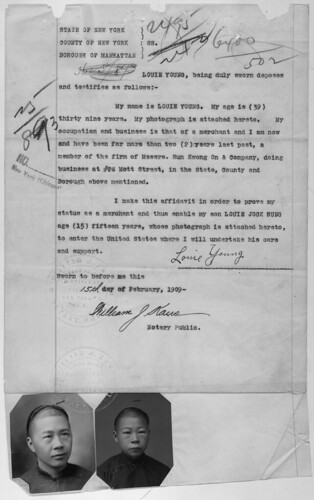
Parenti's book, a good read overall, has a truly amazing chapter on the relation between the enforcement of the Chinese Exclusion Act and other similar laws and the rise of the first ID cards (the chapter can be read online for free). Likewise, it goes into a good amount of detail about the ingenious ways that Chinese immigrants developed for resisting and overcoming increasingly onerous State regulation of their movements and relations. Forgery, bribery, flaunting of the law, lying, reliance on familial relations, mass resistance and refusal -- all of these and more constituted the tool box from which Chinese immigrants drew upon in their fight to define for themselves the terms of their lives in the land of the Flower Flag Country.

The story parallels so precisely the situation here in Arizona that the chapter ought to be required reading for anyone organizing against controls on movement, not least of all right libertarians interested in understanding the roots of the national ID card and the ever-present excuse of policing people of color that makes it possible. Parenti writes, "Ultimately Chinese exclusion was the first campaign of mass identification and registration of a civilian population by the US federal government. Conversely, the paper sons industry was the first largest informal anti-surveillance movement in US history."

So, the awakening on the right to this scam is a very important development. We at PCWC have engaged that movement several times over the question, what we see as the contradiction between the demand by the Right for a police regime for immigrants at the same time it demands immunity for itself and declaims the increasing infringement by the state on their own freedoms. This contradiction stands in stark relief when that same movement insists that the demands it makes -- against all evidence -- are somehow not racist. Being interested in contradictions, PCWC has focused on revealing this incongruity and pointing out that, contrary to what many on the Right say, it is in fact the latent white supremacist immunity from policing that is the hidden solution to the conundrum.

To us it's obvious: one can't support the expansion of police power in one sector without expecting it to expand generally. The support by the white population for increasing controls on immigrants, from eVerify to the border wall, has allowed the State the cover it needed to vastly expand the overall system of policing. Now, these controls are being generalized in the forms of freeway speed cameras, national ID cards, national police powers for local cops, internal checkpoints, etc. Lacking an analysis of white supremacy and its affect on the working class (and similarly without a true understanding of class), libertarians have had a hard time recognizing this contradiction.

The white supremacist influence on their politics blinded libertarians on the Right to the encroaching police state under their very nose. They assumed -- perhaps only unconsciously in the case of many -- that, as whites tend to be generally, they would be exempted from the unblinking gaze of the surveillance state as its domain grew. Indeed, as we have analyzed here in the past, some of their attempted resistance to enhanced policing, because it is perverted by the system of white supremacy, has indeed sought precisely to undermine the broadening of the police apparatus and technology only to demand a return to older methods that tended to land disproportionately on people of color. Not very libertarian!

That is, their fight uses the false cover of a fight against tyranny to obscure what is in reality a demand for a "get out of jail free card" from a system that they hope will focus on people of color specifically and leave them, the "good citizens" that "don't break the law" alone. For example, the dominant tendency within the fight against freeway cameras reflects this tendency, since it demands the removal of a relatively "democratic" policing system (in the sense that it tickets anyone who goes over the limit regardless of race) and its replacement with more human police who will, naturally, tend to reflect the general anti-people of color biases that dominate in other spheres. Of course, some in the struggle against surveillance have dissented, most notably the Santas who disabled speed and red light cameras in December 2008. Overall, however, their position was an extreme minority at the time.

The dominant dialog on the Right with regard to the question of immigration is of course problematic not just because it allows the unobstructed -- even welcomed -- advance of the police state, but also because strategically this blind spot undermines class unity by turning one section of the working class into the complicit police officer and jailer of another section. Under these conditions the kind of unity that is required to project a real working class power against Capital becomes impossible. The white part of the working class, then, is in many ways operating within a cross-class alliance with the capitalists, serving the function of a hammer on people who should naturally be their comrades in struggle.

What's important is not just the way that the ruling class exploits or encourages this backstabbing, but also the way that white workers demand the protection of the nanny state's policing apparatus in order to preserve their privileged status in the workplace and other areas. This should be noted because it reveals the common cause of white workers and the capitalist elite. For instance, in the case of Chinese exclusion white workers wanted regulation of the workforce in their favor and the ruling class wanted a timid, marginalized and exploitable foreign labor pool. The two complemented each other and form, in the case of the white working class, a kind of white welfare system, guaranteeing higher wages and other social benefits in exchange for loyalty to the cross-class alliance of whiteness.

So the realization amongst some in the libertarian Right milieu of the true nature of the anti-immigrant agenda -- at least as far as the policing angle goes -- is a very positive development. They may reject the point I am going to make next, but I don't think that makes it less true. When libertarians support resistance to the application of special police powers over immigrants (and thus people of color in general) by seeing within that attack an assault on themselves as well, they are defying the traditional political bonds of whiteness. And, in doing so, they open the way for broader struggle that can further bring the attack on capitalism and the state.

Monday, March 22, 2010

PCWC Roots: Wolfi Landstreicher


There's a lot of interesting things going on in Phoenix these days. Things are in flux. Our faith in our theories is being reinforced. The recent libertarian revolt against racist right wing legislator Russell Pearce has been a validation on many levels, not least of all the proposition that fight back against the racist anti-immigrant order can come from more than the boring, reformist left. Many people greeted PCWC's interventions and approaches to the libertarian right with deep skepticism (to say the least).

But, after a solid year of engagement (with some flirtation around the anti-NSM and other actions), it's nice to see the libertarians rise up in force and stick to their values, calling out Pearce for the racist fascist he is, and seeing through the bullshit. This is an amazing development, especially for an overwhelmingly white movement. For them to recognize that the controls on movement proposed by Pearce for local bogeyman "illegal immigrants" will generalize beyond their supposed intended target is a breakthrough of gigantic proportions. It's a step against whiteness, whether that movement sees it as such or not. And putting whiteness in crisis is a vital step towards opening up opportunities for the broader attack against the miserable domination of Capital and the State.

I won't write too much more about this now. Things are still in motion, but I can't help but remark on it because it's so momentous. If this angle of attack can spread, let's say, to eVerify and other interventions into the lives of those who seek to self-organize against the power of the system of domination, we will be well on our way to generalizing the struggle. It feels like a major validation of PCWC's theory of "Fractures & Fissures". Where you find a contradiction, you find an opportunity.

I suppose I'm thinking about theory a lot lately not just because we've been seeing the results of our applications of theory onto the terrain of struggle, but also because PCWC's rather "eclectic" collection of theoretical influences has come up a few times recently.

During our time with the Greeks, here and in the Bay, I know I was inspired by just how much the anti-ideological view we take towards anarchy was reflected back at us in their attitudes and politics. It felt very sympatico, even if we came from different national contexts. I was really amazed by their ability to remain entirely open-minded when it came to learning about the political situation here in the US. Reading their book "We Are An Image From The Future", just released by AK Press, is an inspiration to say the least. If all goes well, PCWC hopes to accept their invitation to visit Greece this summer to describe the situation here in the US.

It's true that PCWC takes its influences from a varied range of anarchist theory and opinion. We were lucky to come into organized anarchism during a time when a lot of new ideas were being tossed about, competing and debating. We are race traitor and individualist. Anarchist-communist and anti-tech. We are class war and social war. We are insurrectionist and fanatical.

So, being inclined at the moment towards theory, I suppose it was a stroke of good luck that Ardent Press put out Wolfi Landstreicher's collection of his writings for "Willful Disobedience" in time for the SF anarchist book fair. Even though I think I have all the issues he put out under that title, I snatched it up as soon as I saw it. Wolfi, both through WD and his collective project "Killing King Abacus" was a tremendous influence on us coming up.

Re-reading the book this weekend, I was reminded of just how much of an affect it had on me. Having come into anarchy from a pretty individualist perspective to begin with, but at the same time having to reconcile that with the race traitor politics I was exploring -- in particular its view of strategy -- Wolfi's writings helped me a great deal to realize that my own revolt against this vampiric system was the only place to start in terms of finding common ground with others in struggle.

What I mean is, anarchy is not a moral trip, and it isn't a monkish project of self-sacrifice either. I want to overthrow this system because of what it does to me every day. One must first and foremost be motivated by one's own liberation. Otherwise, it's no different than bullshit liberalism. I'm no one's savior except my own. But revolution is not an act of navel gazing. We win by fighting together, side by side. True solidarity comes, then, from finding commonalities with the struggles of others, and recognizing that one's liberation is inextricably tied into the the liberation of others.

Beyond that, Wolfi's idea of "projectual living" appealed to me greatly. While many of the race traitor theorists I was interacting with were very Marxist influenced in terms of their view of revolutionary struggle, I really found objectionable their resistance to the everyday fight we must engage in just to live with anything approaching dignity in this system. There were no perfect times to struggle. We must fight now. Every day is a new battle, even if the enemy remains the same. Our lives are projects towards the overthrow of this rotten order. As I do in (anti-)politics, so I do in my life. I fight for room to breathe. I attack the system at every opportunity because it seeks to strangle me. Even if much of our lives in this society are an accommodation if we are lucky, we must to the best of our ability stand in opposition -- to strike back -- every moment that we can.

At the same time, the building of massive formal organizations was unappealing to me. Seeing the way the Bring the Ruckus (race traitor) collective operated here in town proved to me the disingenuous nature of cadre organization and the many ways that formal organizing substituted defending the party line for true relations of affinity. Because, they believed, the organization would bring the revolution, the organization must be defended at all costs. Even if they were anarchists in theory, in practice, while in the organization they acted like authoritarians. I didn't want to build the organization. It was Wolfi's writings that helped to inform me in those struggles against BTR and their machinations, and to light the way towards a much more natural and effective form of organizing. -- one that PCWC practices today.

So, it's on that note that I both recommend that people pick up Wolfi's book and check out the many writings from those days that are available online. With the spring weather making outdoors bearable again, I've been spending the last few days sitting under the tree in the garden with a cold beer getting re-acquainted with an old friend. I highly recommend those folks who find PCWC's politics appealing do the same.

You can find many of the articles from Willful Disobedience at this link. And order Wolfi's book from Ardent Press here.

Wednesday, March 17, 2010

Got $20 bucks? Help our Greek comrades continue their U.S. tour!

The VOID Network breaking it down to a packed house during their talk at Beer & Revolution.


Before kicking back with a six pack of Guinness this St. Patrick's Day, please consider kicking down $5 or $20 to lend some mutual aid to our Greek comrades from the VOID Network.

That's right, we're asking you to buy the cheap stuff tonight.

Our Athenian comrades had a really crappy incident last night, their vehicle was broken into in Berkeley, and all of their materials (Boxes of books and pamphlets) for the U.S. tour were stolen. In addition to this theft, the window to the vehicle was smashed, but the worst news of all is that the projector they used to share the images from the revolt was also taken. In short, everything bankrolling the tour is gone.

They are now in desperate need of mutual aid, in the form of monetary assistance, ASAP. The broken window must be fixed before they can continue on their tour, and a donation will help restock those books and pamphlets as well. We were very grateful the folks from VOID took the time to stop in Phoenix for a few days, and it would be a tragedy if they were unable to continue their tour, so please kick some cash down if you've got it.

Hit up Little Black cart and donate:

-$20 donation to the VOID Network
-$5 donation to the VOID Network

Wednesday, March 10, 2010

There's no immigration law like no law at all: On revolution as the necessary conclusion of the migrant movement

A tendency has emerged here in Phoenix that I find very exciting. More and more, as we resist the leftist model, so seductive to others, of building bigger and often disingenuous organizations (instead keeping our relations intimate and small scale), I have found that many of us have converged around a familiar and familial politics that is almost entirely unique in the US. With few exceptions (probably Modesto most notably), a particular strain of class war, race traitor, insurrectionist, and primitivist influenced politics has emerged here. Many anarchists in this town defy conventions, reject orthodoxy and instead take our influences based on what makes sense rather than whatever arbitrary groupings of ideas fall under what predetermined label.

Is it the hot summers? Is it the never-industrialized vastness of the ever-growing suburban wasteland? Phoenix seemed for so long to be like the universe -- vast but always somehow getting fucking bigger. A constantly growing behemoth, ever eating up more desert. Is it the proximity to the border? Is it the fact that Arizona was a segregated state? Is it the fact that you can see the horizon from anywhere in town? Or that the sun sets so brilliantly every evening? Is it because Phoenix was built on blood, for white people and to the exclusion of the native peoples who continue to make this area their home? Is it the malls that provided the plastic playgrounds of our youths? Is it the fact that almost no one living here was born here? Is it the waves of conquest, migration, dispossession and expulsion that define our history? To be from Arizona and also older than ten is a rare thing here, even in this age of economic collapse and foreclosed homes.

One author in particular who consistently writes exactly that kind of analysis publishes regularly at "Chaparral Respects No Borders". A very interesting article has recently been posted there that deserves a wide audience regarding the struggle over free movement, freedom from dislocation and, in particular, the kind of movement that we need in order to settle the questions we face. This most recent article reflects all the characteristics that I find inspiring about much of the writing coming out of Phoenix these days.

The piece uses one of my favorite techniques in writing. It takes a supposition that many people take seriously -- especially one upheld by movement leaders on all sides of an issue -- and subjects it to the real world. That is, for the sake of argument, one takes the positions of one's opposition and one's supposed allies, for instance, seriously and then kind of works backwards with it, showing weaknesses and contradictions along the way. We at PCWC are constantly keeping our eye out for contradictions, and so this approach always gets my attention.

Writing in the most recent piece, "The Best Immigration Law is No Law at All: Some thoughts on the logical conclusion for allies of undocumented migrants", the author smashes apart the presumptions of the movement liberals. The piece destroys the arguments from those that constantly push a legal framework as the solution to the question of free movement. And it lays bare the logical conclusions of those arguments, refuting the idea that the law can offer any answer to the demand of people to travel where they will, when they will. After all, law permits, it does not free: it prescribes freedom's limits. It is the enclosure to the commons.

At the same time, the piece does not spare the Right, pointing out their hypocrisy with regard to the question of class war in Mexico. The racist right in Arizona constantly demands revolution in Mexico, but will they overcome their reactionary ideology to support an anti-capitalist revolution? The forces of the Right hold sway in Mexico, so just who is the Right in the US calling to revolution? And against what? That is a dare that stands before that pathetic movement, and it's a contradiction worth pushing on since it will force them to choose between their reactionary defense of whiteness and colonialism and their supposed commitment to change in Mexico. They can't have it both ways.

The piece is firmly rooted within an anarchist analysis. It deeply calls into question the ability of the State to provide justice, as well as the alliances within movements that serve to maintain that myth. Most importantly, I think, the article recognizes the fact that it will be the people themselves who will organize themselves for their own liberation. It will not be through the hypocritical vehicle of politics that liberation will be delivered. Freedom will come when we are capable of demanding it ourselves, without the needless and regressive mediation of the state, Capital or the managerial activist left.

Read it:
The Best Immigration Law is No Law at All
Some thoughts on the logical conclusion for allies of undocumented migrants

Tuesday, March 9, 2010

The VOID Network reports on their visit to Phoenix

What a pleasure it is to meet new comrades from across the world! This weekend PCWC was lucky enough to share time, beers and plenty of conversation with our new Greek comrades from the VOID Network. We saw them as well as their traveling companion, Peter, off yesterday morning over omelets and pancakes and can't wait to see them again in San Francisco at the end of the week.


The three travelers delivered two interesting presentations while they were here, one on the squatting struggle in Barcelona (something we at PCWC, almost accidentally, had some very exciting experiences with a couple years back), and the other on the Greek insurrection of December 2008, and in Greece generally. Peter and the VOID Network comrades were thoughtful and open to hearing how anarchists and Indigenous peoples here in this part of the world see things and organize.

It was particularly exciting to meet people who were convinced, as we are, that any anarchy in the US -- insurrectionary or otherwise -- must reflect our local conditions and history. We cannot just take anarchist politics, actions and organizing techniques from other cultures and apply them wholesale here. We need an anarchy with American characteristics, if I can use that for shorthand, which analyzes honestly the history of the struggle against capitalism, the state and colonialism here where we live.

We can, however, be inspired by the struggle and tactics of others, and inspired we were for sure. The Greek struggle is a fascinating one, and what the anarchists there have accomplished it truly amazing. There is much to learn from. We were thrilled by the multimedia discussion they led at our Beer & Revolution night on Sunday. In what I think was a great way to start the night, the gathered audience, numbering about fifty over the course of the night, was requested to throw out their questions right at the beginning so that the talk could focus on what everyone wanted to know. This method definitely kept the talk interesting and amusing.

All in all, it was a very fulfilling experience and it is nice to read in their blog that it wasn't a one-way exchange. We, for instance, shared our analysis of the critical nature of white supremacy in maintaining US capitalism and the importance of attacking it as a revolutionary strategy. Likewise, we shared our "Fractures and Fissures" method of intervention and why we use it. For my part in particular, I really found it interesting to hear how Greek anarchists organize within what is a broadly shared cultural experience and how that affects the way they appeal to people.

For those interested in reading about their analysis of their time in town, follow the link below to the blog of the VOID Network, where they discuss in depth their visit, as well as their voyages in general. Very good stuff, comrades!

Click below:
Phoenix Arizona // O'Odham Tribe Land / We Are an Image from The Future U.S.A. Tour 2010