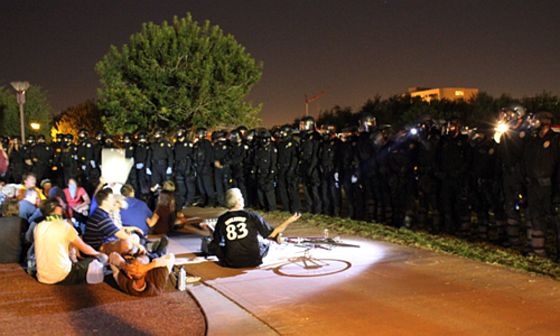
Consider taking some time to send a letter/postcard to Branson Brockman, who is serving 30 days in the county's Tent City for allegedly assaulting a Phoenix police officer at the First Friday anti-ALEC demo, the final day of action during the the annual ALEC meeting held in Phoenixlast December. Branson was charged with walloping a cop with a skateboard after the cop grabbed ahold of some other person dragging a barricade into the street. The cop who attacked the unpermitted street march was one of the usual bike cops patrolling the monthly First Friday in downtown, the thirty officers who swarmed the area in the seconds after the lone officer attacked the march were laying in wait. Directed by the legendary asshole Phoenix cop Mark Schweikert, the dozens of officers flooded that stretch of Roosevelt, with the first cops out of their cars deploying liberal amounts of pepper spray.
As people scattered from the pepper spray, the Phoenix police deployed snatch squads of officers across the arts district, eventually arresting Branson and charging him with assault on an officer. Branson is due to be released by the 6th of October, in the meantime his friends, comrades, and bandmates are putting the word out to send some love his way. All the relavent info is below, along with the original call out from his friends.
ACAB/FTP!
Here's the info on how to write my homie/bass
player of my band, and all around badass motherfucker Branson who is
doing 30 days in Tent City for "Assaulting An Officer" with a skateboard
at some Phx anti-ALEC demo.
Little destroyer scurried away
after the scuffle with them wrangling the shirt off of his back, and
when he was caught in some bourgeois art gallery, they threw him in the
car and
THEN pepper sprayed him.
Send him some appreciation and shit. Anything helps.
Send METERED (means postage paid, NO STAMPS) POSTCARDS ONLY in BLUE OR
BLACK INK ONLY. You can also order him books off of Amazon, and you
should. Tent City Branson Brockman P901194 2939 W. Durango st Phoenix AZ 85009 (Then, on the Then on the bottom right corner, write:) 41 house 19 pod N cell 1 bed 3
A campaign of political repression is under way against anarchist and indigenous projects in Arizona, spearheaded by the Arizona Counter Terrorism Information Center and the Tempe Police Department Homeland Defense Unit. The Tempe police department’s anti-terror division preemptively
shut down the Protect the Peaks solidarity benefit show that was planned for Friday night, using the threat of a fire code violation to ensure that the venue would have to cancel the event. The Homeland Defense Unit acted on an alert they received from Arizona's main counter terrorism information gathering hub, also known as a fusion center, that a benefit show to raise money for the struggle to save the San Francisco Peaks was scheduled to take place in Tempe on Friday night.
The benefit show organizers had contacted a DIY venue/space run out of a warehouse in west Tempe, a well regarded space that has hosted a number of shows over the last
year, often receiving coverage in the Phoenix New Times and other
media. It is a labor of love for the person who runs it, who has a
full time job in addition to hosting the occasional show at the venue. The Protect the Peaks benefit show would have been the first political show to have been hosted at the space, it also put the venue on the radar of Arizona's counter terrorism fusion center.
On Thursday, September 6th the venue operator received an unannounced visit at his workplace from
an officer assigned to the city’s Homeland Defense Unit.The officer, Detective Derek Pittam, threatened to have the venue shut down for fire code violations if the
Protect the Peaks show wasn’t canceled immediately.Detective
Pittam informed the person that he was aware that the venue
regularly held shows and made it clear that under no circumstances would this benefit show be held at the venue. The venue's future is now up in the air due
to the threats of the Homeland Defense Unit, even though Detective
Pittam admitted to the venue operator that he was aware that there had
never been one call to police or reports of any illegal activity at that
location.
Detective Derek Pittam of the Tempe Police Homeland Defense Unit
At least one officer working in the Homeland Defense Unit spent last week locating the DIY venue, identifying the operator of the venue, finding his cell phone number, and where he works his full time job so that he could be harassed by Detective Pittam. They had also decided that their anti-terror unit was going to manufacture a fire code violation as pretext to shut down the show, unless the Homeland Defense unit is regularly enforcing code violations in Tempe.
I've learned that during the workplace visit, Pittam specifically identified support for the "Save the Peaks" as a concern for the authorities. Throughout his visit Detective Pittam made it clear, the issue is with the benefit show not the venue, however the venue would face the consequences for allowing a radical, anarchist, and indigenous themed event.
I've also learned that the venue operator was again contacted on his cell phone Friday night by a Tempe police commander who wanted the venue's permission as the primary property manager to arrest individuals (who may not even know the show was canceled) for trespass on site. The venue operator declined, and was then asked by the commander for the landlord's phone number, which he also declined to provide to the Tempe Police. A friend who drove by the venue Friday evening observed one marked police vehicle on the property where the venue was located, and another vehicle parked near by.
In the short time since word got around about the show being canceled, many people involved with various projects are shocked and outraged over this show of state repression. I was able to chat with Alex Soto, a Tohono O'odham MC from the hip hop group Shining Soul, one of the acts that was scheduled to perform on Friday. In addition to his music, Alex has organized against border militarization on his traditional land, the Tohono O'odham nation, a land divided by the US/Mexico border wall and militarized by the border patrol.
He had this to say about the cancelling of the show:
"The show itself is an example of the solidarity between indigenous people, the Diné and O'odham, and anarchist people who are supportive,
it also means that the authorities are afraid of us acting in collaboration, collectively. They’re
afraid of all of us coming together, it’s not new, it’s happened before at past demonstrations where we’re targeted, we’re marked for oppression, mainly
just by being ourselves and being there.
It doesn't matter to them whether it's an action or protest, or in this case with our
talents and our musical gifts to bring people together, the
state doesn’t respect that. This act of repression by the police further motivates myself and everyone
else involved to push forward and to have another benefit or show, because we
know this will be effective, and all we’re doing now is picking up mics and
guitars.
In addition, I’d like to express that as a Tohono O'odham person, I have solidarity with other indigenous people in this area, in this case it’s Diné people and the other 12 tribes that hold the San Francisco Peaks as a sacred site. This act by Tempe police, and all the entities involved is an attack on who I am and who we are
as indigenous people, it verifies to me that we’re doing our role, in this case by
standing in solidarity with the peaks, or when we oppose the loop 202 freeway
or oppose the border and militarization because this is what solidarity and
healthy communities look like. When we stand together, fight alongside each other, or in this case sing together to defend who we are and what we hold
sacred, then fuck the Tempe PD, fuck Phoenix PD,
fuck DPS, and any entity that tries to stop this energy that’s building
here in Arizona."
When the authorities act to intimidate or threaten dissident voices and movements, it causes a chilling effect,
in this case the Tempe police were willing to let a fire inspector poke
around in the venue until any little violation could be found that would shut the show down. We also know that they wanted to arrest anyone who came to the property expecting to see a show. This is a direct attack on the ability of
people to freely gather, communicate, and organize without the potential of arrest or physical injury by police, in addition to the potential for serious financial problems for the venue operator.
We in PCWC first began running into JT during the early parts of the immigration movement, around 2005, before there was a formal PCWC, really. As many probably know, JT had a rather chaotic political career, but in those days he was allied with State Senator Russell Pearce and local car dealer Rusty Childress. Even then political violence had already begun to rear its ugly head in the anti-immigrant scene. It might be valuable to review some of what had happened in Arizona in the several years preceding JT's final bloody rampage, and it certainly would be worthwhile to consider the ways that anarchists in Phoenix and Arizona organized against him, his politics and his political allies (and enemies) over the last half decade or more. While liberals advocated for his free speech, anarchists opposed him every step of the way. The analysis in this piece reflects our experiences as direct participants and organizers.
RACIST VIOLENCE IN ARIZONA, 2005-2009
JT Ready himself made headlines in March of 2006 when he followed a group of Latino men riding in a truck into a cul-de-sac and opened fire on a passerby, Efrain Martinez, who JT claimed had shot at him. In an indication of what was to be many years of apparent Mesa police protection, the cops took JT at his word and arrested Martinez. After surviving JT's attempt to kill him, Efrain Martinez languished in detention for 42 days before being deported to Mexico for giving a false name to police. Funny thing: a week after being deported, Martinez was back in the country. We taunted JT at his next rally with "We are all Efrain Martinez" signs, among other things.
A recent investigation by the local New Times magazine has revealed that the Mesa police weren't terribly interested in watching white racist militants, even when they were classified as gang members or opening fire on passersby, fueling long-time speculation that JT was at least an informant for one or more police or Federal agencies. Of course, that wouldn't be unusual in the far right scene.
Taunting JT at one of the USA rallies
Before that, in April 2005, Patrick Haab, a white Iraq War vet, held seven Mexican migrants at gunpoint at a rest stop outside Phoenix. Claiming they were in the country illegally, Haab blocked off their vehicle with his own and detained them until the sheriffs showed up, upon which -- and much to his surprise -- he was promptly arrested. Arizona at the time was in the grips of the Minuteman invasion of the border region and the case set off a public outcry in his defense.
Interestingly, it was the notoriously racist Maricopa County Sheriff Joe Arpaio who defended Haab's arrest and rejected his "unlawful" detention of the migrants. In what sounds like an ironic statement now, Arpaio told the Arizona Republic, "Even law enforcement has to have probable cause before taking people out of their cars and telling them to lie on the ground... He threatened to kill them. He did not have the right to do what he did. How did he know they were illegal aliens?" However, Haab received an outpouring of support, including offers of bail money, places to stay and other aid. Remarking on the outpouring, he said, "I really appreciate it. It makes me feel better about this country." He said that he believed the men he detained mistook him for a Border Patrol agent. Several days later Maricopa County Attorney Andrew Thomas dropped all charges against Haab, giving a green light to white reactionaries that such actions would not meet resistance from local government, essentially putting a state sanction on them.
While Haab was a lone wolf, operating on his own to enforce the color line in Arizona, other militia members in Arizona besides JT have shown themselves equally prone to violence. In 2009, for example, Shawna Forde (an extremist, even by Minuteman standards, who reportedly even demanded that members swear off Mexican food) and two men who had split from the Minutemen Civil Defense Corp to form their own splinter group, the Minutemen American Defense or M.A.D., staged a home invasion on the home of the Flores-Gonzalez family in Arivaca, a town near the Mexican border. Sporting military uniforms and claiming to be Border Patrol, they demanded entry to the home in order to check for fugitives.
Raul "Junior" Flores and Brisenia Flores, killed
by the Minuteman American Defense
Once inside, they opened fire when their credentials were questioned, killing two and wounding one. Gina Flores, despite being shot twice in the face, managed to call the police and to return fire, wounding one of the attackers, who all fled. The militia had hoped to steal drugs and cash from the house in order to fund further vigilante activities at the border, and initially the DES itself expressed suspicion of the Flores-Gonzalez family, even though no drugs were found. It turned out all the victims were natural born citizens. Gina Gonzalez filed a lawsuit against the FBI alleging that they were warned in advance of the attack by an informant, who passed on a detailed map of the proposed target and did nothing.
Given the national dialog about what's wrong with Arizona, I want to point out a general trend not just of violence, but of
people from out of state bringing racist violence to Arizona. JT
himself was not born in Arizona, and only moved here after he was kicked
out of the Marines. Indeed, he claimed that he used to do vigilante
patrols in California while stationed there. Shawna Forde also came from out of state, the Northwest. Likewise, Patrick Haab had only just
arrived in Arizona when he assumed the role of self-appointed Border
enforcer at that rest stop. Of Arizona's top three main anti-immigrant politicians, former State Senate President Russell Pearce, Maricopa County Sheriff Joe Arpaio and former Maricopa County Attorney Andrew Thomas, only Pearce was born and grew up in the Copper State.
In the years leading up to the racist backlash against migration, the population of Arizona surged, essentially doubling between 1986 and 2006,
when the anti-immigrant direct action movement began to pop off.
Perhaps surprisingly, a large part of that population explosion came not
from Mexico, but from other states, notably including California, which had
already experienced an anti-immigrant reaction. Census reports put the Golden State as the largest contributor
but with pretty much every state contributing large numbers. A lot of
the blame that gets laid at Arizona's doorstep should at least get shared with the white flight colonists from California and the
blue-haired snow birds from the rest of the country who set down roots in their old age and consistently return Joe and
his ilk to office. It's no coincidence that Joe's strongest base of
support lies in Sun City and Sun City West, planned retirement
communities in northwest of the Valley, where out of state license plates are at
least as common as those of Arizona.
I think this is telling. It's not that Arizona was ever a paragon
of racial harmony, but for a long time Arizonans took a relatively open
border for granted, and the regular coming and going of migrant workers
and indigenous peoples was not considered terribly controversial.
Indeed, the O'odham in Southern Arizona until recently crossed back and forth without need identification or a formal border patrol checkpoint. The disgusting irony of white newcomers forcing original inhabitants to register themselves in order to practice their traditions of free movement deserves far more attention than it gets. Likewise the easy access to Mexican beaches and under 21 drinking defined life for many people in the hot Arizona summers and college spring breaks. Indeed, despite semi-regular pogroms, like Operation Wetback,
which served to discipline and terrorize migrant populations, in
general the Arizona economy and way of life depended on the free movement back and forth
of people.
Another important point: the height of the
anti-immigrant movement came in boom times, before the economic crisis.
Further, Arizona continues to rank among the top retirement destinations in the country. When the white reaction began, housing values were still skyrocketing, the credit cards were still passing out easy money and unemployment was low. So, for white people, especially those who bring their racism with them
from other states and are unfamiliar with the routines of life in
Arizona, white supremacy is their natural class analysis. It is their default setting. It isn't
their fall back position in bad times, it is their first resort all the
time.
Thus, by the time JT Ready began to make independent moves on the scene in a
major way, the stage was already set for anti-immigrant political opportunists
and militants of all stripes, with an ample population now composed of
relatively recent xenophobic transplants from other states primed to
listen. The Minutemen set up their lawn chair encampments on the
border, and in a case of history repeating, cradled their AR-15s in their aging hands and peered south into the
desert with their bifocals and binoculars on the search for brown-skinned folks heading north. However, despite his present association with the racist militia movement, Minuteman Civil Defense Corp leaders eventually turned JT away for being too extreme. This is Arizona, after all.
JT READY, POLITICS AND THE ANARCHISTS
During this period of time, JT was also working in conjunction with other right wing politicians and organizers on a variety of anti-immigrant initiatives, including an earlier version of a SB1070-style law that would have applied in Maricopa County. In those days, JT was busy organizing and intervening with various far right groups, from the infamous Minutemen movement and its spin-offs to a series of protests organized in front of the Mexican Consulate by Rusty Childress' group, United For A Sovereign America, which aimed at bolstering support for various anti-immigrant initiatives.
Confronting a United for a Sovereign America demonstration.
One time, we got a tip off from a journalist at one of the Spanish language stations that JT and his crew were planning to get some footage of the flag being raised at the consulate and of the morning queues for the various services that the consulate provided to Mexicans. Lines at the consulate were routine, as they provided many services for Mexicans in the city. We dragged our asses out of bed early and beat them there. We approached the folks waiting in line for the consulate to open and told them about what was happening and they moved the line to a part of the property where they couldn't be seen. Then when the Nativist film crew arrived with JT in tow, sweating and awkwardly stuffed into a cheap suit, there was a minor scuffle over the filming of the flag-raising, with people blocking off their cameras. This kind of thing was common back then, and we would run into him at immigration rallies and regularly disrupt his events. Whenever we'd show up in our masks and march right into the middle of their protest, all hell would break loose, driving them off message and into a fit of cursing and angry demands that we remove our masks. As a result, the media reported these protests as contentious and controversial. It worked every time.
Disrupting JT Ready's press conference
Around the same time, JT was hanging out with other movers and shakers in Arizona right wing politics, including Pearce, the man who ordained him as an elder into the powerful Mormon Church and who JT described as his mentor. JT would claim that during that time the two shared Mexican jokes on Pearce's porch. In late 2006 it came out that JT, who was then running for city council, had been issued a Bad Conduct Discharge on his unscheduled exit from the Army. When it came out, he had been slated to lead the local Veteran's Day parade in Mesa as Master of Ceremonies, which caused some political problems, leading the veterans group that organized it to dump him. Not long after that, the New Times outed JT Ready as a Nazi when his profile was discovered on the racist dating site New Saxon.
Heading to disrupt one USA's protests at the Mexican Consulate
For a while after that, we didn't have many encounters with him, we'd see him at the massive pro-immigrant demonstrations among the anti-immigrant crowd, protected by a line of riot cops, and occasionally dodging a rock or bottle thrown their way. The immigration struggle had moved into the political sphere, with one racist ballot proposition after another passing with super-majorities each election and the border militias fracturing amidst financial scandal, personalities conflict, territoriality, and demands by some for more militant actions. JT Ready, for example, called for mining the border. In the search that followed his death, police reported finding grenades in the house. This ought to give pause to anyone who remembers that the 2011 #Antisec hack of Arizona law enforcement revealed that explosives had been found near a migrant route and that rogue marines patrolled the region. As with tips to the FBI and Mesa PD before this, these warnings, too, were essentially ignored by local, state and national cops.
State Senator, later Senate President, Russell Pearce
endorses JT Ready for Mesa City Council
Around that same time the Tea Party was born, providing an inland sea for all sorts of racists to swim in. Meanwhile, we in PCWC moved forward in two main directions: trying to come up with innovative strategies as an active minority to fracture the base of the anti-immigrant movement and towards working with Native comrades around border militarization and the preservation of traditional travel rights on the Tohono O'odham reservation. In addition, we sought to highlight the continuity between extreme elements in the movement and the mainstream politicos in the Tea Party and Republican ruling class in Arizona. From this combination our demand for free movement and freedom from dislocation was born, which we would deploy later both within the pro-migrant left, as well as against its opposition in the right wing movement generally and specifically against JT Ready when he joined the NSM and marched on the capitol.
JT READY, THE NSM AND THE ANARCHISTS
At some point JT Ready joined the NSM. It's not clear when exactly, but once he was outed as a white supremacist he seemed to jump headlong into the public role. In 2007 he participated in an NSM rally in Omaha. For the most part, JT's strategy seemed to be two-fold. On one hand he was very active in creating media spectacle and confrontational situations with his small group of white comrades. These involved varying levels of provocation, from his appearances counter-protesting fully armed and decked out military garb at pro-migrant events and Occupy Phoenix, to his two marches with the NSM in Phoenix.
On the other hand, JT formed his own border vigilante organization, which did routine "patrols" in the desert looking for migrants to turn over to the border patrol. JT always claimed that his militia was not a racist endeavor and that all were welcome, but its membership included many NSM cadre. However, it must be said that dupes and patriots are not confined to just the white population, unfortunately. PCWC, being a city-based group, engaged JT on that terrain, but with the objective of forcing him and the NSM to abandon their public activities.
JT's smiling face, out of uniform, but flanked by NSM boneheads.
Challenging the NSM and JT's Nazi road show
The most spectacular clashes between anarchists and JT Ready and the NSM happened in the streets during their two attempted marches through downtown. But these were hardly the only ones. A few months before the first Inglorious Basterds Bloc, anarchists disrupted the book tour of notorious racist David Irving, which had been organized in secret (or so they thought) and which JT Ready and other NSM members attended. Anarchists got the tip off about the tour and then stormed the secret location, disrupting the place, slashing at least one Nazi's tires and jamming the phones at the diner where it took place with threats of boycott and publicity, etc.
Not long after that, word arrived that the NSM would attempt a march in Phoenix to the state capitol. At the time we were heavily involved in intervening in the right wing libertarian movement around their fight against speed cameras and, to a lesser extent, internal Border Patrol checkpoints in Southern Arizona. There was a vigorous direct action and political movement against both at the time, with attacks on cameras coming with frequent regularity, and with white libertarians engaging in civil disobedience at border checkpoints. We were trying to get the libertarian right in this state to reconcile its internal contradictions one way or the other. At the time they were engaging in a lot of hypocritical support for border controls and attacks on migrants while also opposing things like FEMA camps, REAL ID and freeway cameras. We sensed potential.
Many of the libertarians in state government were voting on both sides of those issues, taking progressive positions against REAL ID at the same time they were endorsing attacks on migrants and defending programs like e-Verify. Our objective when it came to those interventions was to help push as many people as we could in that movement off the fence and to choose one side or the other -- to reconcile their contradictory assertions on movement, which we saw as hinging on their defense of the exclusionary politics and privileges of whiteness. This contradiction, it seemed to us, could only be worked out one of two ways: either support free movement for all, or defend white supremacy. There was no middle ground.
JT's NSM boneheads gave us a chance to try to push those right wing libertarians that we have been engaging with into action around the issue of movement, migration and white supremacy. We wanted to split the right wing along what we saw as a very obvious fracture, and in keeping with our fanatical politics, we then sought to deploy this friends/enemies dynamic in order to mobilize people. As we said to the libertarians at the time,"You see yourselves as protesting this country's turn towards fascism. We sympathize with this argument and are ourselves no fans of the Obama administration. However, we want to point out that unlike some of your past protests, the NSM rally offers you the perfect opportunity to make known your opposition to fascism in an unambiguous way."
So, we tailored our imagery and message to this. We chose the Inglourious Basterds Bloc name for a few reasons. Aside from the obvious connection to Nazis and ready to use imagery, it also referenced a really important feature about the movie which we found really entertaining: the idea of an alternate ending -- one we could create that could deviate from the approved narrative. That is, Hitler died in that movie how everyone wished he had in real life, gunned down by the resistance, rather than by his own hand via cowardly cyanide capsule in a Berlin bunker. We chose "Doing it like Grandpa in France of '44" as the slogan and immediately set about addressing ourselves to the libertarian right wing, as well as the white working class generally.
Also important, we carried firearms openly against the NSM, not just for self-defense, or so that the NSM would know we were armed, but also informed by the memory of having seen pacifist anti-war liberals denounce armed anti-war libertarians at protests during the early days of that movement in Arizona. We wanted to differentiate ourselves from the liberals in the eyes of both groups. We knew the significance that would have. And the right wing libertarians responded. Quite a lot of them came out to the action.
Meanwhile, liberal leaders denounced it, something that wasn't new, and would continue over the course of the year at various other actions. In fact, one of the strengths of both NSM actions, but the second one in particular, was that it subverted the dominant message from the mainstream migrant movement leadership. Namely the focus on Sheriff Joe as the epitome of all evil, while giving the Phoenix PD a pass (even organizing with them around marches and security). This despite the fact that the PPD was actually more active in deportations than the Maricopa County Sheriffs Department and that one of the two police unions that represents Phoenix cops took an actively anti-immigrant position, including supporting SB1070. When the PPD stands on the same skirmish lines with Nazis, shields lined up together, gives marching orders to the fascists and even consoles poor JT Ready at the end of his failed march, it's difficult to maintain the necessary liberal political illusion that one police force is preferential to another. This wasn't just some classic anti-fascist common front bullshit. We used the NSM as a tool to deploy attacks against the liberals as well as the right.
That confrontation with the NSM was exciting and invigoration, and I think it was broadly interpreted a success.
It got us mobilized and excited, and built the energy and comradeship
needed in Phoenix for our next big action in January. Interestingly,
the week after the public embarrassment of the November 7th rally at the
capitol, JT Ready showed up at a Tea Party anti-immigration rally
at the same location, accompanied by another NSM member. The
organizers did all they could to separate themselves from the NSM, who
were waving a confederate flag. But when JT unfurled a tapestry
featuring his hero Adolph Hitler, violence broke out, with one right winger physically
attacking JT and without any sense of irony denouncing him and his racism. The movement had begun to split along three fronts,
just as we had hoped. Later, this split would be finalized by an uprising from the Chamber of Commerce
who, with the help of the libertarians in the
legislature and on talk radio, blocked the passage of a whole swath of anti-immigrant legislation
that was following on the heels of SB1070. The anti-immigrant backlash was not defeated, but had received a major blow.
Interestingly, after the IB1, we and other anarchists followed up on those interventions with articles and actions that kept pressure on those groups, culminating with the Diné, O'odham, anarchist/anti-authoritarian bloc
at the anti-Arpaio rally January 16th, 2010, which we hoped at the time would point
towards a new kind of solidarity organized around a different
conversation about movement and borders in Arizona.
Diné, O'odham, anarchist/anti-authoritarian bloc
The NSM continued its organizing, focusing increasingly on its militia work in Arizona, but vowed to return the next year, intent on taking the streets. In November of 2010 they made good on that threat, registering for a permit for a Saturday afternoon march to the Federal courthouse. The permit expired at three and we hoped to keep them from their goal until it did. For a second time, then, the forces that had built the DO@ Bloc came together in the streets, determined to stop the fash and to show a united resistance to Nazis. Once again, JT Ready, now claiming to have left the NSM, showed up in support, marching with them. And we called for a sequel of our successful bloc from the previous year.
The results of that day have been well-documented. Once scouts found the march, the bloc and other militants deployed themselves in the street between the Nazis (who were surrounded by police) and their objecting, setting up barricades. Police held the Nazis back for over an hour, as the clock ticked on their permit, as rocks, smoke bombs and various other projectiles rained down on them, infuriating the brownshirts, who demanded to be allowed to march. The permit expired, but the cops extended it in solidarity, and used force to try to clear the street. A clash and then a running battle followed, with liberal amounts of pepper spray deployed by the police, eventually forcing the opposition back far enough to sneak the NSM into a side gate and then into the safety of the fenced off (and empty) "free speech zone".
Some stuck around and mocked them, but for the most part at this point they rattled off to no one, having set up in the far corner of the plaza and flanked on two sides by giant glass walls that made their chants mostly unintelligible. The whole strategy of the NSM was to play the victim card, hoping to insight white sympathy and to get that trumpeted out through the mainstream media. The NSM knows full well that the press, worshiping its so-called "objectivity", facilitates the opening of space for white supremacists to speak (witness the repeated mislabeling of the NSM as a "white civil rights organization"). The Nazis count on this debate about free speech and the spectacle of resistance to combine in their favor. But that was entirely subverted that day, and their message was completely lost in the media. Once again, liberals who had either opposed directly action against the fascists in the streets, or who had misunderstood the question of anti-fascism as one of free speech rather than self-defense, were left looking useless and reactionary. After the defeat, the NSM vowed to march again, but they never did.
Interestingly enough, a year later, when Occupy Phoenix was happening, and paranoid liberals were in full freakout mode about anarchists and black blocs ruining their non-violent occupation of a public square downtown, we would learn that Phoenix PD were afraid to raid the camp, citing over and over the likelihood that anarchists would riot as the reason. The irony of a bunch of nonviolent peaceniks being protected from police violence in their occupation by the violence of the very group they feared most, was delightful to say the least.
JT Ready's Provocations
JT was known for his solo and small group provocations as well. Not only did he like to play with contradictions and messaging, he also liked to try to intervene within the larger right wing milieu in order to create a sense of continuity between his own white supremacist politics and that of the anti-immigrant right in general. The case already mentioned above in which he appeared at a Tea Party protest was one such time, but even more frequently JT would show up heavily armed, sporting his black NSM outfit or camo militia getup. JT showed up to various politicians' events, even endorsing them, as he did with Joe Arpaio and, famously, with candidate for Maricopa County Attorney Bill Montgomery. When JT and his NSM cronies crashed one of Montgomery's press conferences, asserting their support for "Arpaio's candidate for County Attorney", the candidate vehemently denied any association, politically or otherwise. However Sheriff Joe himself never ran away from them. On several occasions it seemed to be one of JT's primary objectives to associate himself and his NSM with the infamously anti-immigrant Sheriff Joe.
One of JT's NSM cronies, Thomas Coletto, aka "Vito Lombardi",
poses with Joe at a Nativist counter-protest.
Perhaps JT's most famous intervention of this sort, though, happened on the first day of Occupy Phoenix, before the mass arrests and the original failed occupation of Margaret T. Hance Park. By this time JT had been organizing his border militia for a year or so and from our perspective, it seemed to be his main project now. A couple hours into the day, we got reports that heavily armed men, probably fascists, had shown up. We ran over to check it out and found JT, with his big head characteristically squeezed into that tiny little helmet, standing on the edge of the park along with a small coterie of other militia members. Though JT (and various pea-brained right wingers on the interwebs) asserted that he and his goon squad had shown up to assure the safety of the event, it was clear that he was engaged in another one of his provocations, looking for a little media attention for his crew and his cause.
Anarchists, having dealt with JT by this time for the better part of a decade, realized immediately what was going on, and began calling him out to the curious crowd surrounding him. Several families, of the type who almost assuredly would later demand strict adherence to principles of nonviolence in the coming occupation, were captivated by the "cool soldier guys" and happily posed their children with them. It was the same kind of privileged analysis of violence that later led to the fights in Occupy Phoenix over police and "the 99%". As we reminded onlookers and photo-takers that these camo-kooks were Nazis, it caused all sorts of contradictions within the emerging occupy movement to emerge.
Some, predictably, asserted that free speech and the respect thereof ought to define the moment. Others, on hearing the NSM were National Socialists, hemmed and hawed, pontificating about their affinity for socialism. But most tellingly, many liberals got upset at the commotion and started calling out anarchists and anti-fascists for being violent -- that is, yelling. Which is to say, pointing out the presence of armed right wing reactionaries at the protest. This hearkened back to earlier days when anarchists were denounced by liberals when we tried to isolate and drive out National Alliance chumps from an early anti-war rally.
This was our last interaction with JT Ready. By the time he offed himself a few months later, he had quit the NSM, at least publicly, and he no longer engaged in politics in the city, moving instead and once again towards the border with his militia. Though JT proclaimed his group to be open to people of all races and denied it was a front group for the NSM, in October of 2011 PCWC received correspondence from a former member, purged immediately following the Occupy Phoenix photo stunt, that asserted otherwise. "As for the US Border Guard, JT's group the core group of about 3 to 5 that actually go out on patrols are either current or former NSM (sic)," the purged member claimed. The person went on to describe the non-core members as a range of "Patriots, White Nationalists... and just regular pissed off Americans. (sic)" Classic front group.
In the end, JT's dreams of mobilizing masses of people behind his personality and his white supremacist politics failed. He was denied the streets as a vehicle for mass mobilization and very few would follow him out to the desert either. As the former USBG member pointed out, JT was not easy to get along with in person: "JT kicked me out of the USBG on saturday after the rally because I would not bend to his commands... I am my own person, I have my own voice, JT speeks for JT not for me. (sic)" JT couldn't even manage his own small crew.
WAS JT READY A FANATIC?
Joel Olson succinctly defined fanaticism in the political sphere as, "the unconventional, extraordinary political mobilization of the refusal to compromise." In addition, there are several criteria. As summed up in an AK Press interview, fanaticism "1) refuses to compromise on basic principles; 2) divides the world into friends and enemies; 3) puts pressure on the moderate middle; 4) tries to build a constituency; 5) engages in legal and illegal direct action; and 6) seeks to build a new cultural hegemony or common sense."
JT and the NSM, all in costume.
Right off the bat, when we look at JT's career, we see not an attempt to refuse to compromise, but in fact a desire to glom onto broader movements. He was not at war with the middle, nor did he seek to build a new hegemony. As the super-majorities that backed one anti-immigrant measure after another at the polls show, by the time he got active such politics dominated the middle in Arizona. He never attacked the reactionary mainstream current that dominated politics here. JT Ready was like a pathetic, "Me, too!" at the end of every rally, march or protest. JT sought to attract people to him and his various organizations not by forcing the general racist anti-immigrant current to choose one side or another, but by showing them that there was little to no difference between the politics of the middle and the politics of the NSM. "May as well join the NSM," he seemed to be saying. He wanted a re-branding, not a shift in taste.
While JT and his various projects did engage in some direct action, they never built a constituency. Indeed, when the pressure was on the mainstream racist movement in Arizona, they opted to distance themselves from him. The most he was every able to get out in the street at one time was a few dozen, and that with all of the NSM's resources backing him, touring the country in their unreliable American cars. Indeed, even within his own militia, essentially an NSM front, he couldn't mobilize more than a handful, and had to keep the group open to all political persuasions on the reactionary right.
AND JUST LIKE THAT... HE'S GONE!
We still don't know what finally set JT off that day. Some on the reactionary extreme claim JT didn't commit the murders at all, and that he was a the target of a cartel hit instead, a response to the alleged effectiveness of his anti-migrant, anti-narco patrols. But he's gone now... just a bloody mess and then no longer a player in Arizona politics. JT's militia claims it will continue patrols, but there is no reason to believe anyone can fill JT's goosestepping boots. In the aftermath of the massacre, the Arizona legislature failed to approve a measure designed to legalize and institutionalize the many militias that patrol the border in search of migrants. This incorporation alleged to sanitize them by screening them for militants and racists, as if such a task were possible. It's just as likely that they would have just been folded into state power directly. Militia leaders claim this defeat has only invigorated them. Will the current cleft between state and reactionary direct action persist, or is it only temporary? Is this JT Ready's legacy? The recent electoral defeat of former JT chum Senate President Pearce through recall and the rise of more "moderate" right wing voice of capital leaves the question open for now.
Would state legitimation have disempowered the militia movement, or would it have further invigorated it? Time will tell whether they will wither on the vine without mainstream support. Of course, such a breach may be temporary, and we know that the anti-immigrant backlash started in good economic times and there are now far less people able to push back should a resurgence take place. Meanwhile, the forces of reaction, legal or otherwise, continue to build paramilitary experience out in the desert, even if they have been for now opted out of the cities. Times now are much worse, and with political alienation on the rise and capitalism's continued failure to deliver for large portions of the population, it's anyone's guess whether the various right wing capitalist forces of moderation will prevail over demand from below for a state defense of whiteness and privilege.
In the final days of his life, JT posted his usual racist, anti-Semitic, paranoid ravings to various message boards and the facebook page for his campaign for sheriff. He denounced his usual enemies list, including the anarchists. “Have [the anarchists] not yet figured out that they are... just tools in the same globalist tyranny toolbox?” he asked. JT, at the end, still did not understand the anarchists. But we understood him. Even though it had been several months since the anarchists and JT Ready had clashed, he couldn't forget us.
For the better part of a decade, the anarchists had been his only consistent organized opposition. While liberals and moderates couldn't figure out how to respond to him, trapped by their own tepid and defeatist politics, the anarchists were always on his tail, out-organizing him and out-thinking him, determined to win. The only time the liberals engaged in the question was when they actively attacked anarchists, as when they assisted the police attack on the DO@ Bloc. Interestingly, that day one of the objectives of the bloc was to confront the NSM and other white reactionaries, who had announced they planned to march to confront the procession. We didn't buy this nonsense that ignoring fascists, especially in the political climate that is Arizona today, causes them to fade away. Nazis do not disappear when you don't look at them. Challenging them in the streets is not enough -- creative resistance must be in line with particular political circumstances -- but direct action is a necessary component. And, when one knows one's enemy, like we knew JT, it is possible to beat him. JT Ready: loser.
Below we have published an interesting email that came our way concerning tomorrow's expropriation of the unused and now vacant and bulldozed land where the Gentle Strength Co-op once stood. A few things are worth noting.
First, the cops are trying to divide the community. They use classic red-baiting and anarchist fear-mongering tactics to attempt to convince locals and business owners to support a police assault on people who think that fallow land should not remain so merely because some Canadian land speculator wants to keep some property unused. They don't say it, but it is likely that they continue to be threatened by the level of support that local anarchists have developed in Tempe, perhaps most visibly displayed during 2010's anti-SB1070 organizing, neighborhood assemblies, march and protests. Hundreds came out then, unafraid of the fact that anarchists were organizing. Second, we can boil down the cops' argument to this: "we don't want to look bad attacking people who want to use unused land (after all, we are the defenders of property first and foremost), so we want to make sure that only people who will look bad on camera -- anarchists -- are present for the police attack". You know what, cops? There's an easy way to avoid looking bad attacking people trying to use empty corporate land for community purposes: don't attack them. I know that's hard for cops to do, being that they are a violent bunch of thugs. But, who are the defenders of community? The "anarchists" who want to create a commons or the cops who attack the community in defense of corporate property?
A few other interesting points: this property is controlled and left unused by the same company that owns Zuccotti Park. Also, cops have been visiting local businesses to get them to oppose the occupation. Another is that Tempe PD bike cops, which Officer Pittam used to be part of, got training from the Eugene PD after the first Tempe May Day protest, which they deployed the following year in brutal fashion, as is their general tendency. This was facilitated by the nationalization of local policing that has generally prevailed under the post-9/11 regime. And the TPD has tried this scare-mongering before. Note that Pittam himself is now a part of the "Homeland Defense Unit". What "homeland"? Unused corporate property homeland? What they want is for us to leave that property empty until some out of town land-speculating company can finally make a profit.
For the total expropriation of the capitalist class. Also, Pittam needs an editor.
Hello,
Derek Pittam with the Tempe Police Department asked that I share the following
information with you as your neighborhoods are closest in proximity to the
area. Please contact Derek at Derek_pittam@tempe.gov or I with any questions.
Thanks,
Shauna
I write this to you because as you know my career has led me to have a close
relationship with the residents and businesses in and about the downtown Tempe area.
In fact, several years ago, the Maple Ash community honored me with a
“Friend of Community” award. Community members have always known that I
am aggressively proactive on issues of crime prevention. This is no
different, and I am very concerned that the planners of this event have not
disclosed important information in their quest to gain the support of local
residents and businesses.
I know the flyer (above) looks and sounds harmless right? Well
anarchists looked like this (photo below) the last time they planned an event
surrounding “May Day” in downtown Tempe.
Now I know that some may see the photo and then look at the flyer above to
find no correlation. One might think that law enforcement is even taking a
“cheap shot” because after all this event will be garden building…right?…it’s
green…it’s local…it’s hip…it’s taking a vacant brown field and making it
beautiful…why would the police be concerned? Well despite the nice flyers
and excellent planning to get local residents and businesses to show support
and even commit to participation, the planners of this event forgot to do
something… or maybe they did not forget.
At the time of writing this email, no planner for this event has contacted a
private property owner or management group of vacant land within the downtown
Tempe area to ask permission to conduct such an event. No planner
of this event has contacted the appropriate city staff to inquire about proper
permitting or permissions needed to do this event. That’s a problem and
that is why I now have concern as it relates to community members and
businesses who would like to participate.
Basically, this activity is known is “guerilla gardening” and is not new. It
has picked up steam with the Occupy movement and is usually done by seizing and
occupying “privately owned” property.
Upon public safety learning that no property owner/management company within
the downtown Tempe community has approved of this planned activity,
subsequently many downtown property responsible persons have signed “Authority
to Arrest” letters. This allows police to arrest for trespassing without
the property’s responsible person having to be present. As a part of our
duty to protect the rights and privileges of *all persons*, the Tempe Police
Department is prepared to enforce certain laws against those who believe their
own personal liberties supersede the liberties of others.
Why do I think the anarchist organizers are planning to knowingly engage in
criminal activity? Well despite pointing
out the above obvious issue, there are other indicators. On
4/23/12, Modern Times Magazine reported the location for this event in an
online article.
Ironically, police had already been working with the local property management
for this specific location outlined in the above article several weeks prior.
The property management confirmed that this planned activity received
no permissions from the owners to take place on this property. In response,
property management subsequently posted “no trespassing” signs on the
property after the signing an “Authority to Arrest” letter. Not long
after, this post appeared of the event’s Facebook page:
In response to your no trespassing signs, we say “if it’s vacant, take
it!"*
The signs on this lot, as of today, have been knocked down and destroyed by
unknown persons.
Not to be overtly accusatory toward the planners of this event as responsible
for this criminal damage, but it is coincidental and only raises my concerns
that anarchist planners for this event could be anticipating conflict.
After all, staging events that force the police to take enforcement
action police is how anarchists hope to erode community support for local
police departments. Anarchists want to
place police in a position so they can say in a clever sound bite, “See we told
you so… the cops are here to protect the interests of the wealthy!”
In actuality, police would provide the exact same enforcement
action to assist any person exercising lawful standing regardless of their of
socio-economic status. These are well known anarchist tactics that I am all too
familiar with.
In conclusion, researching other “guerilla gardening” actions planned by anarchists
in other cities, the goal is to engage in civil disobedience (as seen in Santa
Cruz, CA in December of 2011) . In other words, due to the liability
concerns of property owners surrounding these “un-insured” actions, the
property owners do not have the chance to be supportive of such an event
without certain guarantees from the organizers, therefore with property owner
participation exclusion from the event planning, conflict is evitable with
police and/or property holder.
Where this tactic meets the goals of the anarchist, it may not be in the best
interests of the local law abiding citizen who thought they were merely
showing up for a community building event where a garden or park was being
built.
Again, I send this to you Shauna for informational purposes to forward to anyone
within the community that you feel may be affected by this planned event.
This way, public safety has expressed its concern with the community
and therefore allows each community member or business to make a decision based
on “free agency” as to whether they will participate or support such an event.
Derek Pittam #14555
Detective
Homeland Defense Unit
Tempe Police Department
We'd like to pass along information from the Arizona Antifa Defense about the case of Dane Rossman, a Tucson resident facing charges from the anti-nazi demonstration in Phoenix back in 2010. With the wounds from the passing of anti-immigrant bill SB 1070 still fresh, 300 people took to the streets back in November of 2010 to drive the white supremacists and fascists from the National Socialist Movement from the streets of Phoenix.
Fierce clashes played out that day, as anarchists and anti-fascists fought both cop and nazi, as the police used liberal amounts of pepper spray attempting to clear the streets. Only two people were arrested that day by Phoenix police, we believe the police were desperate to walk away from the fight with an arrest or two given the intensity of the conflict. The cops had been hindered in making more arrests since two of their undercover officers were chased out of the anti-NSM meeting place, and three other undercover cops were identified as the demonstration wound down.
Dane was one of the people snatched and arrested that day, he was subsequently charged with 5 counts of aggravated assault with a deadly weapon/dangerous instrument and 1 count of rioting. His defense team gives a good run down of the events since that day:
Within a month of the action and arrest, Dane went to an arraignment only to find that his charges had been “scratched.” This meant that while the charges were not being actively pursued, they could be brought back up at any time within 7 years, with or without notifying Dane. And so it simmered for the next year or so.
On Sunday, November 20th, 2011, Phoenix police pulled over a car full of out of town folks for allegedly running a stop sign. The officer immediately informed one passenger, Dane Rossman, that he recognized Dane from actions against the NSM.
After loudly mentioning “anarchists” over police radio, several more squad cars arrived, along with at least one undercover officer. Dane was immediately arrested on a warrant for charges brought back by a County Grand Jury in September 2011. No attempt to notify Dane that the charges were back seems to have been made. Word could be heard over police radios that “there’s a guy working on things” that would “really appreciate 8x10s of everyone in the car.” All passengers were subsequently searched, photographed, and asked if they identify as anarchists.
Dane was released after posting $7,500 bail and now faces six counts of aggravated assault and one felony riot.
Dane is currently facing multiple felony charges that could result in a prison sentence of up to 20 years, his supporters are busy raising funds for legal defense, their goal is to raise $8,000 for private legal counsel. His defense committee has raised 1/4 of the total funds needed, and that's where you come in. We all know money is tight these days, and there's no shortage of comrades who are locked up or facing time and need our support, which is why we are asking for you to find those few extra dollars and send them down to Tucson. Anarchists in Arizona are still very active in opposing the growth of the far-right by staying in struggle with immigrant and indigenous communities under attack by the state and racist vigilante groups. Here, the fight against colonialism isn't left to the history books, it's a daily battle.
Donations can be made through the supporters' WePay account and through paypal (donate using the ramshackleglory@gmail.com email as the recipient). The Arizona Antifa Defense can be reached through email at AZAntifa@gmail.com.
The editors of the new book "Queer Ultra Violence: Bash Back! anthology" will be stopping in Phoenix on Monday March 12 to host a discussion on "Queer Resistance in the Age of Austerity." The event kicks off at 7 PM and will be held at the Phoenix Infoshop, located at 1206 E. McKinley in central Phoenix.
A Presentation by Tegan Eanelli and Fray Baroque; editors of "Queer Ultra Violence: Bash Back! Anthology"
Queer Ultra Violence: Bash Back! Anthology published by Ardent Press, is an analytical anthology that chronicles the (non)organization and militant queer tendency known as Bash Back! Although short lived, Bash Back! had an astonishing impact on both radical and queer organizing in the United States. Bash Back! took on gay assimilation, anti-queer violence, the queer radical establishment, and capitalism with a queer struggle that rejected traditional identity politics. The anthology complies essays, interviews, and communiqués to document the new queer tendency spawned bythe Bash Back! years.
As capitalism and the state are thrown into deeper and deeper crisis, queers and all others historically excluded from both formal economies and from the safety net of the nuclear family, will bear the brunt of the age of austerity. Reflecting critically on the past several years of radical queer action and imagination, the editors of Bash Back! Queer Ultraviolence will attempt to navigate queer space and potential in a world torn by crisis. Through this talk, Eanelli and Baroque will present a series of proposals for action and survival, taking as their starting point the position of queer autonomy and queer revolt against the State and Capital. This lecture will theorize queer gangs, self-defense networks, occupations, communes and a praxis of vengeance.
We highly recommend that all interested people attend this event, and if this is the first you're hearing of Bash Back!, you can check out some of the links below to get familiar:
It's in this context that a new series of anti-union bills have been introduced into the legislature. Backed by the generally reactionary far right Goldwater Institute, these laws would remove basic rights of free association and self-defense from Arizona workers. Among the deletions: automatic deductions and collective bargaining rights over pay and benefits. And, unlike other states, such as Wisconsin, where similar legislation has been introduced, in Arizona police and fire departments are not excluded. This comes in the context of an ongoing series of attacks on unions in Arizona.
In Arizona only six percent of workers are unionized, and this skews heavily towards public sector workers. Perhaps not surprisingly, Arizona has one of the lowest percentage of unionized workers in the US, but even that small number is in decline, and last year many workers took the opportunity of the weakening of automatic deduction laws to leave unions that they felt had been poorly representing them, engaging in the classic 'dues strike'. In Arizona, public sector unions have been increasingly seen by their members as functioning not to defend workers, but rather to manage the imposition of austerity in ways that don't rile up the rank and file.
And, of course, in any labor fight, conflicts with the police are never far off. That's what makes these bills so interesting, Given the important role of police as strikebreakers and the enforcers of capital's will, one tends to assume that almost certainly Arizona's right wing ideologues will have to pull a Wisconsin and create exceptions for the police and fire departments. As we have recently seen in the case of Kyrsten Sinema's liberal candidacy for Congress, even so-called progressives in the state depend on the political support of the racist police unions.
Indeed, Synema recently accepted the endorsement of the worst police union in the state (although choosing is hard), the Professional Law Enforcement Association, famous for its vigorous advocacy for Arizona's anti-immigrant SB1070 law and unconscionable defense of Officer Richard Chrisman, who tortured, shot and killed unarmed Danny Rodriguez as well as his dog in his home on October 5, 2010. Famously, PLEA President Mark Spencer not only helped bail Chrisman out with union funds, but also held a fund-raiser bbq for his defense. But such it is with police unions.
Beyond that, if there is to be a fight that breaks out beyond the strict legislative boundaries enforced by the union bureaucracy and leadership, like perhaps a general strike, bosses and government officials will need the police to impose their class objectives. Police, of course, are not just regular members of the working class. They are paid to wage a never-ending war on poor people, folks of color in particular, and to maintain capitalist relations of property, wage labor and commodity production.
I've been reading Kristian Williams excellent book, "Our Enemies in Blue: Police and Power in America" and he goes into quite a bit of depth about the history and reactionary tendencies of police unions that set them apart from and against other unions. What strikes me as particularly relevant in the current situation is his analysis of the different ways that police union demands function versus the demands of other public sector workers. Setting aside wage and benefit bargaining, the demands and lobbying of most public sector workers tends to involve benefits for the broader working class. That is, teachers in the past have very often demand smaller class sizes, increased funding for free breakfast and lunch programs, and other social programs concomitant with their role. For instance, the American Federation of Teachers in recent years joined the boycott of Arizona over SB1070. These sorts of trends bear out amongst most other public sector unions.
However, this is not true when it comes to the police. The results of police union bargaining tend much more strongly in the exact opposite direction. Also, because of the often mutually beneficial relationship between police unions, the police bureaucracy, government and politicians, police negotiations and the lobbying that their organizations engage in tend to lead directly to increased budgets for weapons and equipment, expansion of police and jail facilities and other infrastructure to be used against the poor and marginalized populations. So, while most public sector bargaining and lobbying can lead to increased services, police bargaining and lobbying leads to more murdered and imprisoned poor people, and the wrecked and ruined lives that go with it. Beyond that, police union bureaucracy serves to protect cops from the consequences of their policing through its various internal discipline procedures.
So, if the legislature sticks to its ideology of right wing austerity and attacks on workers over the class pragmatism of privileging the police, there may be an opportunity to seriously weaken the police unions in Arizona, striking a blow for the working class and the poor and greatly opening up possibilities for further struggle. To do this, workers will have to be brave enough to recognize their opposing interests to the police and to say, "Defend Arizona Workers, Abolish the Police Unions".
Lines will have to be drawn, but they won't be new lines. In all likelihood this will mean contradicting the union bosses who will play, as is their habit, towards the racist, classist law and order line of safety and protection. If we ever want to break out of this system of never-ending work, in which waged labor dominates our lives and we negotiate pitifully with the bosses for small glimpses of freedom and dignity, this will necessarily mean taking on the final defenders of work, the police. Public sector workers may find it expedient in the short term to hide
behind the boys in blue, but long term, given the fight that is coming,
that strategy may come back to haunt them.
By
any measure – unemployment, foreclosures, the rise in food stamp
dependency, homelessness,etc – the US middle class has taken a
beating over the last several years. And although I'm always hesitant
to start an essay off by quoting Zizek, I haven't heard a better
metaphor for both the current economic situation and the shock many
Americans feel at what they see as the death of the “American
Dream” than the iconic scene recounted by Zizek of a cartoon cat
walking over a cliff who proceeds confidently for several paces into
thin air before pausing and looking down. Seeing the gaping chasm
beneath him, it is only then that he begins to fall.
After
three decades of neo-liberal attacks, much of what we consider middle
class life is really debt. That is, it is a fantasy, a placeholder
filling in for the stagnation of wages that was the '80s, '90s, and
'00s. Many other anarchist and Marxist authors have pointed this out
(David Graeber and David Harvey come to mind) but it's interesting
how the entire language of debt and crisis has shifted over the years
of the Great Recession. While today the media discusses it in terms
of austerity, sovereign debt and debt to GDP ratios, early on there
was a lot of talk of underwater mortgages and massive credit card
debt owed by individuals to financial institutions. Briefly this
popped into the media consciousness, as the sheer scale of resistance
forced the media to pay attention to the rapidly spreading
underground debt refusal. People walked away from houses, mailed the
keys back to the bank, and stopped paying on their credit cards. Just
as now the occupy movement routinely violates capitalist notions of
public and private property, then there was a similar rejection of
commonly held relationships and debt culpability. Whereas before
default and bankruptcy had been shameful in the popular consciousness
– with bankruptcy services ads run late at night or sandwiched
between afternoon talk shows - all of a sudden everyone was doing it.
In
2009 the New York Times reported that six percent of credit
card debt had been written off by banks. Faced with a population in
revolt, banks and collection agencies were offering large discounts
to customers willing to pay something – anything – of their
outstanding balance. Many of my friends and I participated in this
silent strike, netting massive discounts on the debts we had run up
over many cash-strapped years. For most of us, it wasn't just that
the debts had gotten too high to maintain, but also that credit card
companies had engaged in a series of interest rate increases, often
for petty reasons or no reason at all. Just like the balloon payments
and interest rate hikes on millions of mortgages, our credit cards
were designed to encourage us to miss payments, to accrue fees and,
when it came down to it, to keep us paying large payments for life on
even modest debts.
Phoenix PD mass arrest occupiers on the first night.
In
my own case my interest rate jumped from around ten percent to 34.9%
for no reason at all. It was at that moment that I joined the
millions of Americans who had come to the obvious conclusion that,
even if we wanted to, we couldn't repay our debts. That decision, for
the fist time, put us and the banks on the same page. In an odd
congruence, we couldn't pay it off and, given the jacked up interest
rates, the banks obviously didn't want us to either. Interviewed in
that same Times article, Don Siler, chief marketing officer at
a major collection firm said, “You can’t squeeze blood out of a
turnip. The big settlements just aren’t there anymore.”
In
September of 2009, Ann Minch of Red Bluff, California posted a video
to Youtube announcing her debt strike as a call to action nationally.
"There comes a time when a person must be willing to sacrifice
in order to take a stand for what's right," she said. "Now,
this is one of those times, and if I'm successful this will be the
proverbial first shot fired in an American debtors' revolution
against the usury and plunder perpetrated by the banking elite, the
Federal Reserve, and the federal government." Many have
forgotten, but Bank of America interceded directly in her case,
fearing the implications of the debt revolt breaking out into the
open.
This
was a time when the first bailout was fresh in everyone's minds. In
2008, following the collapse of the banks and a popular revolt that
scuttled the first attempt at a bailout, the ruling class suspended
politics during the height of the presidential campaign in order to
flood the financial institutions with taxpayer money. John McCain and
Barack Obama put both their campaigns on hold and flew in a panic to
Washington, forcing a highly unpopular recapitalization bill through
Congress, complete with threats of martial law, collapse, and social
upheaval. It was at the peak of a historic election in which the
first black president stood on the verge of victory, riding on
promises – believed by many very fervently – of hope and change,
that the American ruling class revealed itself for all to see as a
monolith, united in its objectives, and willing to dispel the mirage
of partisanship in defense of its wealth and power. This lesson was
not lost on people, emerging later in the occupy movement's
denunciation of party politics.
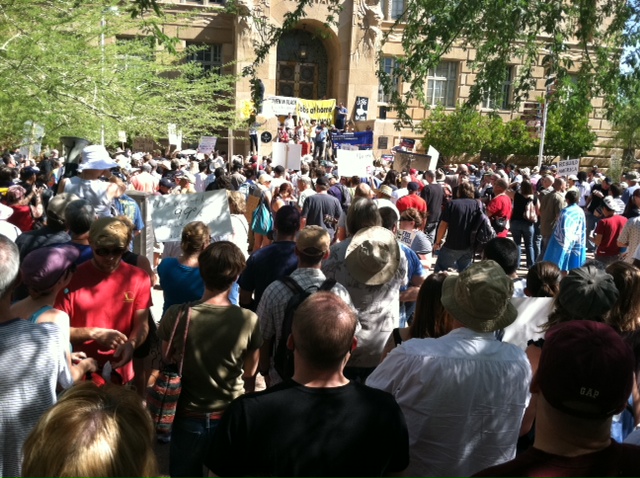
The rally on the initial day of the ocupation.
In
many ways, as I look back on those early years of the crisis, it
seems to me like those quiet, often individual and isolated acts,
perhaps mentioned briefly to friends and family, and negotiated
through a tactic of refusal, were the true precursors to the Occupy
movement. Millions participated, even as they held onto the fading
hope that Obama would deliver the change they thought he promised.
These people – middle class people primarily – had believed with
some justification that the system would respond to them. Indeed,
even though power clearly resides with a very small capitalist and
political elite, the middle class in America is the foundation of
almost all political and economic argumentation. All mainstream
political arguments must refer back to this mythical and
broadly-defined group at some point. The American ruling class
depends on this fecund soil of middle class identity and ideology to
reproduce the mythology and propaganda that maintains the system
overall, and of course the economy and the profits that go with it.
It is the middle class that votes and consumes.
But
for thirty years the middle class had been reduced to a photoshopped
image quite unlike its former robust self. Debt had replaced wage
growth. Home prices and credit card debt rather than real assets
made up its balance sheet. The suburbs, once a vast retreat to safety
and “normalcy” for the mostly white middle class, began to show
signs of collapse. Like mushrooms, one after another “for sale”
signs and foreclosure stickers spread through the car-friendly
neighborhoods. The official unemployment rate (always an undercount),
doubled in the eleven months between April 2008 and March of 2009.
Overnight the foundations of the middle class vanished for tens of
millions of people. What once seemed like a solid foundation was
revealed to have been rotting for some time, as Americans found
themselves crashing towards the basement in what had seemed like an
impossible reversal of fortune.
It
is in these conditions of 2008 and 2009, when the dream of Obama's
Hope and Change had ended and the crushing reality that politics
would not respond to the drowning-not-waving middle class, awash in a
sea of red, that we see the formation of what would become the Occupy
movement. While anarchists are right to point to predecessors in the
student occupations of 2009, and in the anti-globalization movement
before that, these are merely the origins of the form of the
movement, not the origins of the movement itself. In those movements
the general assemblies, spokescouncils, occupations, and
horizontalism have their origins, and the points of cross pollination
between the young occupy movement and those movements are obvious.
But the occupy movement itself had its birth in the crisis, in the
moment of the cartoon cat looking down after walking off the cliff.
It is a movement with a varied composition, which ranges from
homeless folks to students to anarchists to workers, but more than
anything else it is a movement of a middle class that is rapidly
re-proletarianizing, with a collapsing standard of living and
failing job prospects. In the process, it is finding itself in
unfamiliar territory surrounded by unfamiliar landmarks and
neighbors.
PCWC flyer
Nevertheless,
vestiges remain of the many biases and privileges that came with
middle class status in the US, and these contradictions play out in
the occupy movement in ways that we can identify. In particular we
see these assumptions – primarily reflected in the bourgeois belief
that the system ought to respond to middle class people – play out
in arguments around nonviolence, the police, and questions of
perception and imagery. Right now, as we enter what may be the end of
the beginning of the occupy movement, we see the formerly middle
class working out its new identity in public for all to see,
contradictions and all. It appears schizophrenic, asserting at the
same time both what it sees as its fundamental right to protest, to
be heard, and to have its grievances ameliorated, and at the same
time finding itself open to new radical ideas and tactics. All this
while also facing down a system that clearly not only no longer
responds to them but actually sends against them the very same
jack-booted thugs that the middle class supported as they cast their
ballots for one law-and-order president after another in the last
three decades.
We
can lay out a few significant features of this middle class state of
mind that have come into play in the occupy movement, at least as I
encountered it in Phoenix (OPhx). First, as I said above, is a real
sense that the system ought to respond to their demands. That, when
it doesn't, the system is broken. Obviously, this simplistic view
ignores the process of exclusion and dislocation central to the
functioning of the system. Nevertheless, this is the view. Likewise,
there is a desire for respectability, for conformity to normal
bourgeois conventions, for example politeness, and a particular kind
of attire. This desire also often manifests as a rejection of
certain affiliations, and an insistence on maintaining or creating a
particular image. Another feature of this ideology is a desire for
order and an adoration of the police. Finally, one of the most
important elements of the middle class view is the tendency to treat
its view of the world and its experiences as normal, and to impose
hegemony on the movement based on this view.
These
are points of conflict in the movement not just because of the ideas
that form “middle class-ness”, but also because likewise
participating in the broader movement are poor people, homeless
people, and political militants -- primarily anarchists-- who have
quite different experiences with cops and politics, and who envision
different constituencies as the optimal target audience for occupy
actions and propaganda. Beyond this, “middle class-ness” in the
US is anchored to whiteness, and this has caused conflicts whenever
white middle class occupiers have attempted to treat their experience
as normative rather than specific and exclusionary, especially around
questions of policing, incarceration and justice. This makes the
occupy movement not only contested terrain, but one in which the
formerly middle class participants seek to impose their dominance
over the rest of it. Always lurking in the dark recesses of the
middle class consciousness is the idea that politics ought to be the
property of the responsible classes, and rubbing up against these
other populations has been the root of many of the conflicts in the
early days of this movement.
An occupier speaks with a member of a NSM front group.
All
in all, middle class occupiers are in conflict with themselves. They
operate generally within the safe confines of middle class ideology,
but their class position has collapsed. The question is how this
conflicted identity will play out. With no recovery in jobs or
incomes on the horizon, and therefore no way to reconstitute itself,
is the emergence of a working class or other non-middle class
identity inevitable? Will interaction with radicals, anarchists, poor
and working class people, as well as people of color (who may
challenge many of the basic values of whiteness that constitute
middle class-ness) lead to a radicalization, or a rush to defend the
formerly privileged class position? Obviously many downwardly mobile
occupiers long for a return to the good old days of the American
dream. Meanwhile, the system and all likely political candidates seem
wedded to austerity in one form or another. A political response that
would satisfy them all seems improbable.
Within
the occupy movement, at least its Phoenix derivation, the middle
class tendencies played out in a variety of interesting ways.
Nonviolence, for instance, was always deployed ideologically and
never defined. Most people who used the term “nonviolence” with
regard to the movement seemed to move interchangeably between
“nonviolence”, “nonviolent”, “peaceful”, “pacifist”
and various other terms, treating them as if they all referred to the
same thing. Some did this consciously (politically) and some seemed
to be operating out of the generally privileged and anti-historical
narratives of political movements that middle class people use to
mythologize struggle. Cartoon versions of Gandhi and King got trotted
out regularly, stripped of historical context or even political
content.
Given
its lack of definition, the demand for nonviolence was therefore
applied almost exclusively to militants, and never to police.
Militants are considered to be dangerous because they do not adhere
to the ideological and poorly-defined nonviolence of the middle class
occupiers. As a result of our refusal to toe the line, we are treated
as if violence is our preferred method of struggle, or even our
default setting. Our presence is perceived as dangerous. Indeed, the
participation of anarchists in OPhx was and continues to be a source
of much fear and debate, something police have exploited on several
occasions.
The
debate about the importance of nonviolence has a few main elements.
One is the false history of social change that is so important to the
middle class (people who value stability and predictability above all
else). The collapse of their class position has turned them into
disturbers of public order, and yet at the same time, they value
order and civility as hallmarks (or psychoses) of their suburban
lives and democracy. Tied into this is the belief that the system
would and should pay attention to them if only they could make their
case clearly and non-offensively. For this reason, violence is not
only perceived by the middle class as disruptive and ineffective, but
also as poor strategy. This is reflected in almost every discussion
about nonviolence, as the most common refrain “it looks bad on
tv”. We are not to appear like thugs, like criminals, like we are
out of control or not respectable; all loaded language that points to
middle class perceptions and fears.
At
one point during the first mass arrest at OPhx, occupiers (sitting on
the ground as riot cops encircled them) began to chant “We love
you!” and “We are peaceful!”, “We are nonviolent!” at the
cops, as if invoking an incantation of middle class desperation. In a
real way what they were saying was, we are not a threat and we are
playing by the rules. This is the old identity expressing itself. But
it's coming up against a hard new reality. Many of these people had
likely never been on the business end of a riot suit, much less been
arrested.
A tent on the first night of the occupation.
Imagery
and perception played out along the terrain of class as well, with
many middle class occupiers exhibiting a near obsession with how
their fellow occupiers portrayed themselves. In the days before the
actual attempt to take over the park that was initially targeted for
occupation, a Reddit post circulated online which caught the
attention of the middle class elements within OPhx. The post
advocated that occupiers dress well, in suits and other office- or
church-appropriate attire. Supporters of this position claimed that
if we looked good, we would attract more people and that we would
also look sympathetic in the media. In this way, form was valued over
content, which probably isn't surprising for a class that has had the
foundations of its ideology yanked out from under it.
In
the same way that it was alleged that if we appeared respectable we
would be successful, the assumption was that if we looked bad (like
poor people or unemployed people or like people who had been
foreclosed on) then we would lose the support of the media and
therefore of the American people. Dirty clothes and torn t-shirts,
attire (including signs) that evoked anarchism, radicalism, or
homelessness, or a down-trodden or downward trajectory were
repeatedly singled out for being inappropriate.
At
the same time, middle class occupiers treated their assumptions about
who was being appealed to and who would be offended or attracted by
certain attire or messaging as a given, a natural fact beyond
dispute. In a real sense, they were talking about their former
selves, or perhaps their former employers. The idea that perhaps a
movement of the excluded and disempowered might not want primarily to
target middle class people made absolutely no sense to these middle
class occupiers, and their ideal presentation bore a striking
resemblance to a job interview.
In
a media world, driven by the consumption of the middle class, the
middle class naturally has its own image reflected back to them over
and over all day. Middle class-ness is treated as normal and correct
and even as large sections of the middle class found itself abruptly
and increasingly poor or working class, the ideology continued, like
sensations from a phantom limb. Likewise, the point that the media
itself was owned by the 1% and as such had no class interest in
portraying the movement positively (a fact that had been clearly
borne out up to that time by the coverage), was rejected wholesale by
middle class participants, despite the fact that they themselves
broadly felt disappointed and disillusioned by the media. For the
current and former middle class occupiers, the movement was as much
an appeal to conscience as anything else and the main vehicle for
that appeal, initially, was the media.
Beyond
this was the attempt by occupiers to impose on the movement a rigid,
hetero-sexual, anti-subcultural, and white suburban set of standards,
mimicking not so much the promise of the consensus-based general
assemblies that had excited them from far-off Zucotti Square, but
instead functioning more like the neighborhood or homeowners
associations that stifle all threats of diversity or difference in
the far-flung outer developments, now collapsing and emptying at an
astounding rate. This even though their class position had changed
drastically, even if they no longer lived in those suburbs or had
that good job and access to the easy credit that had made it all
possible. This raised the inevitable question of just what kind of
change these people wanted? Was it a break with the old order – the
failure of which had been the motivating factor for so many
participants in the first place – or was it to replicate or shore
up and reconstitute the old middle class life so many had believed
they enjoyed in the decades before the crisis? Was the occupy
movement to be the gravedigger or the defibrillator of the current
order? How deeply had middle class occupiers interrogated the
realities of middle class suburban life?
Anarchist interventions.
Whatever
the answer to that question, OPhx inevitably came into conflict with
the police, who were another point of extremely heated debate. At the
beginning and to this day (though less so now than then), a large
majority of people have clung to the notion that cops were part of
the 99%.
In
order to discuss OPhx and the cops we have to temporarily accept the
idea of the 99%, which I think most anarchists believe is a clumsy
and inaccurate way to approach class composition of society. Many in
the occupy movement are in serious danger of reifying what is merely
a sometimes useful, albeit limited, tool, and this comes out nowhere
more obviously than how they talk about cops. In a way, however, it
makes sense that in the US, where almost everyone thinks of
themselves as middle class, when a class analysis finally broke
through to popular consciousness it would be ridiculously broad,
almost uselessly so. Either way, since “the 99%” was the
terminology being used, the discussion remained largely stuck within
it and vulnerable to its many limitations.
Early
on those political militants, working class people, and people of
color who had altogether different experiences and perspectives on
the police, came into direct conflict with those largely middle class
people who asserted that “cops are part of the 99%”. In an echo
of the conversation about image and perception, middle class
occupiers asserted that if we looked respectable, the cops would
treat us that way. Or if we were polite, the cops would have no
reason to attack us. Indeed, looking good, using good language, and
mouthing the movement's poorly-defined mantra of “nonviolence”
were used not only as some talisman of protection, but also
repeatedly deployed as criteria for singling out the dreaded “violent
provocateurs” who haunted the dreams of middle class participants,
agitators they believed were always ready to infiltrate and disrupt,
thus making the movement “look bad” and leading inevitably to
failure. The further one strayed from these core values, the more
likely it was that one would be attacked as an infiltrator. Thus,
these three criteria were used to reinforce middle class hegemony
over the movement.
People
who pointed out that the cops themselves were violent, and that our
relationship to the police was dictated not by our behavior,
appearance, or language but by our relationships to power and
capital, or that police were generally right wing reactionaries who
would dislike us no matter what we did or acted like, got attacked
themselves for being violent. That is, opponents or even mild critics
of the police were labeled violent for maligning the police or
remarking on police violence. This bizarre reaction was perhaps
natural given the fact that most middle class people's contact with
cops up until their participation in the occupy movement was limited
to getting tickets, asking for directions at public events, getting
directed in traffic, getting help after a crime, and generally being
made to feel safe and protected.
The composition of OPhx was complicated at times.
Therefore,
police were not perceived at all as violent, but rather as
well-meaning members of the 99%, just doing their jobs, and only
prone to violence when provoked by people who deserved it. With seven
million people in prisons or jails or under state supervision at any
particular moment in the US, only the head in the sand NIMBYism of
the middle class could insist to a movement of the formerly middle
class that a small armed gang that puts so many 99%ers in jail every
year was part of the 99%. And, naturally their weak analysis of the
police led to consternation and surprise amongst middle class
occupiers each time the police broke with the presumed social
contract and resorted to violence and arrests against those perceived
socially as undeserving of such treatment.
So
the question remains. What will become of the formerly middle class
occupier? Many contradictions have yet to work themselves out. It
seems natural that a shift out of the comfy middle class wouldn't
come without its problems. Will the second phase of occupy, with the
election looming ever closer, display a more nuanced and advanced
understanding of American capitalism, politics, power, class and
resistance? One of the most inspiring things about the occupy
movement is its willingness to transgress conventional protest
tactics in surprising ways (even as it reinforces others), its
willingness to be disruptive and take over public and private space
and its (so far) rejection of the dominant politics. It shows a lot
of potential to being a creative, critical and confrontational
movement moving in a general trajectory that ought to make anarchists
happy. But will the former middle class occupiers, ejected so
summarily from their positions of privilege, find a new identity that
reflects their new conditions, or having wakened from the dream
briefly, will they instead seek to roll back over and recapture the
comforting fantasies of days gone by? Right now they are in a sense
doing anarchism without anarchism. But is that good enough?
PHOENIX CLASS WAR COUNCIL is a fanatical, revolutionary anarchist group pressing the attack against capitalism, the state and all systems of hierarchy and oppression. We fight for a self-determined, projectual life for ourselves and all humanity. We oppose those who hinder working class self-organization. We are libertarian and libertine. We support movements but we don't wait for them. We are in the thick of it.
Get in touch. Get our stuff.
Where you can find us: No events currently planned