Wednesday, March 17, 2010
Got $20 bucks? Help our Greek comrades continue their U.S. tour!
Before kicking back with a six pack of Guinness this St. Patrick's Day, please consider kicking down $5 or $20 to lend some mutual aid to our Greek comrades from the VOID Network.
That's right, we're asking you to buy the cheap stuff tonight.
Our Athenian comrades had a really crappy incident last night, their vehicle was broken into in Berkeley, and all of their materials (Boxes of books and pamphlets) for the U.S. tour were stolen. In addition to this theft, the window to the vehicle was smashed, but the worst news of all is that the projector they used to share the images from the revolt was also taken. In short, everything bankrolling the tour is gone.
They are now in desperate need of mutual aid, in the form of monetary assistance, ASAP. The broken window must be fixed before they can continue on their tour, and a donation will help restock those books and pamphlets as well. We were very grateful the folks from VOID took the time to stop in Phoenix for a few days, and it would be a tragedy if they were unable to continue their tour, so please kick some cash down if you've got it.
Hit up Little Black cart and donate:
-$20 donation to the VOID Network
-$5 donation to the VOID Network
Wednesday, March 10, 2010
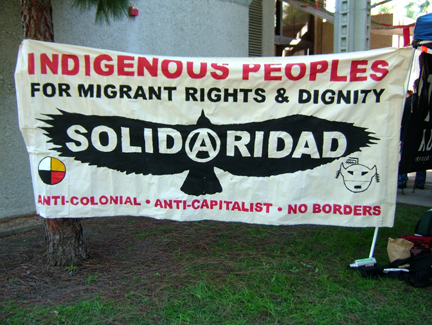
There's no immigration law like no law at all: On revolution as the necessary conclusion of the migrant movement
A tendency has emerged here in Phoenix that I find very exciting. More and more, as we resist the leftist model, so seductive to others, of building bigger and often disingenuous organizations (instead keeping our relations intimate and small scale), I have found that many of us have converged around a familiar and familial politics that is almost entirely unique in the US. With few exceptions (probably Modesto most notably), a particular strain of class war, race traitor, insurrectionist, and primitivist influenced politics has emerged here. Many anarchists in this town defy conventions, reject orthodoxy and instead take our influences based on what makes sense rather than whatever arbitrary groupings of ideas fall under what predetermined label.
Is it the hot summers? Is it the never-industrialized vastness of the ever-growing suburban wasteland? Phoenix seemed for so long to be like the universe -- vast but always somehow getting fucking bigger. A constantly growing behemoth, ever eating up more desert. Is it the proximity to the border? Is it the fact that Arizona was a segregated state? Is it the fact that you can see the horizon from anywhere in town? Or that the sun sets so brilliantly every evening? Is it because Phoenix was built on blood, for white people and to the exclusion of the native peoples who continue to make this area their home? Is it the malls that provided the plastic playgrounds of our youths? Is it the fact that almost no one living here was born here? Is it the waves of conquest, migration, dispossession and expulsion that define our history? To be from Arizona and also older than ten is a rare thing here, even in this age of economic collapse and foreclosed homes.
One author in particular who consistently writes exactly that kind of analysis publishes regularly at "Chaparral Respects No Borders". A very interesting article has recently been posted there that deserves a wide audience regarding the struggle over free movement, freedom from dislocation and, in particular, the kind of movement that we need in order to settle the questions we face. This most recent article reflects all the characteristics that I find inspiring about much of the writing coming out of Phoenix these days.
The piece uses one of my favorite techniques in writing. It takes a supposition that many people take seriously -- especially one upheld by movement leaders on all sides of an issue -- and subjects it to the real world. That is, for the sake of argument, one takes the positions of one's opposition and one's supposed allies, for instance, seriously and then kind of works backwards with it, showing weaknesses and contradictions along the way. We at PCWC are constantly keeping our eye out for contradictions, and so this approach always gets my attention.
Writing in the most recent piece, "The Best Immigration Law is No Law at All: Some thoughts on the logical conclusion for allies of undocumented migrants", the author smashes apart the presumptions of the movement liberals. The piece destroys the arguments from those that constantly push a legal framework as the solution to the question of free movement. And it lays bare the logical conclusions of those arguments, refuting the idea that the law can offer any answer to the demand of people to travel where they will, when they will. After all, law permits, it does not free: it prescribes freedom's limits. It is the enclosure to the commons.
At the same time, the piece does not spare the Right, pointing out their hypocrisy with regard to the question of class war in Mexico. The racist right in Arizona constantly demands revolution in Mexico, but will they overcome their reactionary ideology to support an anti-capitalist revolution? The forces of the Right hold sway in Mexico, so just who is the Right in the US calling to revolution? And against what? That is a dare that stands before that pathetic movement, and it's a contradiction worth pushing on since it will force them to choose between their reactionary defense of whiteness and colonialism and their supposed commitment to change in Mexico. They can't have it both ways.
The piece is firmly rooted within an anarchist analysis. It deeply calls into question the ability of the State to provide justice, as well as the alliances within movements that serve to maintain that myth. Most importantly, I think, the article recognizes the fact that it will be the people themselves who will organize themselves for their own liberation. It will not be through the hypocritical vehicle of politics that liberation will be delivered. Freedom will come when we are capable of demanding it ourselves, without the needless and regressive mediation of the state, Capital or the managerial activist left.
Read it:
The Best Immigration Law is No Law at All
Some thoughts on the logical conclusion for allies of undocumented migrants
Tuesday, March 9, 2010
The VOID Network reports on their visit to Phoenix
What a pleasure it is to meet new comrades from across the world! This weekend PCWC was lucky enough to share time, beers and plenty of conversation with our new Greek comrades from the VOID Network. We saw them as well as their traveling companion, Peter, off yesterday morning over omelets and pancakes and can't wait to see them again in San Francisco at the end of the week.

The three travelers delivered two interesting presentations while they were here, one on the squatting struggle in Barcelona (something we at PCWC, almost accidentally, had some very exciting experiences with a couple years back), and the other on the Greek insurrection of December 2008, and in Greece generally. Peter and the VOID Network comrades were thoughtful and open to hearing how anarchists and Indigenous peoples here in this part of the world see things and organize.
It was particularly exciting to meet people who were convinced, as we are, that any anarchy in the US -- insurrectionary or otherwise -- must reflect our local conditions and history. We cannot just take anarchist politics, actions and organizing techniques from other cultures and apply them wholesale here. We need an anarchy with American characteristics, if I can use that for shorthand, which analyzes honestly the history of the struggle against capitalism, the state and colonialism here where we live.
We can, however, be inspired by the struggle and tactics of others, and inspired we were for sure. The Greek struggle is a fascinating one, and what the anarchists there have accomplished it truly amazing. There is much to learn from. We were thrilled by the multimedia discussion they led at our Beer & Revolution night on Sunday. In what I think was a great way to start the night, the gathered audience, numbering about fifty over the course of the night, was requested to throw out their questions right at the beginning so that the talk could focus on what everyone wanted to know. This method definitely kept the talk interesting and amusing.
All in all, it was a very fulfilling experience and it is nice to read in their blog that it wasn't a one-way exchange. We, for instance, shared our analysis of the critical nature of white supremacy in maintaining US capitalism and the importance of attacking it as a revolutionary strategy. Likewise, we shared our "Fractures and Fissures" method of intervention and why we use it. For my part in particular, I really found it interesting to hear how Greek anarchists organize within what is a broadly shared cultural experience and how that affects the way they appeal to people.
For those interested in reading about their analysis of their time in town, follow the link below to the blog of the VOID Network, where they discuss in depth their visit, as well as their voyages in general. Very good stuff, comrades!
Click below:
Phoenix Arizona // O'Odham Tribe Land / We Are an Image from The Future U.S.A. Tour 2010
Labels:
anarchists,
beer and revolution,
Greece,
VOID Network
Sunday, March 7, 2010
Tonight: March's Beer & Revolution with the VOID Network

Beer & Revolution is back for March! Thanks to everyone who came out for our last B&R in January with Dan Todd and John Zerzan. Over 70 people packed the upstairs space at Boulders on Broadway for a remarkable evening of (anti-) politics and discussion, PCWC recorded this talk and I'll try to have it online before the end of the month.
We're very excited for our next B&R, this Sunday we're fortunate to have some comrades from the other side of the globe, members 0f the VOID Network, straight outta Athens, will be in town to deliver a talk on the (now) infamous rebellion that shook Greece in 2008. The execution of young Alex Grigoropoulos set off days of riots, which became weeks of social upheaval, a broad revolt that challenged the police, capital, the state, and the faux social peace of every day life.
The VOID Network will also examine the context of other revolts, as well as the state repression that follows, in Catalunya (Spain), and the United Kingdom, and what these developments may mean for other social struggles worldwide.
The speakers from the VOID Network have also released a book, "We Are an Image from the Future: The Greek Revolt of 2008," published by AK Press, featuring interviews with anarchists and antiauthoritarians from Athens, Thessaloniki, Patras, and several villages and islands.
This will be an exciting night to hear directly from a few of the participants of the ruptures in Greece, to have some beers (or soda, tea, water, etc.) with friends and comrades, and to enjoy a night of politics and conversation.
One important note, this month's Beer & Revolution WILL NOT be held at the usual stomping grounds of Boulders on Broadway, due to a scheduling conflict. It will be held, for this month only, right down the street at Casey Moore's Oyster House on 9th and Ash. Casey's is gracious enough to let us borrow the dining room this Sunday night, and we're very happy to have B&R there. The other change is that it we'll begin a bit later than usual, around 9 PM, so make sure to get there a bit early, as we'll be starting closer to the posted time than usual. The final bit of news is that we managed to keep this an all-ages event, our comrades under 21 will be able to attend this month's forum.
Come one, come all, we're very excited for tonight, and look forward to seeing folks at Casey's!
Bring your politics!
Thursday, March 4, 2010
Photo of the day
Today's photo is bad ass, straight up. It would appear that someone(s) managed to get atop of the Coor building at ASU main campus and drop this inspiring banner. It's no secret that much of ASU's notoriously apolitical student body is more likely to go for sun bathing and beer pong than organizing and fighting against another tuition attack, thus making this action all the more heartening for us non-students at PCWC.
Not to say the are no critiques of the new student movement (my comrade Phoenix Insurgent posted one of his yesterday), I have a few of my own as well. It's always worth keeping an eye of the wing of the movement demanding tuition reform, or some other appeasement that keeps this movement within the realm of university and student life. This middle ground of the movement will ensure the student discontent stays within the confines of the school, preventing it from spilling out into the broader sphere of social tensions at play.
(photo via ASU resists)
Not to say the are no critiques of the new student movement (my comrade Phoenix Insurgent posted one of his yesterday), I have a few of my own as well. It's always worth keeping an eye of the wing of the movement demanding tuition reform, or some other appeasement that keeps this movement within the realm of university and student life. This middle ground of the movement will ensure the student discontent stays within the confines of the school, preventing it from spilling out into the broader sphere of social tensions at play.
(photo via ASU resists)Tuesday, March 2, 2010
Some thoughts on the ongoing student struggle from someone who is not a student
The grandfather of a friend of mine was a forced Jewish laborer in the Nazi munition camps during World War 2. When reparations were finally paid to the survivors, his grandfather refused them. My friend asked his grandfather why. "Because as it is now, I was a forced laborer against my will, but if I take the compensation, then I was just an employee of the Nazi state."
It's interesting. During one of the more curious exchanges between the Greek government, now in deep financial crisis, and the German government, who most elites are expecting to bail the Greeks out, the Greek Deputy Prime Minister evoked the history of Nazi occupation of Greece during the Second World War. He said: 'They took away the Greek gold that was at the Bank of Greece, they took away the Greek money and they never gave it back. I don't say they have to give back the money necessarily but they have at least to say "thanks".'
More than 300,000 Greeks died in that occupation as agriculture production was shifted to feed the Nazi war machine. And after the Nazis came the Americans, with their anti-communism, coups and dictatorship. American anarchists are quite familiar with the role of the Greek students in bringing those CIA-backed governments to their knees.
Here at home, of course, many people have raised the demand for reparations. The foundation of the idea is certainly sound. Land was stolen, labor was stolen. Little to no payment was given. Even today, the repercussions resound throughout communities. Take a look at the difference in family wealth between white families and essentially all other demographics. Check out the disparities from the suburb to the reservation, or from the exoburb to the south end of town. Surely this requires rectification, if not remuneration. And, despite its dominance as local currency in the white middle class part of town, that payment cannot be tendered in boredom or ennui.
The sad emotional state of the suburbs is no compensation for the death and destruction wrought on those tagged at birth as enemies of American capitalism. Many white insurrectionist anarchists seem to want to leapfrog over what is derisively called "identity politics"; nevertheless, what are we to do with the reality of a white supremacy that, despite all the European communist theory thrown at it, still persists? Indeed, the insurrectionist call to jettison analysis of race -- or, perhaps, to put it on the same level as the boredom and emptiness of white suburban life -- seems at times like an alleged sophistication hiding what would otherwise be considered crass right wing analysis.
Still, the anarchist response to such things has usually been that our reparations take the form of expropriation. We will seize back what was stolen; dispossess the dispossessor. What is worth keeping we will keep and reorganize under a totally different ethic. What isn't worth keeping, we'll burn. As Errico Malatesta said, "If one really wants to change the system in fact and not just superficially, it will be necessary to destroy capitalism de facto, expropriating those who now control all social wealth, and immediately set about organizing a new social life on a local basis and without passing through legal channels. This means to say that in order to create a 'social republic' one must first bring about... anarchy!"
We aren't afraid of ruins, as Durruti said. Still, some of our parents were, weren't they? They fled to the outskirts when they got the chance. Some of our parents got stuck in those ruins and desperately wanted their kids to escape them. But either way, there was no escaping the ruin of Capital, was there? The architecture of the collapse of industrialism imprinted on the suburbs, too. Cookie cutter homes. Some are squats now. But a great deal of the empty ones are gutted, showing that even desperate people see little point in expropriating them beyond what can be carried away. Their Wal-Mart design serves only one purpose: the reproduction of the alienation of Capital. Deep down we all know this.
Neighborhoods without neighbors. Hours wasted driving to meaningless jobs. The price the white middle class is willing to pay not to live near poor Blacks, first and foremost. And others of course. The chemicals of Capital fill the gap, but the shame remains, manifesting as fear and violence. Students shoot up the schools. Dad shoots up his work. The lithium of the recovering inner city heroin addict and the Valium of the 1950's middle class housewife have merged to keep the rest in place, even if that restless leg syndrome won't let up. These are suburbs but they aren't les banlieues. Could they be? What does it mean to hope that they could be?
But, of course, as I referenced above, in this day and age, where the destructiveness of capitalism to the Earth is widely recognized in anarchist circles, and where Capital's ubiquitous presence squeezes profit and commodifies everything everywhere, seizing the means of production, as Malatesta mostly meant, seems like less and less of a sufficient answer. Not to say that we won't take them. Just that taking them doesn't quite seem like the answer it once seemed.
So, getting back to the question of reparations, if we are in an age of all-encompassing Capital, and at the same time, most of the actual production we do is both pointless at best and harmful at worst, what do we do? Is destroying Capital, including its physical edifice -- from factory to prison to university -- a kind of reparation? If I burn the warehouse down, after looting it of course, rather than collectivize, is this a reparation? Or is it revenge? Perhaps both? Does that make me the enemy of someone who wants to collectivize?
I find myself asking these questions as I watch the increasingly militant student movement in California. I sympathize with the desire to smash the university, both physically and politically. Nevertheless, I often wonder, as I read the likewise increasingly fiery proclamations emerging from the insurrectionist tendency within it, whether that struggle, which contains both the demand for the destruction of the entire vampiric order and at the same time the refusal to accept compensation from it, may find itself unable to communicate with, not only most the university population, but also the general population as a whole. And I wonder if its determination to downplay or ignore the ongoing role of white supremacy in American capitalism, may lead to a critical weakness as it torchlit marches ahead.
Of course, as I often hear, the demand is to generalize the struggle. Certainly. That is the goal of any nascent uprising. And there are indications that this is happening. But isn't the larger question, perhaps setting aside for now the tendency of the American working class to look down on university students as privileged, how a movement can articulate and mobilize behind a position based on what will be perceived as an attack on standards of living and social mobility. An attack on opportunity, even.
This is not to deny that, in reality, the university does not in fact deliver those things for many, even most, people. Clearly it is just another factory reproducing a class necessary for Capital's expansion. It's like asking if one's job fulfills. It feels like the set up to a joke. No one but a few could take it seriously.
Nevertheless, the university is not perceived this way in the common conception. Nor is the student experience broadly viewed from the outside as oppressive (quite unlike, for instance, high school and other compulsory education). So, it seems to me, the dare on the university student movement is not merely to generalize itself by, for instance, seeking a replication of its tactics (as I said, this is obviously necessary), but to make an argument that the critique it has of its own conditions, while perhaps contrary to the generally held mythology, are in fact just as miserable as life under other modes of capitalist production.
Towards resolving this dilemma, which I do not think is unique to the student uprising, we must spend time thinking very hard about the kind of arguments that can break through these widely help misconceptions. I think it's sometimes possible to get lost gazing into the fires we set. And it's not always true that the fire that liberates us liberates everyone else. Or, even if it could, if you're going to burn your own house down, you need to think hard about how to convince your neighbors not to call the fire department. And not to become a vigilante fire fighter, for sure. They're going to get nervous as those flames lick ever higher and higher and closer and closer to their own house.
Because, in the end, we're talking about a radical departure from the way that society is organized today. I mean, we clearly need fire -- and lots of it. But, while I think we rightly resist the temptation to prescribe what that world would look like specifically after the flames of the revolution have subsided, I think it's important to generalize the argument and, importantly, to look for critical contradictions within the experiences of others that can make clear how the student struggle is related to others, even those that have not yet emerged. Find these contradictions and push on them. See what happens. The odds are things will realign in new ways. New opportunities that were not initially obvious will present themselves.
For instance, do most people realize that the destruction of the university at its logical conclusion means the destruction of the work system as well? Perhaps the workers may lament the tuition increase as something akin to a pay cut, but does the more radical analysis find purchase with them? As someone who is not a student, I am prepared to suggest that the answer might be no. Or it might be sort of yes if they are putting their own kids through school. The movement must think of contradictions in the system that can be attacked that will plainly reveal this reality.
Figuring that out, I think, is the task before the student insurrection. It is not incumbent on the movement to listen to the self-serving warnings of the professional leftist managers of social revolt. But that doesn't mean there aren't people worth listening to. Look around for others making absolutist demands and connect with them. Consider how their demands fit into the already existing analysis. "Fuck work" is an obvious starting point. But there are others. Whose land are you on? Can you answer this question? This is a good place to start, too.
To get to this place, it will require, perhaps, a little less European insurrectionist communist theory, and a little more connecting with real life experience, especially the lived experience of others. To generalize the struggle the analysis must also be generalized in some sense. This, as the Zapatistas say, requires listening. But there is a strong insurrectionist tradition in American history. Think John Brown. Think Nat Turner. Think Set-tainte of the Kiowa. Think Harriett Tubman. People who at least at some points in their lives refused compromise. Consider their names and their struggles. Incorporate the demands of others into the flyers, banners, manifestos and communiques.
White supremacy will be a fatal weak point if it is not confronted head on, so it must be done now. Think how white supremacy fucks up the struggle against capitalism. Why do working class white Minutemen track down and confront working class or peasant Mexican migrants? Why did poor Southern whites join the slave patrols that returned to their masters Blacks that participated in the ongoing general strike against the slave system? This makes sense only when we consider the cross-class alliance of white supremacy.
This doesn't mean a watering down of politics. On the contrary. But take a fanatical approach. Attack the middle ground but try as much as possible to ground your infinite demands in obvious truths. Then attack those who deny reality with a friend/enemy dichotomy. Think how the Abolitionists attacked the wishy-washy middle. There's something to be learned there. Read William Lloyd Garrison. From the middle will emerge your worst enemies. You've already seen the damage a handful of liberals can do. Therefore, it is incumbent on you to destroy the middle ground. It pretends to offer reason but instead delivers only more insanity.
But, above all else, in the US every movement must consider carefully how its politics fit into the overall context of white supremacy. But there's hope: when the system of white supremacy is in crisis -- which means that enough crazy motherfucking white people reject their whiteness in solidarity with people of color that the reactionary system can no longer be counted on to undermine class solidarity -- amazing things happen. The very explosions insurrectionists desire manifest! The women's movement emerges. Gender and sexual relations shift. And on and on. Capital becomes weak and stumbles. The Reconstruction legislature of South Carolina sent revolutionary salutations to the Paris Commune. Think about that. The capitalist machine counts on the alliance of whiteness to create within struggles an emergency escape hatch for white people of all classes. This must be refused.
White supremacy may seem quaint and "olde timey" in the age of a Black president, but it's grip is still on us. It is the cross class alliance that time and time again turns the white working class against what would otherwise be its comrades. It is the knife's edge of Capital. If the student movement can generalize itself, whatever else it does, it must attack white supremacy head on. This is what will throw the system into crisis. This contradiction is what will build that unstoppable constituency that will overturn Capital.
Think insurrection. Think John Brown. Think Bleeding Kansas. Think solidarity. Death to Capital.
Labels:
anarchists,
insurrectionist,
march 4th,
reparations,
student movement
Monday, March 1, 2010
Defending diversity of tactics in Vancouver
Below I have linked the first part of a panel discussion co-hosted by rabble.ca and Working TV that took place Saturday February 20 in Vancouver on diversity of tactics following the anti-Olympics actions. This question is one that we in Phoenix are familiar with and the panelist defending the black bloc in this case, Harsha Walia, does the best job that I've seen yet in breaking down the accusations leveled at the bloc. I think there's a lot of good stuff here and I appreciate the way she has organized the ideas in her presentation. Enjoy!
Click here to see the rest of the discussion.
Friday, February 26, 2010
John Zerzan discusses DO@ block on his radio show [VIDEO]
This comes a little late, but since we haven't updated the blog in a while, I thought I would post the video from John Zerzan's radio show which followed his visit to Arizona. He spent much of the time discussing the DO@ bloc and things he experienced on his trip. Two people from Phoenix called in and shared some thoughts on the situation in Arizona and what we're up to.
Anyhow, enjoy. We're working on some new stuff that I think will be pretty interesting, mainly focusing on calling out and challenging white people around questions of white supremacy, the policing of migrants and freeway development on the reservation. You know how we do it: look for contradictions and push on 'em. So, stay tuned for more.
Personally, I've got a lot of thoughts running through my head these days that are cross-pollinating, going back to the Indigenous resistance panel at the LA Anarchist Bookfair (which included DO@ participants) up to and including some of the new stuff that has come my way since then. I'm going to do my best to get them all down sometime in the next few days, if I can, in some comprehensible form. I'm very excited about some of the action ideas we've been tossing around. Hopefully they'll make a splash.
In the meantime, enjoy the video. You can catch John's show every Tuesday night at 8 o'clock our time, sometimes streaming video. And, for those going to San Francisco for the anarchist bookfair, John will be speaking, so you can catch him again. If all goes well, there'll be some discussion of DO@ there as well.
Labels:
doa bloc,
John Zerzan,
PCWC Media,
primitivism
Thursday, February 18, 2010
Reflecting on what the immigrant movement might learn from the "6A" statement
We were watching the local news a few years ago. A cameraperson for a local news broadcast was following Maricopa Sheriff Joe Arpaio on a tour through his notoriously awful jail facility. It was being broadcast live and Joe was his usual cocky self.
Typical of the kind of uncritical platform that the media regularly gives Joe, he was armed with the mic himself. Obviously thrilled at his chance to speak directly, unfiltered, through the media, and filling the role himself that would normally be played by a reporter, he approached an inmate. "You enjoying your stay here?" he asked, chortling in that characteristic farm animal way he has.
"No, sir," replied the inmate, looking down and stating the obvious.
"You got anything you want to say?" grunted the sheriff to the inmate, sticking out the microphone again.
"Yeah. I do," said the prisoner, a visible rage welling up inside him. "I just want to say that every night before I go to sleep I pray that in the morning you'll wake up, go out to get your morning paper and get hit by a truck."
Infuriated, Arpaio called over the guards. "Put this wiseguy in solitary! Bread and water!"
The prisoner was hustled off in a rush, but even though we couldn't see his face anymore, we could tell he was smiling. And so were we.
I bring up this actual event because recently a controversial article, authored by "Anonymous Arizona Anarchist Advocates for the Assassination of Arpaio" ("6A") has been making the rounds. The article defends the deployment of the infamous "ASSASSINATE ARPAIO" banner which was on quite obvious and bold display at the January 16th march to the jail.
A lot can be said about the banner, and the writers do indeed say a lot themselves. The article is well-written and entertaining, and really doesn't require any additional defense, nor does it seem to ask for one. So I won't give one. I'm more interested in the questions it raises.
I do have some quibbles with it, however, which I'd like to get out of the way before I consider what the statement means for the movement. For instance, I can see the point of the authors making up quotes from silly pop stars. However, in the current climate, I think such fiction-writing comes across less as satire than is perhaps intended when it is extended to organizers like Sal Reza. I understand that a lot of people, myself included, legitimately feel like Sal has acted badly and said some ridiculous things ("crazies", denouncing us as unwelcome outsiders, etc). But while we envision a different sort of movement, we don't want to destroy it. I think its fine to take self-important movement leaders down a notch, but it's important not to inadvertently feed fears of police meddling.
It would be a shame if peoples' legitimate, if overblown, fears about COINTELPRO operations provided the excuse to avoid responding to the very real concerns raised in the DO@ bloc statement. To the extent this is the case, the utilization of satire must be considered very carefully. Likewise, given Arpaio's history of manufacturing his own threats, one should be careful about playing into his hands as well. Joe loves to appear persecuted. I say this not to chastise but rather to caution. I really liked the Zack de la Rocha quote, though.
That said, I started off my article with the interview I saw on TV in order to illustrate a point: even though the authors have taken what seems like an extreme position (and despite the fact that they themselves equivocate a bit on what they meant by it), this is only so when viewed from certain angles. From the perspective of the one prisoner above, for instance, it's unlikely that such a proposition seemed so to him.
Indeed popular rage at Arpaio seethes in this state, especially amongst the poor and working class of all races, the overwhelming victims of Joe's attacks. If the banner shocked, you should hear some of the things people say when the camera's not running. More than once I have had someone I just met, from middle aged women in line at the grocery store to young kids in graffiti crews, say much worse about "America's Toughest Sheriff (™)". At the bottom, where we know better than to waste our time voting for our prison warden, Joe is truly hated.
It's only in the bourgeois press and in the polite middle classes that Arpaio is seen as anything other than the class enemy, plain and simple. The downtown yuppies look down on him and mock him as a doddering old coot, much like they mocked that murderer Bush the Younger.
But those of us at the bottom of the class hierarchy know the truth of it. Joe locks up our friends all the time. In a sprawling city without decent public transit, our friends wind up in his tents in the 120 degree summers for DUI. While in there they accumulate vast debts that they struggle to pay on minimum wage. They lose their apartments and their cars. Our friends get nabbed by his deputies for being brown and wind up back in Mexico, even though they left there when they were six months old. Or they get snatched at a protest for daring to form the radical wing of the movement. It's all the same. Amongst our class, we don't mince words when it comes to Arpaio. We know the enemy when we see him and we call him such.
I write this next part not to lecture the authors of the piece, but to make my position clear. I am not a believer in propaganda of the deed as a political strategy. I have said before and I continue to believe that, if the movement is going to focus exclusively on Joe (and this is an important question to ask), then the best possible outcome is for a direct action movement engaging in creative resistance to force him to resign and flee the state in humiliation and defeat. This is the kind of outcome that builds movements and sets them off towards their next challenge. As the "6A" authors themselves point out in their piece, whack Arpaio and there's just another asshole waiting in the wings to replace him. To prevent that, you have to change the politics of Maricopa County. I'll come back to this point.
I don't need to give a history of the Galleani circle to illustrate this point, I hope. Propaganda of the deed might be exciting and sometimes even inspiring, but it is far more often an indication of the defeat of a movement than of success, a symptom of weakness rather than strength. We all get a laugh from history that Spanish anarchist exiles tried to bomb General Franco from the air after WWII. But we also forget that they were "Spanish exiles" for a reason. Franco had won. Also, however popular such sentiments may be, it's important not to write checks that cannot be cashed. This isn't a call to conservatism, but a reminder that, even when we speak obvious truths, escalation does not serve a movement that isn't prepared to deal with the consequences.
As with any rule, there are exceptions (we all cheered when Hitler got it in Inglourious Basterds), but we should be careful when making them. And in general these exceptions come during revolutionary situations when contradictions explode onto the stage. I do not believe we are yet in this kind of situation. And trust me, if we were, and Arpaio had to deal with a real popular movement from below, he'd be running with his tail between his legs back to Berlusconi's Italy for protection. Creating and supporting such a movement is our task as revolutionaries.
Still, I think there is something important that we can learn from the "6A" statement that would be useful for the movement in general. The crux of the argument, which I like, is that despite all our efforts, Arpaio is returned to office time and time again with large majorities backing him. Statewide this political reality is reflected in the supermajorities backing every anti-immigrant initiative on the ballot. He has continued to use the immigrant movement as a foil to bolster his approval among reactionary whites in the county and to solidify them in their obstructionist position to working class unity.
As it is currently oriented, the movement plays into this trap time and time again. The sheriff may seem a useful dupe, but one wonders, as the statement asks us, what all the marches and sign-holding has accomplished, after all, if all it does is make Arpaio stronger? To say nothing of whether it attacks the overall statewide system of white supremacy (which must be our larger goal). Even if we are not advocating political murder (and I am not), is there a point at which it is all right to ask this broader question? If it's only taboo that keeps us from thinking critically about the kind of movement we have, then by all means, let's blaspheme!
But when we ask critical questions about the movement we are answered with silence. The strategy that it is following is the strategy that it will continue to follow, despite (or perhaps because of) its failure. And that's just that. So we are told.
But despite the righteous outrage and condemnation that "6A"'s bold statement has elicited in some quarters, doesn't organizing in opposition to one politician who is essentially immune from electoral challenge, and therefore from popular pressure, eventually beg the very question that so-called responsible moderates now decry? I mean, in some sense, isn't the "6A" statement "baked into the cake" as the movement is now oriented? I think so, and that's a problem. But it's not a problem that anarchists created, even if it was anarchists who made the banner. And it isn't a prisoner problem either, just because a prisoner spoke out on TV. It's all our problem as long as we continue down this path.
This is why we at PCWC, along with our other comrades, advocate for a reorientation of the movement away from focusing on Sheriff Arpaio and towards a broader view. One that incorporates more voices and links more struggles. One that demands free movement and freedom from dislocation. One that challenges the checkpoints. One that challenges the Border Patrol on the rez. One that fights the cameras on the freeways and streets. One that opposes the dislocations of Native peoples for resource extraction. One that sees all the police agencies as complicit in the attack on people of color specifically and the poor and working class generally. One that fights Wackenhut's prisons, the FEMA camps and the tents at the same time. We want a movement that is not afraid to ask questions and, importantly, unafraid to make connections.
One part of that organizing was the DO@ bloc, which was itself a manifestation of much deeper work at coming together with comrades that in many ways stand outside the movement as it now exists but who deserve a respected place in it. For us white anarchists in particular, we have another particular charge that goes beyond critical solidarity with regards to the movements with which we engage. We have a special obligation to reach out and explain to white people why they ought to reconsider their reactionary position with regard to the immigrant movement. And we have a political burden to create situations that reveal this hypocrisy and put white people in political predicaments where they must choose a side. Which is it? Solidarity or reaction? Getting white people to answer that question, that's our task and one that PCWC takes very seriously. Think about contradictions in the white working class and push on them. See what happens.
It speaks volumes that, despite the extensive popular hatred of Joe, the immigrant movement has not been able to tap into it. Indeed, it appears afraid of it. With the exception of the first few popular explosions and megamarchas, a popular movement against Arpaio and the broader attack on movement has not manifested. In fact, the risings in the early days were much more broadly aimed than at one measly county cop. So what happened? Where did everybody go, and why? Should we be afraid of these questions, too?
Since those early days, many people with legitimate reason to oppose him politically from the poor and working class have not joined in. In essence, the migrant movement has failed to mobilize a popular movement against Arpaio. Also, white anarchists have failed to mobilize white people. We mobilize ourselves just fine, no doubt. But too often anarchists are so disgusted with the white communities that we left or opposed, that we are loathe to engage with them. The problem is, this only adds to the climate that leaves the migrant movement reaching out now to hypocritical politicians, aging pop stars and President-Saviors to rescue it. Lacking a popular movement, it doesn't matter how Arpaio leaves the scene, someone else just as bad will surely take his place, even if they are less ostentatious in how they do it.
Likewise, the movement is unable to create a dialog that goes beyond just one person to challenge the entrenched system of white supremacy throughout the state. It is afraid to call out local police forces, preferring to maintain the illusion that one cop shop is worse than the others, despite the obvious evidence to the contrary. Organizers work with Phoenix PD even as the agency moves steadily ahead towards turning every beat cop into an ICE agent. The same with Chandler. Look at where the alliance with Mesa's Gascón got everybody.
The politicians that flirt with the movement are likewise useless. One thinks it's okay to dislocate Indigenous peoples from their homes for the freeway, and to shift all the pollution and resulting health issues that come with it onto the reservation. And another denounces anti-Arpaio protesters with his mouth while taking money from the Phoenix Law Enforcement Association with his hands. And on and on.
This is a failed strategy.
And while a bullet in this situation doesn't solve it either, we ought to be thinking hard about what would. Internally, in my opinion, this process begins with addressing the concerns of the DO@ bloc. On that basis we can heal wounds and build a unified movement that can discuss strategy and tactics in a democratic fashion. With regards to the anarchist movement, it must be on us to create the kind of situations and manifestations that bring white people around to the importance of solidarity. From there we can start to think about victory.
Wednesday, February 17, 2010
This Thursday: 'A Critique of Biopolitical Economy' with Rob Poe
Rob Poe is a regular attendee of Beer & Revolution and participates in discussions with a critical voice that I respect. This Thursday afternoon he will be giving a talk at the ASU West bookstore called "A Critique of Biopolitical Economy". I find his politics interesting for a variety of reasons, not least of which is his willingness to critique technology from a Marxist perspective. Below I have linked all the relevant information for those interested in attending.
Thursday, February 18
A Critique of Biopolitical Economy
A talk by Robert Poe (MACS graduate student, ASU West)
4:00pm - 6:00pm, ASU West Bookstore
Robert Poe will be presenting portions of his Master's thesis, A Critique of Biopolitical Economy, which engages thoroughly with the works of Michael Hardt and Antonio Negri (i.e. Empire, Multitude and Commonwealth). He grounds their political economy in the history of the Marxist and anarchist political traditions and subsequently critiques how emancipatory their conception of resistance is as understood through the political subject of the multitude. Given his strong philosophical background he will also be critiquing their use of prominent thinkers and concepts in the history of philosophy, particularly Spinoza (the concept of the multitude is taken directly from Spinoza's work). Ultimately, he hopes this project will provide a sustained critique of current movements which seek to challenge global capitalism from a predominantly apolitical position (i.e. the abandonment of the struggle for political power). The philosophical concepts of immanence and transcendence also play a crucial role in this presentation. He will look at how their philosophical and religious interpretations are equally applicable to the realm of political economy, specifically to the re/production of and struggle against global capitalism. The work of Spinoza plays a key guiding role in helping to understand the complex entanglement of politics, philosophy and religion.
Subscribe to:
Posts (Atom)