Saturday, May 2, 2009

NEW SHIRTS FOR SALE!!!


Watch the shirts in real life action in our demo video:


New shirts from Phoenix Class War Council, hot off the presses! We have modified the jolly roger with two crossed RPGs (a favorite weapon of the pirates). On the back is the Phoenix Class War Council logo and the classic pirate quote, "And what do you mean by seizing the whole earth? Because I do it with a petty ship, I am called a robber, while you who does it with a great fleet are styled emperor."

Sixteen bucks gets it, plus shipping. All money goes directly back into expanding our propaganda operation, buying books, magazines, making more shirts and various other things. Our desire is to grow the operation so we can bring in as much anarchist and other literature/schwag, etc, as possible so we can increase the exposure of Arizona anarchy and deepen anarchist dialogue in general. Help us help you! Email us at firesneverextinguished[at]gmail.com to get one and we'll work it out.

Also, don't forget that we still have the "No Racists" Sheriff Joe shirt as well, which we're selling for twelve bucks. These are both quality shirts. Get 'em while you can.

Blood on the Line: Resistance, Empire and Repression at the Border

This is the first text from a flyer distributed at the May 2nd demonstration in front of the county jail. Perhaps a critique will appear here if I have some time to do it. Certainly a lot can be said about the generally sad state of the pro-migrant camp these days.


By Phoenix Insurgent

The border fence is a result of three factors, inextricably intertwined: the expansion of capitalism, global war for empire and the desire of common people to organize their own lives free of the first two.

In 1854, the ratification of the Gadsden Purchase settled a border dispute stemming from the American invasion of Mexico seven years earlier (the “Halls of Montezuma” reference in the Marines battle hymn pays tribute to the occupation of Mexico City). With the war over, Southern capitalists and slavocrats turned their greedy eyes west, hoping to expand their trade and the slave system. Mountainous northern Arizona was deemed too difficult for a railway, and so the US purchased from Mexico the region that now encompasses southern Arizona. Thus the border moved, splitting both Mexican cities like Nogales and native peoples' traditional lands.

During this time, the border remained open and people moved relatively freely back and forth. A surveying team in the region left stone piles every couple miles as they traveled, delineating on the land a line on a map generally deemed meaningless by the region's inhabitants, who were keen on constructing their own lives free from such interference. In fact, the first physical barrier wasn't built between the two countries until 1918, when US war hysteria led to the Battle of Ambos Nogales.

Paranoid about a German-backed invasion from Mexico, the US deployed forces to Nogales. When a man crossing the border refused inspection by US troops, it quickly degenerated into open warfare, with American soldiers exchanging fire with Mexican troops and ordinary Mexicans fed up with the degrading treatment routinely meted out by US border guards. The resulting bloodshed left three US soldiers dead and hundreds dead and wounded on the Mexican side, including the mayor of Nogales. As a result, the US built the first chain link fence dividing the two countries.

Since then, as Capital and the State expanded their domination of the region, that fence has grown, even though our resistance to it has continued. While American Capital has become increasingly free to travel to Mexico, sucking the wealth into American banks, people have fought for their right to cross the border on their own terms, free from regulation. Tribes divided by the border have struggled to maintain their historical right to cross and migrant workers have voyaged back and forth in search of work and visiting family.

And, of course, millions of white Americans have crossed for vacations and to set up second homes, something that is largely unremarked by mainstream American society. Indeed hundreds of thousands of Americans live in Mexico, many of whom never register with Mexican immigration agencies. In the US, the freedom of white people specifically and American citizens in general – and the rich of all nations -- to travel to Mexico is considered a birthright, the spoils of war. Meanwhile, the legitimate desire of other people to do the same is criminalized and regulated.

Nevertheless, the right of all humans to travel wherever they wish, whenever they want is elementary to being a free person. As an obvious impediment to that, it is therefore our position that not only should the border fence be stopped and dismantled, but that free movement of all people should be encouraged. All people now held for “immigration” violations should be immediately freed and those already deported should be allowed free travel back if they so desire. All facilities for immigrant detention should be closed and leveled without delay.

Friday, April 17, 2009

News of Interest 4/17/2009

You are being lied to about pirates

Who imagined that in 2009, the world’s governments would be declaring a new War on Pirates? As you read this, the British Royal Navy - backed by the ships of more than two dozen nations, from the U.S. to China - is sailing into Somalian waters to take on men we still picture as parrot-on-the-shoulder pantomime villains. They will soon be fighting Somalian ships and even chasing the pirates onto land, into one of the most broken countries on earth.

But behind the arrr-me-hearties oddness of this tale, there is an untold scandal. The people our governments are labeling as “one of the great menaces of our times” have an extraordinary story to tell - and some justice on their side.

-San Francisco Bay View


Dozens of U.S. citizens deported

Pedro Guzman has been an American citizen all his life. Yet in 2007, the 31-year-old Los Angeles native - in jail for a misdemeanor, mentally ill and never able to read or write - signed a waiver agreeing to leave the country without a hearing and was deported to Mexico as an illegal immigrant.

For almost three months, Guzman slept in the streets, bathed in filthy rivers and ate out of trash cans while his mother scoured the city of Tijuana, its hospitals and morgues, clutching his photo in her hand. He was finally found trying to cross the border at Calexico, 100 miles away.

-Associated Press


Get the Feeling You're Being Watched? If You're Driving, You Just Might Be

The village of Schaumburg, Ill., installed a camera at Woodfield Mall last November to film cars that were running red lights, then used the footage to issue citations. Results were astonishing. The town issued $1 million in fines in just three months.

But drivers caught by the unforgiving enforcement -- which mainly snared those who didn't come to a full stop before turning right on red -- exploded in anger. Many vowed to stop shopping at the mall unless the camera was turned off. The village stopped monitoring right turns at the intersection in January.

-Wall Street Journal


Paris liberation made 'whites only'

Papers unearthed by the BBC reveal that British and American commanders ensured that the liberation of Paris on 25 August 1944 was seen as a "whites only" victory.

Many who fought Nazi Germany during World War II did so to defeat the vicious racism that left millions of Jews dead.

Yet the BBC's Document programme has seen evidence that black colonial soldiers - who made up around two-thirds of Free French forces - were deliberately removed from the unit that led the Allied advance into the French capital.

-BBC News


Obama to seek $83.4 billion for Iraq, Afghan wars

President Barack Obama is seeking $83.4 billion for U.S. military operations in Iraq and Afghanistan, pressing for a war supplemental spending bill like the ones he repeatedly voted against when he was senator and George W. Bush was president.

Obama's request would push the costs of the two wars to almost $1 trillion since the Sept. 11, 2001 terrorist attacks, according to the Congressional Research Service. The additional money would cover operations into the fall.
-Associated Press

Thursday, April 16, 2009

March was a month on the move!

Phoenix Class War Council(ers) are back in the valley after a month of travels, adventures, and politics.

Sorry for the lack of updates recently. March has been a month of movement for us here at PCWC. Collectively, we put out our newspaper (email us for a copy at firesneverextinguished[at]gmail.com for a copy) and distributed the shirts we printed. Aside from that, much of the month was taken up with travels and scheming.

***

Phoenix Insurgent was in Europe again, drinking and touring, and meeting up with anarchos there. France and Spain were mostly occupied with forgetting politics and integrating into the much more laid back French and Spanish lifestyle. A return visit to the great bookstore Alternative Libertaire produced a copy of an biography of Durutti in Spanish, French and English. Ample opportunities to practice French, especially at the bars, led to some great conversations about French politics and, especially, the role of minorities from Brittany to Algeria (you can email PCWC in French, English or Spanish, by the way).

Moving on to London via train, PI met up with some folks from the great journal Occupied London, threw back some beers and Turkish pizzas, and got some great conversation and a better picture of politics in that neck of the woods -- especially the revolutionary green sense of the word. That part of town is slotted for that combination of building boom/demolition/expulsion/colonization that accompanies the Olympics wherever it goes (London 2012), and work is already steadily underway with all the usual characteristics (new sports stadiums, extension of subway lines and the clearing out of old -- or even not so old -- buildings for new ones dedicated to the new capitalist enterprises).

On the other end of town, PI met up with some folks at Freedom Books and then got a great political/historical tour of Whitechapel and the Whitechapel Anarchist Group space. Apparently a political history pub crawl had just taken place recently, sparking all sorts of ideas for similar projects here in Phoenix, especially downtown. PCWC has been reading Bradford Luckingham's very interesting histories of Phoenix lately, revealing just how much we have to learn about our own town and how Capital and politics has shaped it.

As for the WAG space, the Valley would be doing great if it had a space like that here. In what they call the London Anarchist Resource Center, they boast what is probably the biggest anarchist library publically available and have room for meetings, movie showings and an area for the construction of the various accoutrements of protest and struggle, such as signs, banners and the rest. Also, for those that don't know, WAG puts out a great broadsheet in the Class War style (i.e., snotty, uncompromising and graphically appealing). Apparently it gets quite decent distribution, which is a hell of an accomplishment given that the neighborhood they're in is undoubtedly the most conservative Muslim neighborhood in London.

While in London, and searching for pubs that didn't close at eleven (!), PI had some time for seeing the sights, including a trek to Marx's grave. Most notable about the grave are three things. First, and obviously, the head.


Apparently, the sheer and quite ridiculous size of it was even controversial amongst Marxists when it was built. Secondly, it was so big it was impossible to get a decent photo next to it without looking silly. Thirdly, even though communists the world over have declared their opposition to private property (but is it really not private property if the new landlord is the State?), some of them obviously knew vaulable real estate when they saw it, because surrounding Marx's grave are the final resting places of at least a dozen notable communists.


Also, while in London, that trademark British sense of humor was evident in the weirdest of places:


Irony outlasts empire every time.

A walking tour of Notting Hill, following the directions from a Class War pamphlet, revealed George Orwell's house while a meandering tour through the financial district and the surveillance geography of the "ring of steel" put an exclamation point on it. Cameras there cover all entries and exits, and one certainly gets the feeling not only that one doesn't fit in, but that one is at least potentially tracked at all times while in the vicinity.

In terms of tactics and issues that anarchists are having in London, I came away with a warning on "kettling" and police Forward Intelligence Teams. Kettling, not an unknown phenomenon here in the US (PCWC members encountered it as early as 2000 in LA during the Democratic Convention), has become widely known now thanks to the recent G20 protests in London. Kettling basically involves the police attempting to hem in anarchists -- to follow them with massive force and to pen them up, preventing any action to take place. This often leads to violence and detention.

FIT, however, may be less known. FIT teams gather information of event organizers, leaders and other important information, for the purpose of disrupting actions. Apparently, they can be quite intrusive as well, not being satisfied to gather data passively from a distance. As a result, something calling itself FIT Watch has emerged to counter the increasingly intrusive presence of the police at protests. According the London FIT Watch's blog,
Fit Watch are a fluid group of people who have come together to resist and oppose the tactics of the Forward Intelligence Teams (cops who harass protesters).

We aim to act in solidarity with each other, supporting campaigns by being at meetings and protests, making it harder for the police to film and gather intelligence.

We hope to encourage a culture where their presence is not acceptable and to act when we see people being followed and harassed.

We aim to make it harder for them to photograph and intimidate us by getting in the way of their cameras, taking photos and publishing as much information as we can about them on our blog.
Such tactics, by both the police and anarchists, have made various appearances in Phoenix in the past, especially during the height of the May Day protests in the early 2000's. Nothing particularly matching FIT Watch in terms of aggressiveness and specific aim emerged, however, to counter the cops. Copwatch, of course, routinely documents protests and police activity at them, and so, occasionally, do the ACLU. But neither of these seeks to actively disrupt the activities of the police. As things heat up here in town, we'll surely see the return of the "red squad" to anarchist events, and when that happens, we may look to our comrades in London for some ideas about how to deal with them.

As for kettling in Phoenix, there were attempts during the May Day protests to surround anarchists, but they were often thwarted by going the wrong way down one-way streets, which prevented the po-po from following us with their cars and wagons. In Tempe (which doesn't have one way streets downtown), however, the police brought in bike cops and were more successful in keeping us in place, at least the second time May Day was organized there (after they had received training from the Eugene police department). At the most recent immigration protest in Phoenix, cops did attempt what looked like a proto-kettling operation, but it was foiled by staying in the streets, the sheer numbers and the medians in the streets.

The rest of the European vacation eventually moved to Spain and was aimed primarily at accomplishing two main tasks: (1), relaxing in the sun, and (2), successfully driving a car through southern Spain. Both were accomplished, to varying degrees, with driving coming in a distant second given the insane driving conditions in Spanish cities. Fortunately, driving in Mexico provides preparation to a limited degree for the "devil may care" attitude of Spanish motorists (although it made Mexican drivers look quite sane by comparison).

One thing that is always apparent when traveling in Europe is the total lack of working class Americans. International travel in the US is almost exclusively the domain of five groups of people: the rich and upper middle classes; students (mostly coming from those classes); traveler kids and musicians; retirees; and the military. Almost nowhere does one find folks in their thirties and forties from working class backgrounds that aren't in the military. This is a great tragedy. While recognizing the destructive nature of air travel, it would surely be worth everyone's while to find a way to correct this deficiency. Certainly first class would make a great spot for an open bar, if we could prevent the business class from flying.

***
Collin Sick's been busy as well, traveling across the state, as well as venturing into the Bay Area, and making a trip down to Quitovac, Mexico. March began with the benefit show for the Unity Run that our O'odham friends organized, and Collin was able to help out with. The show raised hundreds of dollars for the run, and collected a sizable amount of flour, coffee, and rice for the runners. Highlights included the spray can artists going to work on massive panels outside, Dumperfoo doing live art, and DJentrification, Optimal, Shining Soul, and The Insects killing it during their sets.


The next weekend saw some frequent flier miles thrown down for the annual excursion to the Bay Area for the 14th annual San Francisco Anarchist Bookfair and the 9th annual BASTARD Conference. This is the fourth yearly trip from Phoenix to the Bay, and sadly the first without PI attending, although to be fair he was in Europe having a wonderful time of his own.

The trip was split between political fun and vacationing with friends, as many old comrades had come down from Portland just for some good ol' fashioned drinking and trouble making. Social highlights included the free admission to the last half hour of the Simian Mobile Disco show, being taken out by the greatest radical queer ladies for a stop at the worker owned Lusty Lady peepshow, and a night out with our homeboy Crudo that saw us hitting up a warehouse party in Oakland and finishing the night at Zeitgeist in the City.

Politically, the trip was full of highs, the annual anarchist cafe was seemingly full of familiar faces. Lots of good discussions that began that night carried over into the next two days, with Saturday's Bookfair, and the BASTARD on Sunday. Although the bookfair has extended to a two day affair in recent years, the trip to Berekely for the BASTARD conference is worth skipping the second day.

The day at the bookfair was great, more reunions with old friends; chatting about politics; buying a grip of new books, pamphlets, and magazines; and sharing laughter and gossip on the scandal of the bookfair, the dumping of water on the literature/propaganda of the Revolutionary Communist Party (RCP). The RCP had shown up to the bookfair in a typically sectarian manner, they had not reserved a table space, they demanded to be given a space on the property, and when refused by the bookfair organizers, they continued to protest while their propaganda and materials were moved by attendees to a spot outside of the San Francisco County Fair Building (the space where the bookfair is held). Sometime after this a comrade had heard enough of their complaining that their authoritarian Maoist communist group was barred from tabling, so the person did the sensible act, or maybe just did something that should have been done long before, and took a gallon of water to their propaganda.

Folks gathered outside the bookfair to continue the discussion from Doug's "Importance of Intentions in Anarchist Actions."

Unfortunately the chat ended abruptly when a few "comrades" from the RCP came back to confront the person who allegedly dumped water on their propaganda. Most folks seated leaped to the alleged water dumper's defense and told the RCP off, the RCP responded by retreating, but were later seen wandering around asking bookfair attendees to sign a petition denouncing the water attack. Sadly, a few anarchists actually went ahead and signed their petition, a truly pathetic show of solidarity with one of the worst authoritarian commies groups. PCWC wants to make it clear, we stand behind the person(s) who took action against these Maoist jerks, and share the sympathies of other comrades who have voiced their support for the action.

The BASTARD was a great time as well, Jason McQuinn, the former publisher of Anarchy Magazine did two fantastic sessions, one on Post-Leftism, the other on Max Stirner. Both were really engaging, a note to the organizers of the SF Bookfair: Give this guy a session next year, he's a great speaker.

It was back to Arizona for Collin, with the next weekend paying a short visit to the Dry River in Tucson for a discussion on networking and future statewide meetings with other Arizona anarchists.

The next weekend saw a 4AM wake up call for the drive down to Quitovac, a Tohono O'odham village in Sonora, Mexico. For the second time in two years, the O'odham of Quitovac are resisting plans for a toxic waste dump on the ceremonial lands near the village, they have again been joined by other O'odham and allies from across Mexico and the United States. The O'odham Solidarity Project, in cooperation with O'odham people on both sides, worked to get the word out that last year's victory in shutting down the dump was a temporary win, and that the traditional ceremonial land is in peril once again.

PCWC members have worked in solidarity with local O'odham youth for a few years now (before the PCWC was even kicking), and fully support the O'odham people and their fight to preserve their Himdag, their way of life, both in the Phoenix area as well as in southern Arizona and northern Mexico. O'odham people are struggling not just against the environmental racism and destruction that indigenous people across the Americas are fighting, but also the racism that comes with being a people whose land is divided by the U.S/Mexico border.

This most recent meeting in Mexico produced a resolution calling for support for the O'odham, and demanding the state of Sonora and the government of Mexico respect environmental laws and put a permanent end to this toxic dump. The Phoenix contingent had also brought down clothes, blankets, and school and medical supplies for the village school. The time spent with the kids was a fantastic experience, and PCWC looks forward to continuing to support this community in resistance.

Below are some of the snap shots of this trip, with a few notes.


Blockading the highway outside of Quitovac for traditional O'odham song.


Walking back to the village from the highway, an elder and children from Quitovac joined with those from the other side of the border.


The youth! These kids were great, at one point there was even some beat boxing and a freestyle session. The kids love hip hop!

Saying goodbye. The kids line up at the gate to say good bye.

Back on the other side of that goddamn reinforced line.

"That's one tall cactus on that hill..."(AKA) Camoflaged border patrol spy vehicle.


***

Future projects:

*Be on the look out for a PCWC sponsored anarchist pub night! Taking a cue from New York's turn of the century German anarchist movement, we will be hosting a regular social outing for anarchists & anti-authoritarians at a local bar. Official announcement and more details to follow.

*A new flier and essay are in the works, there's more t-shirts on the way, and a ton of new stuff for tabling. On the way, a new order of books from AK Press and crimethinc.

*Catch us at the Marquee Theatre on Sunday, May 24. We'll be tabling at the Propagandhi show, make sure to come out and support one our favorites acts, and stop by the table and say hi and grab a pamphlet or shirt.

*Look for a return to regular blogging as well.

And, as always, if you want to contact us, hit us up at firesneverextinguished@gmail.com.

Monday, March 30, 2009

PCWC shirts for sale! No More Racism!

PCWC has shirts printed up, for sale, and ready for wear! Just like you, we're sick of the racism and popularized white supremacist currents at work in the police departments and amongst the white citizenry of Maricopa County. We're sick of the intimidation of workers, the racial profiling, and the "crime suppression" sweeps targeting working class communities of color. It's time to make our resistance visible, to let others in this town know that we do not tolerate racism, or give white suprmacists a pass. To do our part we have printed up a shirt that gets straight to the point, "No More Racism," and fuck Sheriff Joe.

We've sold out of small and medium sizes, but we plan to have more printed shortly, we also plan on printing up other designs as well. We still have plenty of shirts in large, x-large, and xx-large for sale, all shirts are black with white ink, and run for $10. Contact us if you want to buy one, or a few for your favorite friends and comrades.

Friday, March 20, 2009

News of Interest 3/20/09

Bash Back! Statement of Support to Those Who Evicted the RCP

Yesterday, March 14th, the Revolutionary Communist Party (RCP) was forcibly evicted from the San Francisco Anarchist Book Fair. Surprisingly some “Anarchists” have criticized the move and have even defended the Maoist’s right to free speech. These Anarcho-Liberals have gone as far as to suggest that throwing water on the RCP’s literature is violence. Soon after the incident, the RCP started a petition denouncing their eviction. Dozens of so-called “Anarchists” signed the petition.

These Bash Back!ers think the petition is a fantastic idea, and we want to thank those who signed the petition of a historically heterosexist organization. Now we know whose side you all are really on.

-Bash Back! News


High unemployment rate boosts Army recruitment

South Carolina has long been a fertile ground for recruiters, its 10.4 percent jobless rate — second-highest in the nation — appears to be prompting even more people to visit or give the Army a call.

Through the first five months of the 2009 fiscal year, which began Oct. 1, the number of troops signed by the Army’s Columbia Recruiting Battalion was up 17 percent compared to a similar period in 2008. By the way, the jobless rate in South Carolina in 2008 was 6.9 percent.

-McClatchy


The ICE Docs That Cost a Mother of Three a Broken Arm and a Beat-Down

I've obtained the documents the MCSO was so hot to have Maria del Carmen Garcia-Martinez mark with her fingerprint. You can see them for yourself, here.

Initially, I believed that there was just one page, but now I see there are four pag es that the MCSO had Garcia-Martinez put her fingerprint on. Garcia-Martinez, who cannot read or speak English, believed the paperwork was a voluntary removal form to send her back to Mexico, and so refused to cooperate. She relented after six MCSO guards broke her arm, and left her in a room for several hours. When eight MCSO returned later that night and told her to give up her fingerprint or else, she allowed them to put her finger on the documents.

-Phoenix New Times


Violence on Paris streets as millions protest against Nicolas Sarkozy's handling of economic crisis

Schools, courts, post offices, universities and hospitals were closed, with public transport severely disrupted, as up to 200 marches were organised against President Nicolas Sarkozy's approach to the global downturn.

The biggest protests were in Paris, where police said up to 85,000 people took five hours to walk from Place de la République to Place de la Nation. As the light faded, hundreds of riot police were sent to the area where anarchist groups waving revolutionary flags were among those massing. Riot police fired rounds of tear gas after demonstrators lit fires and smashed shop windows. Fighting broke out on all corners of the square, with police moving in to try to arrest ring leaders.

-Daily Telegraph


Leading climate scientist: 'democratic process isn't working'

Protest and direct action could be the only way to tackle soaring carbon emissions, a leading climate scientist has said.

James Hansen, a climate modeller with Nasa, told the Guardian today that corporate lobbying has undermined democratic attempts to curb carbon pollution. "The democratic process doesn't quite seem to be working," he said.

Speaking on the eve of joining a protest against the headquarters of power firm E.ON in Coventry, Hansen said: "The first action that people should take is to use the democratic process. What is frustrating people, me included, is that democratic action affects elections but what we get then from political leaders is greenwash.

-The Guardian


Vandals Strike Berkeley Marine Recruiting Center

The United States Marine Corps Officer Selection Office in downtown Berkeley came under attack once again Wednesday night when a group of vandals broke the building’s windows with sledgehammers and splashed them with red paint.

Officers at the recruiting center at 64 Shattuck Square were not able to say whether the incident was related to protests taking place throughout the rest of the country on the eve of the sixth anniversary of the Iraq war.

Berkeley Police Department spokesperson Officer Andrew Frankel said the police received a call at 8:54 p.m. Wednesday from an eyewitness who reported that three suspects were breaking the Marine Corps office’s plate-glass windows and splashing them with red paint.

-The Berkeley Daily Planet

Sunday, March 8, 2009

Benefit show for O'odham Unity Run tonight!

A few of our O'odham comarades are throwing a benefit show tonight for the annual Unity Run, an event that unites the different O'odham tribes though a traditional walk/run from the tribal land in the valley, all the way down to northern Mexico. This benefit will raise the money for much of the flour for tortillas, rice and beans, and coffee needed for therun. The Insects, Shining Soul, Optimal, DJENTRIFICATION, and others will be throwing down the beats and rhymes. BREZ and DUMPER FOO will be painting, in addition to donating pieces that will be available for auction/sale tonight. Show begins at 6:30, check the flyer below for more info.

Support indigenous communities and resistance to cultural death. Support the O'odham Unity Run.

Friday, March 6, 2009

A Venue of Vultures: Where Now For Anarchists and the Immigrant Movement?

By Phoenix Insurgent

Last Saturday’s anti-Sheriff Joe march was truly a very exciting moment in recent Arizona and anarchist history. Especially given the statewide anarchist meeting that happened the following day, which was attended by fifty or so people by my count. There was a real feeling of excitement that I haven’t felt in some time and it was good to see a lot of new and familiar faces in attendance. Further, I think the discussion about tactics and politics was productive and interesting. It showed a broad and sophisticated understanding of both our politics and the political situation –tactical and strategic – in which we find ourselves these days. In that spirit, I think a few things are worth noting about the march and recent political events.

For one, this was one of the first occasions in some time when a relatively large group of Arizona anarchists came together in the street. Indeed, the march moved into the street not because of sheer numbers or because the organizers planned it that way (as was claimed after the fact – despite the obvious discomfort our actions caused them at the time). The throng moved into the street because anarchists actively pushed into the street and held it until enough other people (who obviously likewise wanted to defy the organizers’ silly and humiliating sidewalk march) joined us. The police backed down and we took the street, opening it up for everyone else.

Eventually nearly everyone was on the street and Central Avenue was shut down for a couple hours. Had we not been there, given the omnipresent though perhaps somewhat well-meaning internal protest police actively working to contain the protest (paralleling the efforts of the cops to do the same thing), the odds are that the march would have continued along the sidewalk for four pathetic miles. How sad! This is important to note, I think, not leastwise because it reveals the gulf between the organizers’ conservatism and the much more radical desires of the base. This is a space that can be occupied by anarchists. I’ll come back to this later.

The Movement Vampires Rise Again!

Second, it’s also worth noting that the celebrity of this event drew all sorts of folks, including many people I haven’t seen out in some time, like families and older people. Unfortunately, it also drew the vultures, eager, as they are, to feed on the corpse of a movement for their own petty benefit.

For instance, ANSWER, weakened from the recent death of its previous host, the anti-war movement, and which anarchists here have driven out of town every time they tried to set up shop here returned for the march and were handing out their silly literature. Anarchists confronted them and they seemed a pathetic bunch indeed. The chapter in attendance was obviously from LA and I can remember breathing a sigh of relief that we don’t have to deal with the alphabet soup of leftist cults that other big cities have to.

On that note, the Party for Socialism and Liberation (PSL) was also spotted in attendance near the ANSWER banner, hoping no doubt to bore yet another movement to death with its leftist machinations and cult of Che. Also, some people from Bring the Ruckus (BTR) were out as well, hoping to attract the unsuspecting and earnest to their front group the Repeal Coalition (and then to secretly recruit from within that pool). As usual, though, they brought no actual “ruckus” with them and they were largely invisible both in terms of effect and presence.

To the extent that these opportunistic groups remain marginalized, the hope for self-organization remains alive. Anarchists would do well to maintain the marginal status of these groups and, if possible, to shut them down before they can get their skeletal hands on what’s left of the movement. Surely if the leftist parasites have their way the small break we forced last weekend will be the last and things will quickly return to boring, ineffective business as usual.

The Dead Shall Walk the Earth!

The real problem is, however, that the immigrant movement is dead. It had a chance but the dead weight of its own tepid, middle class leadership and the forces of reaction suffocated it practically at birth. The leadership seems to have gotten scared after the first series of really big events here in town and quickly acted to contain things. After the vigorous explosions of the first couple megamarchas, it’s almost as if the bosses of the movement were more comfortable with a smaller, more manageable movement. So they downsized and ran from their base. But this had the unfortunate effect of opening them up to attack. Since that sad retreat anti-immigrant ballot initiatives have passed with overwhelming majorities (over 70 percent in almost all cases), essentially criminalizing all undocumented people in the state. So, while some may be tempted to hail Saturday’s march as a rebirth, in fact it was a wake.

And as I said, a corpse attracts vultures and the movement is dead. What we see now is an attempt to defend the last vestiges of dignity and to draw a line in the sand, perhaps too late, beyond which we all hope the reactionaries will not cross. Said another way, the immigrant movement has lost the initiative and has become a rearguard action. While I don’t think it’s impossible that the movement could revive, in a hopefully more militant, radical and truly democratic form, in order for that to happen the failed leadership must be toppled and replaced by more creative people from the base.

As far-fetched as that may seem, it’s not impossible. It’d be hard to imagine a situation in which the bankruptcy of the leadership could be any more obvious. After all, hundreds of thousands of immigrants have been deported or have “deported themselves” from this state in the last couple years as the hammer and anvil of state and reaction came down ever harder on them. This sent politicians scrambling to appease the demands from large segments of the white working and middle classes for action on their cross-class alliance with the ruling class. No political force proved up to the task of challenging the attack, not even the Federal government, and as a result the ideas of the extreme reaction to immigrants now dominate the debate in Arizona. That sounds like total failure to me. Meanwhile, the leadership has in many ways carved out for itself a cozy position as chief mediator of the movement with regard to the rest of Arizona society. Certainly there is ample cause to challenge the current leadership as well as good cause to abandon the legislative tactic.

Circle A’s in the Air!

However, returning to the march, I’m proud that Arizona anarchists pushed the tactics a little bit. Anarchists from the Phoenix Anarchist Coalition (PAC), Central Arizona Radicals Opposing Borders (CAROB), Phoenix Class War Council (PCWC) and various affinity groups have been involved locally in the immigrant movement here for many years and it was good to see business as usual downtown disrupted on Saturday. Such reactionary policies must have consequences after all – and the marches even a couple years or so ago took the street quite regularly, even if it was permitted (unlike this most recent march – a new tradition that should be defended). To have stayed on the sidewalk would have been to accept another in a long string of retreats for the movement and would have stood some distance from the heady days of the huelga and megamarchas of 2006. Further, pushing the march into the street put the conservative leadership of the march into an awkward position, which was perhaps revelatory to many participants. I certainly heard many positive comments from non-anarchists once police finally conceded the streets to us.

Perhaps where Arizona anarchists fell off was in the literature department. Our position on the border is in reality the position of the base of the movement, which by definition has rejected that arbitrary line between Mexico and the US, and flyers explaining would have been useful. I had some, but with a march that big, they go fast. Indeed, our position is an easy enough one to defend given that the immigration issue itself centers on the rejection of the border by so many people. This should be the starting point for all our arguments. It’s likewise a good argument for ferreting out the conservative positions of the movement’s leadership.

It’s a sad commentary on the leadership of the immigration movement that they have actively distanced themselves from this obvious fact. Given the congruity between the base and our position on movement and the border, anarchists would do well here to make our politics more prominent, especially if we are going to continue to push the envelope in the street. Lacking that, we do at some point risk being labeled as hooligans or worse, especially since our actions necessarily challenge the leadership of the movement. One of our goals should be to keep the pressure on and hope it opens space for new leaders and tactics to emerge by adhering to this obviously true but, within this context, fanatical position: free people need free movement.

Further, there are opportunities for us given the anti-fascist nature of the campaign against Joe. Indeed, ‘anti-fascist’ in the singular sense, since it seems very narrowly oriented towards Arpaio alone. For instance, when Mesa PD chief Gascón was butting heads with Arpaio, much of the leadership of the movement rushed to his side, despite the fact that he was using anti-gang task force to round up and harass people leaving anti-Arpaio rallies in his jurisdiction.

As anarchists, we can critique this narrow view and make both pragmatic demands as well as provide a revolutionary framework. We can demand that there be firm standards for whoever takes Joe’s job once he’s out (if that ever happens, which is in question given his broad support in Maricopa County). We can demand the closing of the camps, the end of segregation, a return to three meals a day and the termination of the everyday project of humiliation and murder that Joe pushes in his jails. At the same time, we can point out that no matter who comes in after Arpaio, that person will still be a sheriff and he or she will still be prosecuting a war against the poor and working class. We can say that no one will be free until those prison doors open and the demolition crews knock down the last wall. And the immigrant camps are a great example to advance the anti-prison argument. After all, if we can get people to see that immigrants are unjustly held then perhaps we can make similar analogies about the status of other prisoners.

Keep an eye on the right!

Turning to our adversaries on the right wing, there is a real contradiction between the acceptance of camps for immigrants and the fear of them being used by FEMA during the declaration of martial law or some other, perhaps false flag, emergency. These are legitimate fears. An argument that camps for one type of person – especially when they are run under Homeland Security – can just as easily serve as camps for gun owners resisting confiscation or ‘patriots’ resisting Wall Street bailouts can go a long way towards undermining the right wing’s faith in the ICE and affiliated detentions.

Many right-wingers, especially the Alex Jones/Ron Paul set, already recognize the dual and duplicitous nature of the many drills being run by the government across the country, and are deeply suspicious of the creation of proto-martial law formations like NorthCom and the deployment of military forces for domestic operations. This is true even while they may at the same time support such forces acting on the border. Likewise, if foreclosures continue to mount, as they surely will, it will also put the sheriff in a politically uncomfortable position. In addition, rumblings against freeway and other cameras open up other potential linkages to ideas surrounding control over movement. These are all potential fault lines in whiteness that might be exploitable by anarchists who are astute and in tune with the characteristics of that movement and can be bold enough to assert them.

All said, there are plenty of opportunities within what is left of the immigrant movement for anarchists. The question has become, what forces are at play within it and what forces are coming to bear on it? Will the vultures get their hands on it? Will the movement leadership hang onto its position despite (or perhaps because of) its failure? What will the economy mean for the movement? Is it too late? Has the struggle moved out of Arizona to greener pastures?

Time and struggle will reveal the answers to these questions.

News of Interest 3/06/09

Caught on film and stored on database: how police keep tabs on activists

At 11:37am on August 8 last year, two police surveillance officers sat in a patrol car in Kent and switched on their Sony digital video camera.

When the tape started to roll, they stated they were "evidence gatherer" surveillance officers and
explained the purpose of the operation. A lead surveillance officer and his assistant, they were on duty to help police the Climate Camp demonstration, an environmental protest against the nearby Kingsnorth coal-fired power station.

What the pair did not know when, 20 minutes later, they stood on a grass verge at the entrance to the camp and started work, was that their surveillance
footage would be obtained by the Guardian. It would provide evidence of the crude monitoring methods u sed to glean information about campaigners and would prove that journalists are being targeted by police surveillance units.
-The Guardian


Arsonists Torch Berlin Porsches, BMWs on Economic Woe

When Berlin resident Simone Klostermann returned from vacation and couldn’t find her Mercedes SLK, she thought it had been towed. Police told her the 35,000- euro ($45,000) car had been torched.

“They’d squirted something flammable into the car’s engine block in the gap between the windshield and the hood,” said Klostermann. “The engine was completely destroyed.”

The 34-year-old’s experience isn’t unique in the German capital. At least 29 vehicles were destroyed in arson attacks this year, most of them luxury cars, according to police. The number is already about 30 percent of the total for 2008. The latest to go up in flames was a Porsche, on Feb. 14, two days after a Mercedes was set alight in a public car park.

-Bloomberg.com


Climate change protest disrupts flights at Aberdeen airport

Flights at one of Scotland's busiest airports were disrupted today when climate change protesters dressed as Donald Trump played golf on a taxiway.

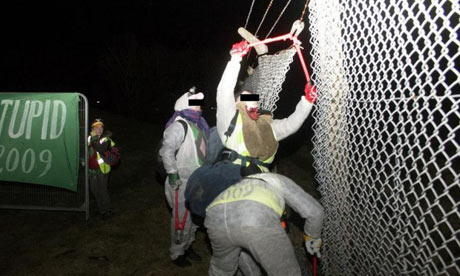
Nine demonstrators from the Plane Stupid campaign group cut through Aberdeen airport's perimeter fence at around 2.15am in protest at BAA's plans to expand the airport.

Seven protesters who had put up a "wire fortress" on a taxiway for North Sea helicopters handed themselves over to Grampian police at about 8.20am. Two others on the terminal roof surrendered to police at about 9.30am.

-The Guardian


7.3 million people in US prisons in '07

A record high-number of 7.3 million Americans were behind bars or under a correction system in the US in 2007, according to a research.

The record-high number, one in every 31 adults, includes people in prison or jail, and on probation or parole.

The results of the research conducted by Pew Center further indicated on Monday that America's prison population has skyrocketed over the past quarter century.
-Press TV


Mobile prison cells will cage criminals on the beat

The "mobile urban jails" will be used in targeted areas such as tho se rife with knife crime and anti-social behaviour or where there is no police station nearby.

They will allow officers to process criminals, fingerprint them and issue, on-the-spot fines, bail or court summons without having to go back to a police station.

A satellite link will even allow a custody sergeants to charge offenders via video while offenders could be held for up to six hours.

-Daily Telegraph


Mutiny at the Market

A tenants' mutiny at Grand Central Market was resolved last week after a group of merchants who had withheld their February rents came to an agreement with the landlord and paid up.

As part of the resolution with landlord The Yellin Company, rents will be lowered and advertising fees charged to the tenants will be eliminated.

The fracas, which resulted in many rents being paid two weeks or more late, is yet another sign of the financial hardships stemming from the national recession. Although most visitors to the Downtown Los Angeles landmark were unaware of the situation, several tenants said their future survival is in question.
-Los Angeles Downtown News

Monday, March 2, 2009

Our Own Boulevards: Capital's constructions from Van Buren to the Champs-Élysées

Introduction by Phoenix Insurgent
SPECIAL FEATURE ON CAPITAL, RACE, AND THE CITY
There are more people in motion in America now than at any time in recent memory. Immigrants displaced by the forces of reaction; workers dispossessed due to layoffs; families uprooted by foreclosure; inner city residents removed by gentrification. The cities we live in, like everything else in capitalist society, are a reflection of the battle between our limitless desires to constitute our lives, and Capital's authoritarian demand that we adhere to its calculating will.

With so much up in the air, and with a vacuum steadily filling the space once inhabited by Capital, the next few years will surely see the clash of competing visions of social organization. How will we organize? Where will we put down new roots? Where will we stay and fight? Who will fight whom? These questions as of this writing remain unanswered, although we catch glimpses in the factory occupations and riots on one side and the cops, cameras and the army on the other. Though we can't see the future from here, we expect answers soon.

In an attempt to find these answers, we have attached two essays from the past that address the political nature of the city in different ways. Towards understanding them together. below is a new analysis of the two pieces by Phoenix Class War Council member Collin Sick. The first piece is Jean Reynolds' analysis of South Phoenix. The last is from the insurrectionary journal, Killing King Abacus. Both pieces appeared within a year of each other, although they offer different critiques of the city. We hope you enjoy the two together.


by Jon Riley

Below are two pieces that have greatly informed the politics of those of us involved in Phoenix Class War Council.

“South of White Phoenix” appeared 10 years ago as an article in a broadsheet published by the original Bring the Ruckus (BTR) collective, based here in the valley. BTR are heavily influenced by Race Traitor politics, a tendency that sees any revolutionary movements’ success in the United States as hinged upon an attack of white supremacy and an end to the courting of the white working class by the elite.

The author Jean Reynolds’ piece is noteworthy for the dissection of the South Phoenix as a clearly defined political space created solely for the placement of people of color. These were not neighborhoods created by working class white mobs violently evicting Blacks and Latinos from mixed neighborhoods to enforce segregation, rather a mobile conceptualization that crosses streets and river beds as communities of color are moved from one neighborhood to another, largely by the hands of capitalists. Many of the bankers and executives from the valley disguised their racism by calling it simple economics. Take this 1965 Phoenix Point West interview with an unnamed business executive, from Bradford Luckingham’s Minorities in Phoenix (page 174):

“You ask about the Negro problem in Phoenix. Understand now, if you want to know what I really think, I can’t be quoted. I can’t have the company I work for associated with what I say. If you’re going to use my name, then I’ll repeat the standard line – civil rights, education, tolerance, the whole bit. But as a businessman and a taxpayer, I think there’s a real problem. We’ve got all those people down there [South Phoenix] and let’s be honest about it, most of them are costing the rest of us money.

They’re uneducated, unskilled. You can’t hire or use half of them. Their crime rate is way up. They can’t pay any taxes. I’m not anti-Negro, but you wanted my opinion. Just from the standpoint of simple economics, the city would be better off without them.

Another thing, with all the civil rights marching and demonstrating, how long is it going to be before some half-educated crackpot gets these people all excited and we have a first class race riot on our hands? This has nothing to do with prejudice; I’m talking straight economics and the city’s image. I don’t think there’s any question about it; Phoenix would be better off if they weren’t here.”


This is typical of the cross-class alliance between whites that is needed to enforce segregation on people of color. With segregation breaking down in Phoenix in the 1950s, people of color in the valley were quickly rebuffed by the elite with the creation of “South Phoenix,” virtually ensuring that a defacto housing disparity and widespread poverty would continue in the Valley of the Sun.

The second piece (“In the Distance: Suburbia against the barricades.”) comes from another influential tendency to Phoenix Class War Council, this from the short-lived insurrectionary anarchist publication Killing King Abacus, The unsigned piece analyzes the class geography of Paris and squarely places the blame on Georges-Eugène “Baron” Haussmann, the architect of class war urban planning under Napoleon III. His brutal renovation of Paris became a near blueprint for city planners across the US. Haussmann’s project in Paris took back control of the physical make-up of Paris for the French elite, in order to diffuse the power the small streets held when the insurrections and revolutions ignited and communards and workers rushed to barricade them. Though it achieved this to the relief of the bureaucrats, the capitalists had it their way as well. Haussmann aimed to construct a city that would “detain and fix the rootless and to channel workers into linear movement: from home to work, from work to home (from “In the Distance”).” He would surely be pleased to look upon Paris now, a hub for elite capital, complete with its large boulevards and massive public transportation apparatus, in other words the perfect mechanisms for the transportation of labor.

Clichy-sous-Bois and South Phoenix everywhere

Naturally there are important dynamics to note when comparing Haussmann’s radical restructuring of Paris in order to better facilitate Capital's domination of the new industrial era and the manner in which U.S. planners applied the Haussmann model. Much like the anonymous Phoenix executive quoted above, Haussmann, too, would also not likely have seen any need for a superfluous population, especially one comprised of the immigrants and descendants of indentured slaves from the former colonies, or in the case of the United States from the colony that existed within.

World War II devastated France, and much of the reconstruction efforts came from an immigrant influx from France’s North African colonies. Their efforts were rewarded with the construction of massive public housing estates, the ghettos to house their children and grand children. While white French planners in the era after the massive overhaul of Paris created the ghettos as a self-congratulatory olive branch to the thousands of new immigrants, white Americans simply abandoned the metropolitan city for the suburbs. Their flight was aided by the massive new freeway systems that made it possible to travel to the factory or office miles and miles away. Not only did post World War II American urban planners see it necessary for the suburbs to exist in order to create space and bring a piece of nature to middle and working class whites, but also to function as a release valve easing the wide spread paranoia whites felt as the breakdown of legal segregation saw families of color moving into previously all white neighborhoods.

Phoenix’s history is unique, as one of the cruelest and polarized urban environments in the U.S, with great amounts of wealth accumulated amidst the stark poverty of the reservations for Indigenous people. But along side this resides an assigned political space/internal containment policy for people of color within the city limits.

BTR is correct to assign the status of South Phoenix as a white supremacist political construction that has for years locked people of color in isolation, suffering the violence of benign neglect from the state. We see the similarities in South Phoenix and in the poverty-stricken suburbs of Clichy-sous-Bois, itself at the center of the insurrections against racism and police violence pervasive in French society. While we agree with BTR that the attack on white supremacy is central to the struggle, we also recognize that the systems of control are so advanced that the struggle for freedom must also be a total attack against the ideology of the city, until it no longer remains a political space dominated and shaped by Capital.

There is little doubt the Haussmann would smile upon the fate of the French Arab, African, Muslim, and immigrant populations stewing in the decrepit suburbs on the outskirts of nearly every major French city. We see the sociopathic legacy of Haussmann’s systems of control reflected in the white supremacist mirror of America. This vision stares back too, as Clichy-sous-Bois and the other ghettos like it continue to explode in rage against exclusion, poverty, and alienation. It is obvious, to even the most casual observers, that a massive crisis is reshaping the economic, political, and social geography all humans inhabit. Where will the “Clichy-sous-Bois”'s of the world develop in this crisis and where are capitalists already planning the next “South Phoenix”?

But we know that the plans of Capital always emerge in response to our own desires to construct our own lives and our own boulevards. We make our own paths. What will they be?


SOUTH OF WHITE PHOENIX
How the North Was Won

by Jean Reynolds
Bring the Ruckus

Why is it that such a large percentage of people of color live in south Phoenix? Is it because people just like to live with “members of their own race,” or are there deeper reasons? A look back at Phoenix history reveals that this segregation came about through government-supported policies. These policies upheld white privilege at the expense of Blacks, Chicanos, and other people of color.

Many of us have heard about segregation in the South. That kind of discrimination was practiced here, too. Prior to the 1950s, whites enforced total segregation of Blacks from Phoenix churches, schools, theaters, and restaurants. Similarly, residents of Mexican descent were forced into the basements of churches, inferior schools, the balconies of theaters, and only allowed to swim in public pools or dance in popular dance halls one day a week. It was a taboo to cross Van Buren and enter the “north” part of Phoenix (except to work) until well in the 1940s. Blacks and Chicanos were denied access to well-paying jobs. Instead, they often took menial jobs such as such as farmworkers, industrial and manual laborers, laundry workers, or as maids for middle-class or rich whites.

Drawing the color lines
But this kind of segregation wasn't the only kind of discrimination that existed. Government policies and local real estate developers enforced another kind of segregation which kept southern Phoenix black and brown, and north Phoenix white. During the 1930s the federal government created the Home Owners' Loan Corporation (HOLC), which mainly provided financing for homes and business loans. Another program, the Federal Housing Administration (FHA), encouraged banks to lend money to prospective home-owners by offering insurance on “approved” homes.

What these programs meant in reality was that many white people in Phoenix bought new homes while most people of color continued to live in substandard housing. Why? because both the HOLC and the FHA relied on certain standards to determine property values. These standards were based on the race and class of the residents living on the property. This is how it worked:

HOLC appraisers surveyed Phoenix to determine the “security” of properties. They crated a map, labeling the best properties with an “A” and the “hazardous” properties with a “D”. The appraisers relied on local real estate standards to grade the properties. Local developers created these standards by ranking people eon a scale of racial desirability. For example, whites of northern European descent were given the highest rating, while Blacks and Chicanos ranked the lowest on the scale. According to Phoenix real estate guidelines, if a non-white family moved into a neighborhood north of Van Buren, property values would begin to decline. Whites, on the other hand, took full advantage of HOLC and FHA programs to move into better homes.

Inventing south Phoenix
South of Van Buren, most neighborhoods were already poor. Federal loan programs and local banks ensured they stayed that way. Before someone could get a loan to buy a house, start a small business, or improve her or his property, their land had to be appraised. The appraisal was based on the HOLC map. Residents of these neighborhoods couldn't get financial help because they lived in areas rated as “hazardous.”

Therefore, people of color were not just excluded from homes in north Phoenix neighborhoods, they were denied money for economic growth and development in their own communities. The makings of a poor “south Phoenix” had begun.

In the 1930s, “south Phoenix” was defined as the area between Van Buren and north of the Salt River, which is now considered downtown. After World War II, many Blacks and Chicanos (and other poor folks) began to move to cheaper housing south of the Salt River, which was an agricultural area outside the city limits until 1960. This is the area we now call “south Phoenix.”

As we can see, “south Phoenix” is not a fixed geographical area but a concept, defined as wherever people of color are concentrated. This concept stillexists in people's minds today and is a direct result of federal policies and local practices that maintain white privilege.

The next south Phoenix
Now the city is planning to develop the Salt River area – from 24th street to 19th Avenues, from Baseline to Buckeye. A plan called “Beyond the Banks” envisions a recreational are, hotels, and other dreams of grandeur. What happens to all the poor, mainly Chicano and Black folks in these areas? They'll have to be removed if the city wants to attract all those visitors and businesses. So, again the past, people of color will be forced to live on some other piece of land unwanted by whites, perhaps out of the city's boundaries. When that happens, yet another south Phoenix will emerge. Unless we do something to stop it.


In the Distance: Suburbia against the barricades.
Haussmann and City Planning: the birth of the human tide

From Killing King Abacus #1

"Having, as they do the appearance of walling in a massive eternity, Haussmann's urban works are a wholly appropriate representation of the absolute governing principles of the Empire: repression of every individual formation, every organic self-development, 'fundamental' hatred of all individuality."--JJ Honeger 1874(Benjamin, 122)

"But by the any standpoint other than that of facilitating police control, Haussmann's Paris is a city built by an idiot, full of sound and fury, signifying nothing." Guy De Bord

Haussmann did not invent city planning, the Romans and ancient Chinese planned cities. Modern cities were planned and built in the British and French colonies earlier than in Europe. Washington DC was planned and built on an empty field decades before Haussmann refashioned Paris. What was different about Haussmann's Paris is that he built his new national capitol on top of the old Paris, a pre-industrial city. Haussmann's Paris reveals more about the architecture of capitalism and of the nation state than L'Enfant's D.C because it shows us what Haussmann chose to destroy as well as what he chose to build. In his demolition of poor neighborhoods and narrow streets we can see what he considered a threat to the new state and economy.

Boulevards were already replacing narrow streets in Paris two decades earlier than Haussmann took office, but on a much smaller scale. During the July revolution of 1830 an ironic twist befell government soldiers. The large squares of granite that were being used to pave new boulevards were dragged up to the top floor of houses and dropped on the heads of soldiers. These stones became a common source of barricade building materials. In 1830 there were 6,000 barricades. Haussmann took office after both the 1830 and 1848 insurrections, in 1853. In an attempt to prevent other insurrections, Haussmann tried to eliminate the construction of barricades by destroying narrow streets and replacing them with wide boulevards. He also built boulevards in order to allow for the easy transport of troops "connecting the government with the troops and the troops with the suburbs" and allowing troops to surround neighborhoods in the city. (Benjamin, 137-8) By paving boulevards Haussmann facilitated the regulated and regular movement of troops.

Haussmann's Paris was more than just a city. It was a symbol; its monuments and boulevards created an image of the capitol of a powerful empire. The fancy new boulevards that were part of this image pushed rents up just like recent "urban revitalization" projects. In 1864 Haussmann gave a speech venting "his hatred of the rootless urban population." (Benjamin, 12). The construction of boulevards drove the proletariat into the suburbs and increased the population of wandering homeless. Working class neighborhoods were destroyed to literally pave the way for boulevards, and when this didn't drive workers out of the city rising rents did. Haussmann's destruction and construction placed neighborhoods that were likely to revolt outside of the city. Boulevards allowed traffic to flow to the center of the city. The movement of workers' homes to the suburbs meant that 'commuting' to and from work was born on a mass scale.

"Hundreds of thousands of families, who work in the center of the capital, sleep in the outskirts. The movement resembles the tide: in the morning the workers stream into Paris, and in the evening the same wave of people flows out. It is a melancholy image...I would add...that it is the first time that humanity has assisted in a spectacle so dispiriting for the people." A. Gravneau, L'ouvrier devant la societe -Paris, 1868 (Benjamin, 137)

Haussmann aimed to detain and fix the rootless and to channel workers into linear movement: from home to work, from work to home, a precursor to metro, boulot, dodo.

Haussmann planned the construction of railway links between the center of Paris and its outskirts during a period in which the European railways expanded considerably. "Space is killed by the railways and we are left with time alone." -Heinrich Heine (Rice, 207) Space may not have been killed by the railways but high-speed travel has made travel time a greater consideration than travel distance. What Georg Simmel said of money can be said of the modern city. They both allow connections between previously distant things but make that which is close more difficult to reach. While distances were conquered by the railways, the nearby slipped further away. That is, at the same time as transportation and communications allowed one to reach far away places in a short period of time, ones neighbors became more distant: industrialization demanded more hours of work and more travel time to and from work, there was less time to socialize.

Let's not forget that the separation between work and leisure time is accompanied by the separation between living and working spaces. Industrialization and the subsequent proletarianization of large sectors of the population created this separation on a mass scale. Peasants had worked at or near home, those that had worked and lived in separate quarters generally found that the distance between these 2 points increased with industrialization. The increasing partition of time into working and living in separate spaces effected customary meal times, household labor and its sexual division, family relations and leisure activities. This separation began a process of increased dependence on consumer goods for previously home produced items. The creation of suburbs increased the distance of this separation. This separation corrodes the type of relationships that could form a basis for attacks on the established order. This separation organizes the spatial and temporal imposition of consumption and production. The prevalence of the spatial and temporal separation between work and 'life' was born with industrialization but has come to appear timeless and natural. The naturalness of this separation kills the passion for freedom by limiting our capacity to imagine any other organization of space and time than the repetitive constriction which capital imposes on us.

North American Suburbs: the paved dream.

Before World War II, the U.S. was already a highly industrialized country. Thus, the conditions I describe above were already common to North American cities. From the 30s on, the distance dividing living and working spaces increased exponentially as millions of Americans moved to the suburbs, highways were built and millions of Americans bought cars in an attempt to close this increasing distance.

The federal government employed millions in the thirties to build a new landscape. After WWII the Veteran's Mortgage Guarantee Program provided low cost housing to millions of people. From the late 40s to the mid-60s developers built 23 million new homes. Industry followed these mostly white new suburbanites out of the city, partly because unions were weaker there. In the 40s and 50s the government invested millions of dollars on the suburban infrastructure: gas, electricity, roads, sewer systems and highways. They built thousands of roads and highways allowing for easy movement between suburbs and city centers. Poor neighborhoods were unable to resist the construction of highways through their neighborhoods whereas rich neighborhoods had the clout to prevent this from happening. One more recent example of this is the construction of a highway in South Central Los Angeles while the rich of Beverly Hills were able to stop the construction of a highway in their neighborhood.

The defense department spent millions of dollars on freeways after the war. Just as Haussmann's boulevards were strategically useful to the military, highways could potentially be used as runways to land bombers. More significant though was the alliance between, car companies, the oil and rubber industries that lobbied for the construction of highways, and the state. These companies used the coercive power of the built environment to insure the consumption of their products. Suburbanization was a perfect accompaniment to the construction of roads, highways, and mass produced automobiles. Greater distances between work and home along with terrible public transportation (again thanks to the friendship between government and car and oil companies) created a need for automobiles.

Alienation is built into the city and into the suburbs, in its concrete and asphalt. Take the example of Los Angeles, the city built to accommodate cars but not walking human beings. In LA many people think nothing of driving 45 minutes just to go a bar to have a drink. Instead of having neighborhoods where one finds a whole street of bars or cafes, places to socialize are spread out over the city. North American cities lack any pre-capitalist history; they were built from the beginning by the dictates of capital, with government help. The result: urban blights that are more adapted to the automobile than the human being.

Unfortunately cities that predate capitalism can be also transformed into concrete monsters. In Torino, Italy the gigantic FIAT plant began assembly line mass production based on Ford's model decades before the rest of Europe. The result is the same as occurred in U.S. cities: mass production needed mass consumption to perpetuate itself, a cityscape was built that conformed to the requirements of accumulation. Someone had to buy the cars, to make this possible the car companies made sure that roads were built. Torino is a rare European example of the results of the dominion of a car company and its allies over a cityscape. Concrete partitions between seemingly endless apartments and a proliferation of roads have surrounded the walkable narrow streets of the old city. The FIAT plant employed a large percentage of Torino's residents for many decades. The employees were scattered throughout the city while the FIAT was in one location, the result: auto, boulot, dodo.

Back in the U.S.A., the suburban lawn and backyard were offered to a section of the working class and to the middle classes. The alienation from nature they experienced in their new automobiles and at work was compensated for and then hidden by an equally alienated but much more pleasant relationship to nature at home. Forced to buy what they could easily make at home if there were time, watching adventure on TV, the suburbanite resorts to control over nature where he lacks control over his own life. Therefore we observe bushes trimmed into squares, a neurosis for mowing lawns and meticulously planted rows of flowers. Garden stores have proliferated and the suburban yard has become nature as commodity. The suburban yard, the lies on television and 17 choices of toothpaste all helped perpetuate the illusion of the American dream. The American dream is lifeless and as uniform as the suburban lawn; it is produced by the television instead of by subjects that intervene in life in order to transform it. The American dream hides the degrading reality of a processed life from those "lucky" enough to afford it. Where private property reigns the ownership of one's living space, work-space, and just about every other space by capitalists the property poor individual is perpetually constrained. Suburbs conceal alienation from nature and other human beings as well as the lack of power that suburbanites exercise over their own lives at home and at work.

The separate ownership of living and working spaces divides opposition to Capital into labor and rent struggles. On the other hand, the illusion of homeownership (getting bank loans to buy a house) gave millions of workers a vested interest in the system of private property, and diffused any potential struggle against landlords. This has resulted in community action to protect the property values in a given area. Workers have organized to keep other workers out of their neighborhoods. When millions of blacks moved to northern cities, white neighborhoods tried to prevent blacks from moving into their neighborhoods in order to protect their property values. This "community" action" is in many cases the action of illusory communities. The average suburbanite or city dweller doesn't know many of her neighbors. When she chooses to take community action to protect her property value, this is a "community" connection based on money, and seldom on direct human connections.

While Haussmann's Paris served to create an image of the capitol of a powerful empire, city revitalization projects create an image of the new "beautified" city that is sold to us under the guise of community pride. In both of these examples this was achieved through the displacement of the poor. The "community" is sold to us with citywide celebrations, city fairs or official Millennium celebrations. The State and the media help create and perpetuate these imagined communities, that is, communities which lack commonality based on direct human relations but are instead based on an abstract conception of common identity, the most obvious example of this is the Nation. Capitalism destroys human connections but it replaces this vacuum with imagined communities.

Haussmann built boulevards to prevent the construction of barricades and completely destroyed the neighborhoods where insurrection was most likely to occur. These neighborhoods reappeared in a different form in the suburbs. North American suburbs are built so that few direct relationships of the sort that Haussmann paved over ever develop. Communication is as much a threat to state control as barricades. In the suburbs, houses are far from shopping areas, places to socialize, and work places. Meanwhile the suburbanite is sold the idea that she likes this on TV, and is bought off with excessive consumption. The suburbanite is lost alone in a labyrinth of reflections. Unable to find anyone to discuss anything of substance with, she is left with only images for companions. While the suburbs were being designed to placate and stupefy, the inner cities were becoming increasingly marginalized economically. Haussmann destroyed slums to prevent insurrection, but in the U.S. slums sprouted up right in the shadow of the American dream. During the Rodney King Riots, suburbanites watched the adventure on TV.

Sources:

Benjamin, Walter. The Arcades Project. Trans. Eliand, Howard and McLaughlin, Kevin Cambridge: Harvard University Press, 1999.

Harvey, David. The Condition of Postmodernity Cambridge:Blackwell, 1990.

Rice, Shelley. Parisian Views. Cambridge: The MIT Press, 1997.